Aug 1, 6:02 PM
The Myth of the Burning Earth: Why Climate Alarmists Are Wrong About Wildfires
Politicians eagerly blame summer infernos on a warming planet, conveniently ignoring arson, forest management, and a global decline in burned land.
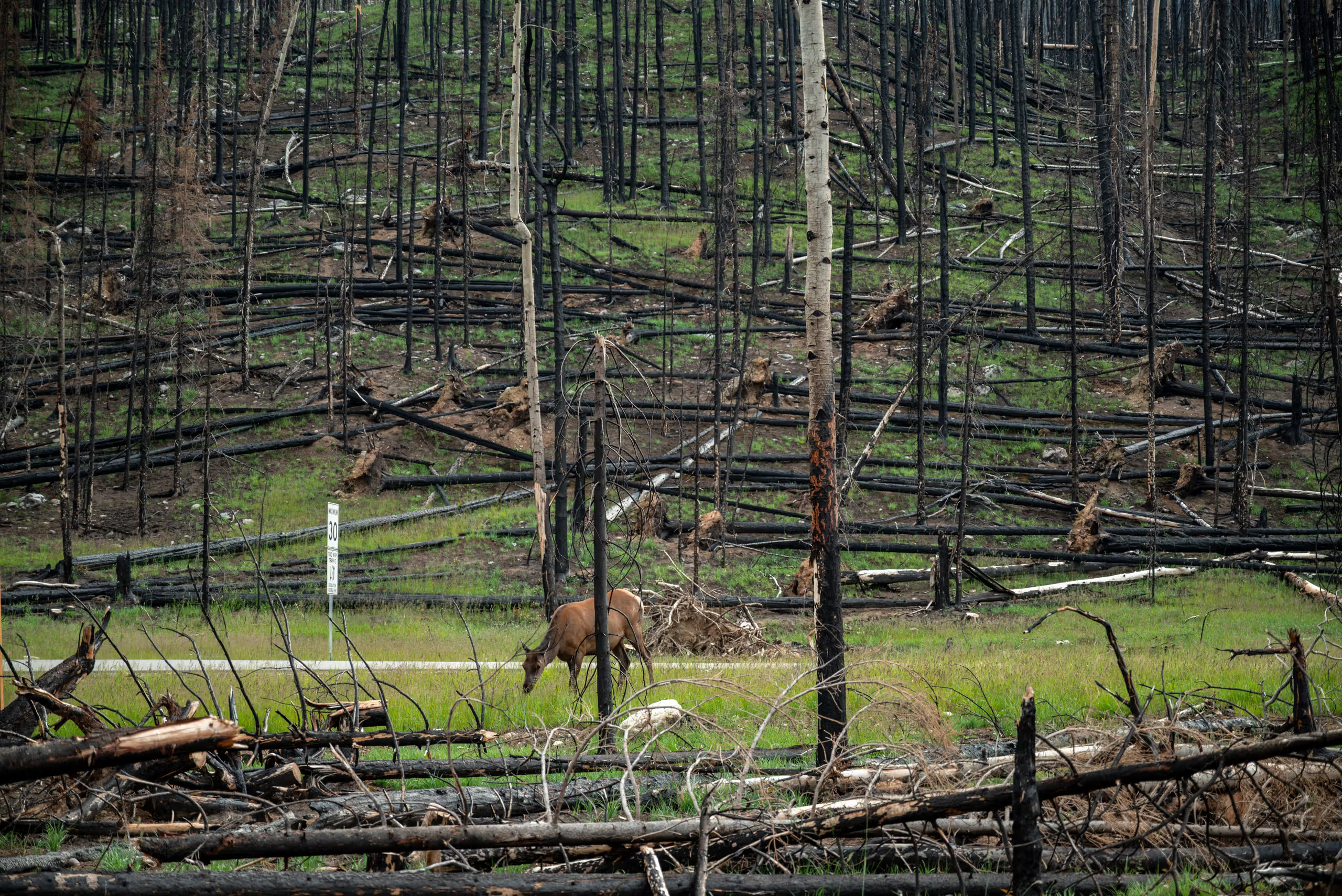
Every European summer now arrives with a predictable ritual: the production of apocalyptic imagery and the subsequent political moralising. A recent photograph showing holidaymakers lounging on a beach while a wildfire rages in the distance provided perfect fodder. Karl Lauterbach, Germany's perpetually anxious SPD politician, seized the moment to lecture the public. In an official statement, he proclaimed that one could not depict the passive, ignorant experience of climate change more aptly, lamenting that the earth is burning while people take holidays under a cloud of particulate matter. State media outlets like the Tagesschau quickly followed suit, detailing how the weather is turning the continent into a tinderbox, complete with lengthy explanations of fire clouds and dry vegetation.
In their eagerness to frame every charred tree as a direct consequence of a warming planet, politicians and public broadcasters conveniently omit a crucial detail. Forests rarely spontaneously combust. Upwards of 90 percent of all wildfires are ignited by human hands, through gross negligence or deliberate arson. French authorities alone have arrested 184 individuals for arson this year. Blaming the climate for these infernos is a profound distortion that frames human criminality as a meteorological inevitability, acting as if nature itself is punishing humanity for its carbon footprint.
The narrative of a burning planet collapses entirely when subjected to statistical scrutiny. The total area consumed by fires worldwide has actually decreased by approximately 25 percent since the late 1990s. Data from the European Space Agency reveals that the reduction in burned land since 2008 is the sharpest recorded in 120 years. The Copernicus programme confirms that global carbon emissions from fires have hit a historic low since records began a quarter of a century ago. This massive decline, driven largely by changing agricultural practices and population growth in Africa, dismantles the hysterical claim that the globe is ablaze.
Within Europe, the historical context paints a far less dramatic picture than the one peddled by climate alarmists. Across Portugal, Spain, France, Italy, and Greece, the average annual burned area steadily declined from 449,000 hectares in the 1990s to 330,000 hectares in the 2010s. While extreme anomalies exist, such as the 2025 spike where over a million hectares burned across the EU, these events occur alongside unprecedented ecological recovery. Since 1900, the continent's forest cover has expanded by a third, adding 14 million hectares since 1990 alone.
This woodland expansion introduces a bitter paradox for forest management. Decades of effective fire suppression have created vast reserves of unburned undergrowth. When this accumulated fuel catches fire—usually thanks to an errant match or a deliberate arsonist—the blaze is exponentially more destructive. The scale of modern wildfires is fundamentally a crisis of human negligence, criminal behaviour, and flawed ecological management. Treating these fires merely as a symptom of global warming serves those peddling climate anxiety, but ignores the mundane, solvable reality on the ground.
Written by Martina Kirchner martina.kirchner@alpineweekly.com