Mar 11, 11:26 AM
Switzerland’s Neutrality Is Starting to Look Like a Convenient Illusion
When conflicts involve Washington, Bern suddenly struggles to decide what counts as a war.
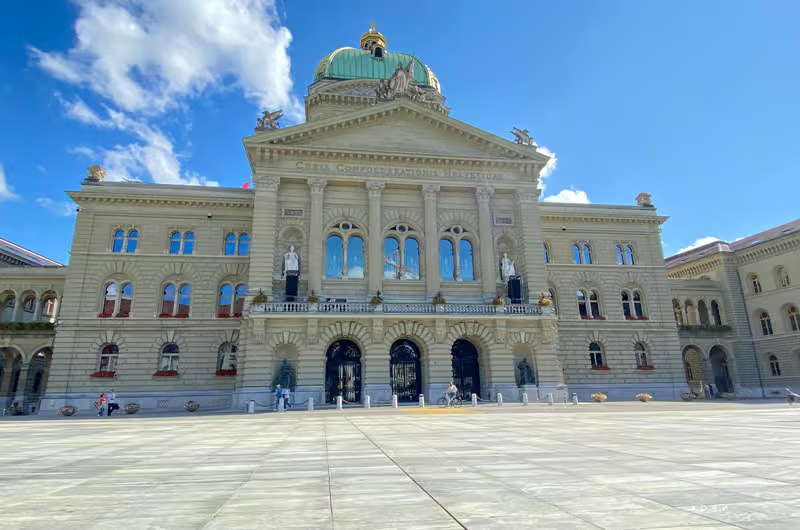
For generations, Switzerland has worn neutrality like a badge of honor. You picture a nation perched above geopolitical tussles, steered more by legal codes than raw power plays. Yet, the fresh debate about arms exports to the United States is starting to crack that image.
Right now, several requests to export Swiss military gear to the US are on hold. Swiss law says such shipments must halt if the recipient is embroiled in an international armed conflict. And here’s the kicker: the US is currently involved in military actions tied to the Iran war.
On paper, the legal rules seem straightforward.
In reality, the Swiss government seems a bit flustered.
Officials claim it’s too soon to say if this counts as an “international armed conflict.” According to the State Secretariat for Economic Affairs, the fighting must hit a certain intensity and last long enough before it’s legally labeled war.
That stance might seem fair if Switzerland applied it uniformly. But here’s where things get tricky.
When Russia invaded Ukraine, Bern had zero hesitation calling it a war. The legal reading was sharp and quick. Neutrality laws were enforced rigorously, and the government moved fast to sync up with the West’s stance.
Now, when the US carries out military ops in the Middle East, the Swiss seem at a loss over whether it's actually a war.
The inconsistency is glaring.
Critics say this hesitation isn’t about legal nuance but political pressure. After all, Switzerland’s economic ties to the US run deep. Washington is a major buyer of Swiss defense products and a key player in the country’s high-tech landscape.
Declaring the Iran conflict officially a war would have serious fallout.
It wouldn’t just affect conventional weapons exports but also dual-use technology—stuff that serves both civilian and military ends. Switzerland churns out a ton of advanced machinery that falls under this category, forming a vital slice of its export business.
Right now, these goods can leave under a general permit. But if the conflict gets war-status, every shipment would need specific clearance.
For Swiss firms, that spells big uncertainty and could shake up a valuable market.
The economic stakes shed light on why the Federal Council drags its feet. Still, it sparks a tougher question: what’s left of Switzerland’s famed neutrality if it bends every time significant economic interests come into play?
For many, the script is becoming obvious. Neutrality gets thrown around confidently when the political hit is small. But when it risks alienating powerful allies, suddenly neutrality looks flexible—open to interpretation.
The endgame? A doctrine that feels less like rock-solid principle and more like a handy tool to mollify interests.
Decades ago, this would’ve been almost unthinkable. Switzerland built its brand on independence and steady conduct globally. Neutrality wasn’t just law; it was woven into national identity.
Now that identity’s under serious pressure.
The dithering over Iran lays bare a tough truth: neutrality is tricky in an era dominated by tangled economies and political alliances. Switzerland stands outside military blocs, sure, but it’s firmly woven into Western political and economic networks.
In that setting, neutrality becomes harder to apply cleanly, full of contradictions.
The Federal Council says it’s all about rigorous legal review. But the longer it sits on the fence, the tougher it is to keep up the image of principled neutrality.
Because when war’s definition hinges on who’s fighting, neutrality starts to look less like a conviction—and more like a diplomatic fudge.
Written by Martina Kirchner