Apr 14, 12:37 PM
Your Boarding Pass Is a Surveillance Warrant: What Happens to Your Data When You Fly
Booking a flight triggers a hidden chain of data collection that spans airlines, governments, and intelligence agencies. Here is exactly what they take, who sees it, and how long they keep it.
You hand over your passport at check-in, scan your boarding pass at the gate, and settle into your seat. What you have actually done is trigger a sprawling, largely invisible machinery of data collection that will track you across borders, through government databases, and into the hands of agencies you may never have heard of. The journey your personal information takes is longer, stranger, and considerably more unsettling than your flight.
What Gets Collected: The Full Inventory
The data haul begins the moment you book a ticket. Airlines require your full name, gender, date of birth, passport or national ID details, nationality, email address, and phone number. If you are flying to or through the United States, you must also provide your residential address at both origin and destination . Payment information follows: card number, expiration date, CVV code, billing address, and cardholder name. All of this is packaged into a Passenger Name Record, or PNR, a file that follows you through the entire travel ecosystem.
But that file grows. The EU's PNR Directive mandates collection of at least 19 separate data categories. Beyond the obvious identifiers, the record includes: the date of booking and ticket issuance, your complete itinerary, frequent flyer details, travel agency information, check-in status, whether you missed a flight, seat number, baggage details, and code-share information. For unaccompanied minors, the system records the name and contact details of both the dropping-off and collecting adults, along with their relationship to the child. Every change made to this record, from seat reassignments to meal preference adjustments, is logged and stored .
Who Gets Access: The Unseen Audience
Your data does not stay with the airline. Under the EU PNR Directive, airlines are legally required to transmit PNR data to a designated government unit, twice: once before departure and once after arrival . In Austria, this unit is called the Passenger Information Unit, housed within the Interior Ministry. Twenty-one personnel currently have direct access to that database, with plans to connect 91 commercial carriers . Across the EU, similar units operate in every member state, and they share data with one another, with Europol, and with national police, intelligence services, and domestic security agencies .
The scope of access extends further. For flights involving the United States, PNR data is pushed to the Department of Homeland Security. Australia's Customs and Border Protection receives the same. These transfers happen automatically and without your specific consent for each flight, based on international agreements that permit profiling, the sorting of passengers into risk categories using secret, pre-defined criteria, all without any initial suspicion or criminal lead .
Facial Recognition: The New Frontier
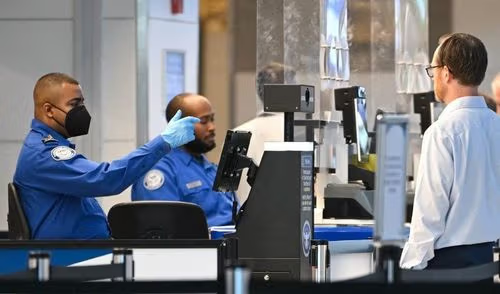
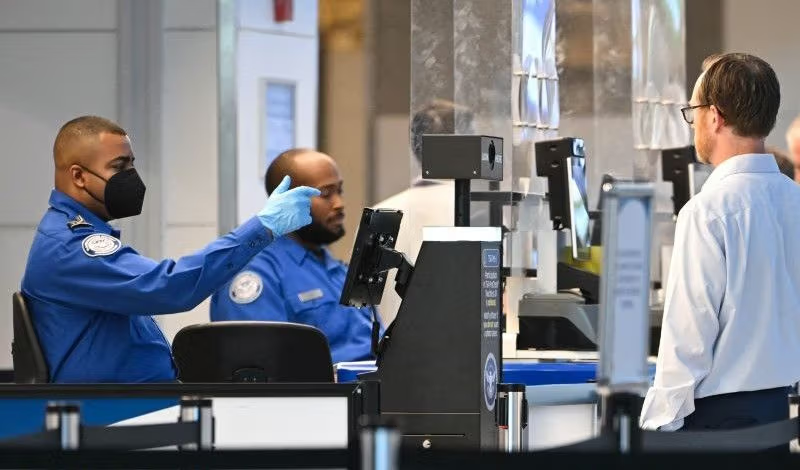
At the airport, a second layer of biometric collection kicks in. In the United States, the Transportation Security Administration has deployed Credential Authentication Technology at nearly 250 airports. The system, known as CAT-2, scans your face and compares it to the photo on your passport or Real ID . The TSA claims images are discarded shortly after use. The practical reality for travelers is that the opt-out mechanism, though legally required, is not prominently displayed, and exercising it may result in additional screening or delays .
The European Data Protection Board has taken a more restrictive stance. In a 2024 opinion, the board rejected scenarios in which biometric templates are stored centrally under airport or airline control for anything beyond 48 hours or tied to a passenger account indefinitely. The only configurations deemed potentially compliant with GDPR are those where the biometric template remains on the passenger's own device or is centrally stored but encrypted with a key held exclusively by the passenger .
How Long They Keep It: The Retention Reality
Storage periods vary dramatically by jurisdiction, and the differences reveal much about how each government values the data. Under the EU PNR Directive, passenger records are depersonalized after six months, but depersonalization means only that the full name is masked. The data can still be traced back to an individual, and the complete record is not deleted until five full years have elapsed .
Austria over-fulfills the EU mandate by extending PNR collection to intra-European flights, not just those crossing the external border . Germany's system is projected to process 180 million passenger records annually .
Outside the EU, the timelines stretch further. The United States retains PNR data for 15 years under the current framework . Australia's agreement with the EU permits storage for up to 5.5 years . Some advocates have called for extending US retention to 30 years .
Airlines themselves operate on varying schedules. Singapore Airlines and British Airways typically retain customer data for seven years after the last interaction. Scandinavian Airlines keeps records for a decade after a flight concludes. Lufthansa's policy ranges from six to ten years, but notes that data tied to legal disputes may be preserved for up to thirty years .
The Algorithmic Dragnet
Here is the part most passengers never consider: your PNR data is not simply sitting in a database waiting for a human to look at it. It is being continuously and automatically filtered by algorithms searching for anomalies. The system is designed to generate "hits" on patterns that deviate from some statistical norm, hits that are then forwarded to authorities for manual review .
The false-positive problem is mathematically inevitable. When you search an enormous dataset for something exceedingly rare, even a highly accurate algorithm will produce a flood of incorrect flags. In Austria, the system generates approximately 490 alleged hits per day, roughly 3,340 per week. Of these, only 51 were confirmed as legitimate, and only 36 cases yielded information deemed significant for counter-terrorism or serious crime investigations. Just 30 incidents resulted in direct intervention at the airport. The hit confirmation rate stands at 0.1 percent .
Those 490 daily false positives are not harmless. Each must be manually reviewed by a human operator. Each represents a person against whom there was no well-founded suspicion, yet who was subjected to additional scrutiny anyway. The process inverts the presumption of innocence: everyone is monitored, the algorithm flags many, and humans sort through the innocent .
Data Breaches: When the Vault Cracks
The concentration of passenger data creates a correspondingly attractive target. In July 2025, Qantas confirmed that a cyberattack on its systems exposed the personal information of approximately 5.7 million customers. The compromised data included names, addresses, phone numbers, email addresses, and frequent flyer details. The airline stated that credit card and passport information were not affected, and that no evidence suggested the data had been publicly disclosed or misused . The breach was linked to an attack on the software provider Salesforce, affecting 39 companies in total .
This was not an isolated incident. In 2024, a Qantas mobile application glitch allowed some users to access other passengers' boarding passes, frequent flyer points balances, and flight details, and even attempt to cancel flights belonging to strangers. That same year, an Australian digital photography retailer saw 304,000 customer records uploaded to the dark web, and a medical prescription service suffered a 6.5-terabyte data theft affecting 12.9 million Australians .
The Broader Framework: Why This Exists
The PNR system emerged from the aftermath of the September 11 attacks as part of a global push to tighten aviation security. The United Nations Security Council, through Resolution 2396, has called on all member states to develop capabilities to collect, process, analyze, and share PNR data . Yet implementation remains uneven. According to the International Civil Aviation Organization, only 26 states actively request PNR data, and just 68 of ICAO's 193 member states have established an Advanced Passenger Information system .
Civil liberties organizations have mounted sustained legal challenges. The European Court of Justice has ruled on three separate occasions that data retention schemes violate fundamental rights, most recently in 2017 when it found that PNR data sharing with Canada breached both the right to privacy and the right to data protection . In Austria, a complaint filed with the Federal Administrative Court argues that the PNR Directive itself is incompatible with fundamental rights and that Austria's implementation, by extending collection to intra-European flights, goes beyond what the directive requires .
The critique extends beyond legal technicalities. The algorithms that sift passenger data operate without transparency, and their criteria are not disclosed. Sensitive characteristics may be inferred through proxies: a meal selection can stand in for religion, a travel pattern for ethnicity. When an algorithm flags a passenger, there is no meaningful avenue to understand why or to challenge the classification .
What You Actually Agree To
When you click "I accept" on an airline's privacy policy, you are consenting to a chain of data sharing that extends far beyond the carrier. Akasa Air's policy, typical of the industry, states that personal data may be disclosed to third-party service providers, affiliates, and group entities. It may be transferred across borders. It may be retained for as long as necessary to fulfill "business purposes," and disposed of according to "applicable laws and regulations in the respective geography" . The vagueness is deliberate and industry-wide.
Air China's policy specifies that for flights touching US territory, local regulatory requirements compel the provision of address information for both origin and destination . Corporate travelers face additional exposure: their booking details, including employee identifiers and corporate account codes, are visible to employer account administrators who manage travel rosters .
The Takeaway
Every time you fly, you are not just a passenger. You are a data subject, enrolled in a global surveillance architecture that was built in the name of security and now operates largely by inertia. Your name, your face, your payment details, your itinerary, your meal choice, your traveling companions, and your baggage are all recorded, transmitted, stored, algorithmically analyzed, and potentially shared across jurisdictions for years after you have forgotten the trip entirely. The system generates thousands of false accusations daily, subjects innocent people to additional scrutiny, and has never been convincingly shown to achieve its stated security goals. Yet it persists, because the infrastructure is built, the agencies are staffed, and the data keeps flowing. You are the product, and your boarding pass is the receipt.
Written by Thorben Thiede