Mar 20, 12:56 PM
Farage Proposes Ban on Mass Muslim Prayers at Historic Sites, Sparking Political Storm
Reform UK leader’s comments deepen divisions over religious freedom, identity and public space ahead of next election
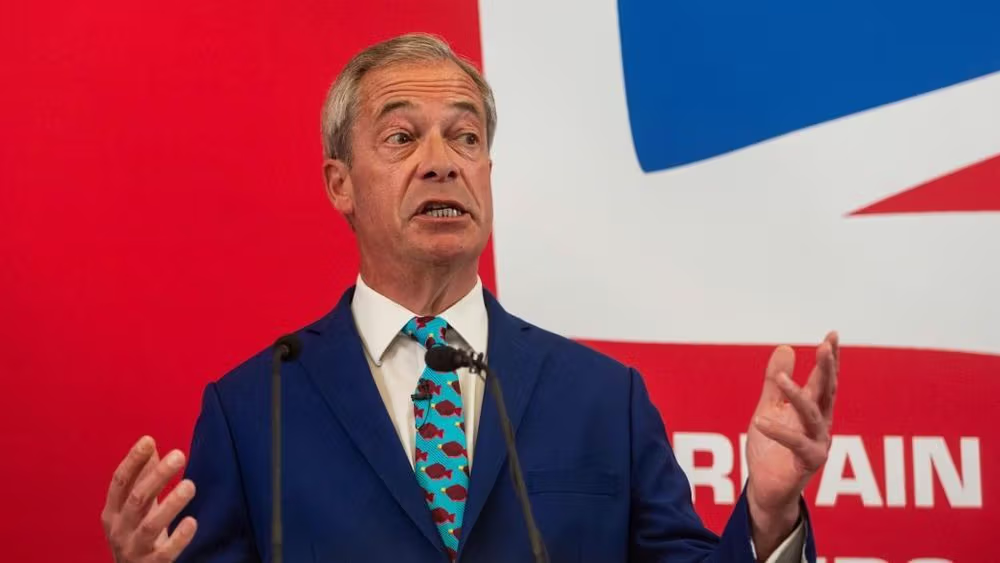
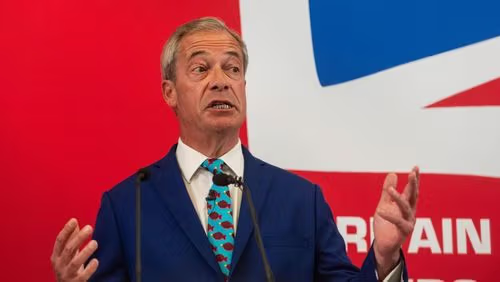
Nigel Farage has ignited a fresh political controversy in the United Kingdom after proposing a ban on large-scale Muslim prayer events at historic British sites, framing such gatherings as provocative displays rather than expressions of religious freedom.
The leader of Reform UK made the remarks during the launch of his party’s manifesto in Scotland, where he argued that while individual worship should remain protected, mass public prayers — particularly at symbolic national locations — should be restricted. Referring to a recent event in London, he described such gatherings as attempts to “overtake, intimidate and dominate.”
The comments follow a debate triggered by a public Ramadan prayer held earlier this week in Trafalgar Square, attended by hundreds of people, including London Mayor Sadiq Khan. The event, organised by the Ramadan Tent Project, was widely presented by its organisers as a celebration of community and inclusion, marking the breaking of the daily fast during the holy month.
However, criticism emerged from parts of the political spectrum. Conservative justice spokesperson Nick Timothy described the gathering as divisive, prompting Prime Minister Keir Starmer to call for his dismissal. Farage has now taken the argument further, placing it at the centre of a broader political message about national identity and public space.
In his speech, Farage insisted that his proposal was not aimed at restricting private religious practice but at what he characterised as “demonstrations” in prominent locations. He drew comparisons with several countries in the Middle East, where public religious gatherings are subject to tighter controls, arguing that similar limits could be justified in the UK.
The remarks have intensified an already sensitive national conversation about multiculturalism, religious expression and the boundaries of public life. Critics argue that singling out one religious group risks undermining Britain’s long-standing commitment to tolerance and equal treatment under the law. Supporters, meanwhile, say the issue reflects wider public concerns about integration and the use of shared civic spaces.
Farage’s intervention also carries clear political implications. His Reform UK party has been gaining ground in national opinion polls, positioning itself as a challenger to both the governing Labour Party and the Conservatives. By focusing on culturally charged issues, he is seeking to consolidate support among voters who feel disillusioned with mainstream politics.
Asked whether similar restrictions would apply to other faiths, Farage suggested that comparable events by Jewish or Christian groups were not taking place in the same way, a distinction that has drawn further criticism from opponents who accuse him of applying a double standard.
For the government, the episode presents a delicate balancing act. While defending freedom of religion remains a cornerstone of British public life, ministers are also under pressure to address growing political polarisation around identity and social cohesion.
As the debate unfolds, it highlights a deeper tension within British society — one that extends beyond a single event or policy proposal. At its core lies a broader question about how a diverse society negotiates the visibility of faith in public spaces, and where the line is drawn between inclusion and provocation.
With elections still some distance away, the issue is unlikely to fade quickly. Instead, it may serve as an early indicator of the themes that will shape the next phase of British politics, where questions of culture, identity and belonging are increasingly at the forefront of public debate.
Written by Andreas Hofer