Mar 20, 2:48 PM
After Fatal Gondola Crash, Switzerland Questions the Limits of Its Cable Car Boom
As alpine transport systems grow faster and more ambitious, the Engelberg tragedy raises fresh concerns about safety
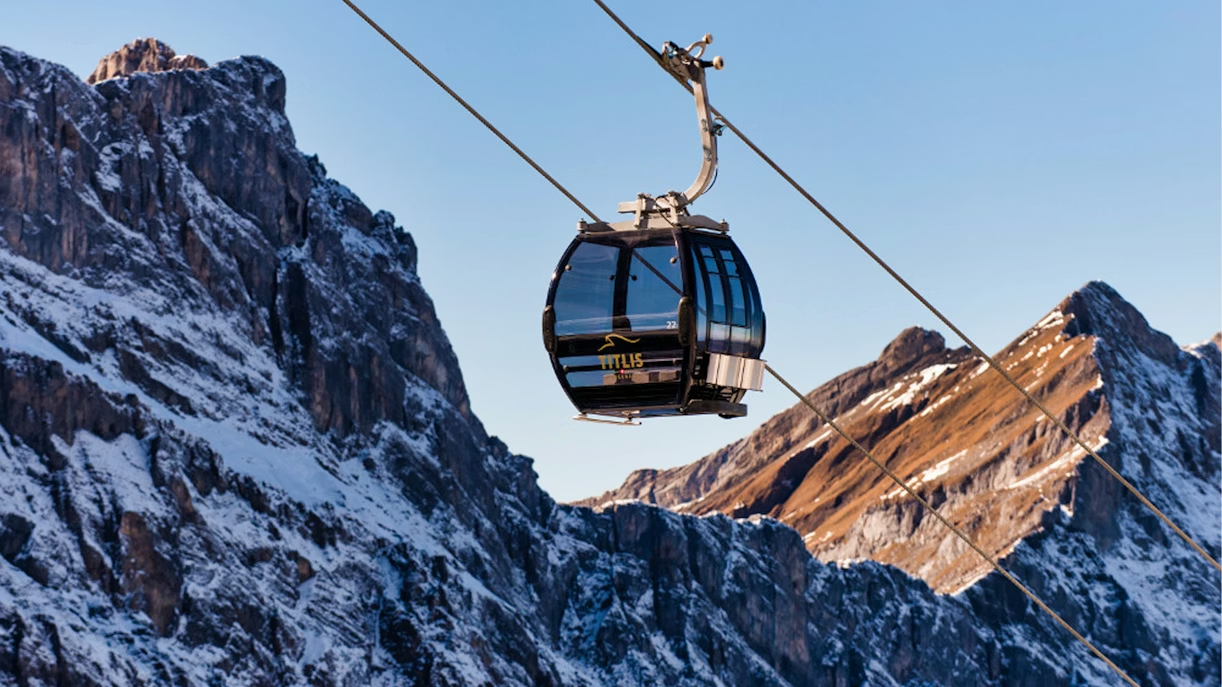
A day after a fatal gondola accident at the Titlis resort, a sense of shock continues to linger in Engelberg — along with a growing unease about the safety of one of Switzerland’s most iconic transport systems.
The death of a 61-year-old woman, whose gondola detached and fell from the Titlis Xpress line, has shaken confidence in a network long regarded as one of the safest in the country. While the cause of the accident remains under investigation, the incident has prompted broader questions about how far the industry’s rapid expansion can go without compromising reliability.
For now, part of the system remains suspended. Gondolas on the affected section between Trübsee and Stand have been taken out of service, with passengers redirected to alternative cable routes. Elsewhere on the mountain, operations continue largely as normal — a reminder of how deeply embedded these systems are in Switzerland’s tourism and transport infrastructure.
Yet beneath that operational continuity lies uncertainty. Officials have offered initial hypotheses, but no definitive explanation. The failure of a mechanical clamp is being examined as a possible cause, alongside the role of strong winds that were reported at the time of the incident. According to company representatives, staff had already begun shutting down the system due to weather conditions when the accident occurred. These are preliminary assessments, and investigators from the Swiss Transportation Safety Investigation Board are now working to establish the exact sequence of events.
The lack of clear answers has only amplified public concern. Cable cars are widely considered the safest mode of transport in Switzerland, carrying millions of passengers each year with remarkably few incidents. Official statistics show hundreds of millions of passenger kilometres logged annually, with accidents involving injuries remaining extremely rare.
That record, however, has been built alongside a steady transformation of the alpine transport landscape. In recent years, Swiss mountain railways have undergone rapid modernisation, with new lines designed to move larger numbers of passengers more quickly and efficiently. The industry has become a showcase of engineering ambition, where speed, capacity and technical innovation are constantly being pushed further.
In the Bernese Oberland, a recently opened cable car at the Schilthorn now holds the distinction of being the steepest in the world, climbing at a gradient of nearly 160 percent. In Zermatt, visitors are transported to Europe’s highest cable car station near the Matterhorn, while elsewhere projects have redefined both altitude and speed.
Even ground-based systems are part of this trend. The Stoos funicular, with its strikingly steep incline, has become a symbol of how far Swiss transport engineering is willing to go to overcome the limits of terrain.
Together, these developments have created what some industry figures describe as an “alpine metro” — a dense, high-capacity network designed to move tourists through mountain regions with the efficiency of an urban transit system. On most days, it functions seamlessly.
But the accident in Engelberg has exposed the fragility behind that precision. A system designed for maximum performance must also contend with the unpredictable realities of mountain environments, where weather conditions can change rapidly and infrastructure is exposed to extreme stress.
For now, the focus remains on the investigation and on supporting those affected by the tragedy. Yet the incident has also opened a wider conversation — one that goes beyond a single mechanical failure.
As Switzerland continues to push the boundaries of what its cable car systems can achieve, the question is no longer just how high or how fast they can go, but how resilient they remain when something goes wrong.