
Apr 14, 7:42 AM
UNHCR Reports 14,000 Sudanese Refugees Have Reached Europe as Mediterranean Remains World's Deadliest Migration Route
Four die in English Channel attempt, 18 perish off Turkish coast, and new EU asylum reforms move toward 2026 implementation amid shifting global displacement figures.
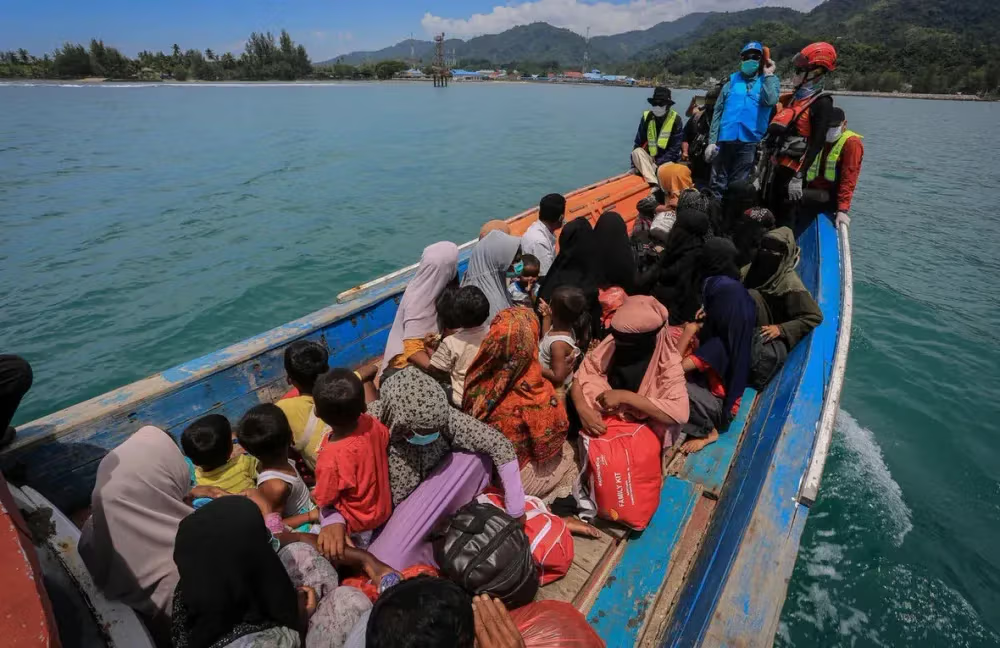
The civil war in Sudan has generated what the United Nations now describes as the world's largest humanitarian crisis, with approximately 11.6 million people displaced either internally or across international borders. While roughly 4.5 million of these individuals have sought refuge in Sudan's immediate neighboring states, a growing number are undertaking the perilous journey toward Europe. Mamadou Dian Balde, the UNHCR regional director based in Nairobi, stated that a lack of viable futures and persistent uncertainty about an end to the three-year conflict are pushing people further afield. According to UNHCR figures, nearly 14,000 refugees from Sudan have already arrived on European shores via the Mediterranean, with Greece, Italy, and Spain all recording entries. The director also noted that more than half a million Sudanese are currently situated in Libya.
The broader migration picture across the continent remains lethal. Four individuals—two women and two men—lost their lives early on the morning of April 9 near Équihen-Plage in the Pas-de-Calais department of France. According to local prefect François-Xavier Lauch, the group was attempting to board a small inflatable vessel destined for the United Kingdom when strong currents swept them away. Thirty-eight other people were rescued from the same incident, with one person treated for severe hypothermia.
Separately, off the coast of southwestern Turkey near the tourist destination of Bodrum, a rubber boat carrying migrants sank on April 1. The Turkish Coast Guard reported that at least 18 people died in that incident, while 21 were rescued. The search for an unknown number of missing individuals continued in the aftermath. According to the coast guard's account, the vessel capsized during an attempt to evade a patrol ship that had ordered it to stop, with rough wind and sea conditions causing water to swamp the craft. The nationalities of those on board were not immediately established.
Global displacement figures released by UNHCR indicate that by the end of 2024, 123.2 million people worldwide were considered forcibly displaced, a category that includes refugees, asylum seekers, and internally displaced persons. That number saw a slight decrease to just over 122 million by the end of April 2025. Minors remain disproportionately affected, with 49 million children—or 40 percent of the displaced total—recorded at the close of 2024. The data also shows that the vast majority of refugees, some 66 percent, reside in countries directly adjacent to their nation of origin. The largest host countries globally include Colombia with 2.8 million, followed by Germany and Turkey each with 2.7 million, Iran with 2.5 million, and Uganda with 1.9 million.
Since 2014, the International Organization for Migration has documented more than 82,600 migrant deaths or disappearances globally. The Mediterranean Sea stands alone as the most fatal migration corridor on earth, with 34,657 deaths and disappearances recorded in that body of water over the same period. The IOM explicitly cautions that these figures represent minimum estimates only.
On the policy front, the European Union has undertaken a fundamental overhaul of its asylum and migration legislation. The new Migration and Asylum Pact formally entered into force in June 2024 and is currently in its implementation phase, with full application scheduled to begin on June 12, 2026. Key components of the reformed system include mandatory screening procedures at external borders, new border processes for specific categories of arrivals, a revised mechanism for determining member state responsibility, and a solidarity framework requiring states to either accept relocated asylum seekers or contribute financially and operationally. The border asylum procedure may extend up to twelve weeks, with the possibility of an additional twelve-week return border procedure following a rejection.
The number of asylum applications within the EU has declined notably. Member states registered 669,400 first-time applications in 2025, representing a 27 percent decrease from the 912,400 recorded in 2024. Spain received the highest number of initial applications in 2025 with 141,000, followed by Italy with 126,600, France with 116,400, Germany with 113,200, and Greece with 55,400.
Regarding the situation for Syrian refugees following the removal of Bashar al-Assad on December 8, 2024, a return movement has commenced, though UNHCR figures suggest conditions remain far from normalized. Between December 2024 and early March 2026, approximately 1.5 million Syrians returned to their home country from abroad. Additionally, by early February 2026, more than 1.7 million internally displaced Syrians had gone back to their areas of origin. The UNHCR had previously urged host states in December 2024 to suspend negative decisions in Syrian asylum cases, citing an unclear and unpredictable security environment that precluded reliable assessments of safe return conditions. As of the end of 2025, roughly 3.68 million Syrian refugees remained registered in neighboring countries, including some 2.3 million in Turkey.
Border crossing data from the EU's Frontex agency indicates a general downward trend in irregular entries. The total number of irregular border crossings fell to 178,000 in 2025, a decline of 26 percent compared to the previous year. Greece continues to function as a primary entry point, registering 62,000 sea arrivals in 2024 and approximately 41,700 in 2025, a decrease of 23 percent. Migration patterns have partially shifted away from the traditional eastern Aegean islands toward Crete and the Dodecanese. Greece has constructed or planned new closed controlled centers on Lesbos, Samos, Chios, Kos, and Leros, funded with EU resources. In early June 2025, roughly 7,400 refugees and migrants resided on the Aegean islands, with approximately 6,400 housed in these facilities. In July 2025, Athens temporarily suspended, for an initial three-month period, the acceptance of asylum applications from individuals arriving by sea from North Africa. In September, the maximum period of administrative detention for irregularly present migrants was extended from eighteen to twenty-four months.
Libya remains the principal transit country on the Central Mediterranean route, with IOM data from late 2024 indicating more than 824,000 migrants present within its borders. The route continues to be the most lethal approach to Europe. By early April 2026, the IOM reported the deadliest start to a year in the Mediterranean since 2014, with 990 fatalities registered, including 765 on the Central Mediterranean corridor. United Nations reports document systematic abuses within Libyan detention facilities, including torture, sexual violence, forced labor, extortion, and human trafficking.
On the Atlantic route toward Spain's Canary Islands, nearly 47,000 irregular border crossings were logged in 2024. That figure dropped by more than 60 percent in 2025 to just under 18,000. The English Channel remains politically sensitive but statistically secondary within the broader European context. The United Kingdom recorded around 37,000 small boat arrivals in 2024, a number that rose to approximately 46,500 in 2025. Following a change in government in mid-2024, the new Labour administration discontinued the previous Rwanda relocation scheme and has instead focused on intensified measures against smuggling networks and enhanced cooperation with French authorities. The Refugee Council reported that at least 69 individuals lost their lives attempting the Channel crossing in 2024.
The Western Balkan route, while still operational, has diminished in significance compared to the peak crisis years of 2015 and 2016. Frontex recorded just over 21,500 irregular crossings on this route in 2024, and it remained a secondary corridor throughout 2025. On the Mediterranean, private search-and-rescue organizations continue to operate in the absence of a coordinated, state-led European rescue framework, navigating ongoing political tensions regarding their role and impact.
Finally, the invasion of Ukraine in February 2022 triggered displacement movements on a scale unseen in Europe since the Second World War. As of February 2026, UN figures show that over 5.37 million Ukrainian refugees have been registered across Europe, with an additional 550,000 registered elsewhere globally, bringing the total to approximately six million. EU member states agreed in June 2025 to extend temporary protection for more than four million displaced Ukrainians until March 4, 2027. The Swiss Federal Council adopted a corresponding measure on October 8, 2025, deciding that the special protection status S would not be lifted before that same date.
Written by Andreas Hofer