Apr 14, 11:02 AM
Europe Celebrates Orban's Defeat, But Hungary's New Path May Not Deliver What Voters Were Promised
Brussels breathes sigh of relief as Magyar's landslide victory ends years of obstruction, yet the choice to abandon Orban's sovereignty-first approach may prove a costly miscalculation for ordinary Hungarians.
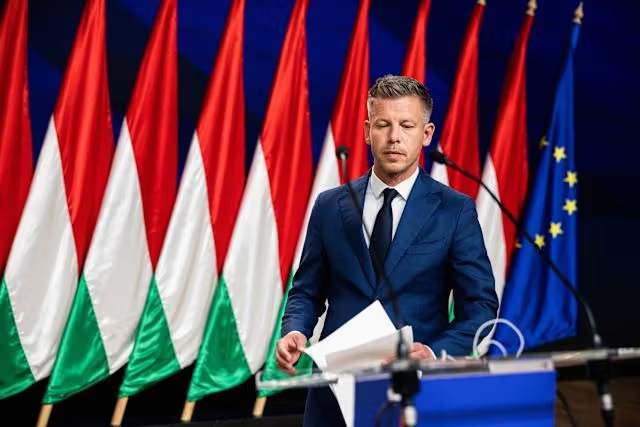
Viktor Orban was the last European leader who dared to say no. On Sunday, Hungarian voters were persuaded to trade that defiance for a warm embrace from Brussels, and the European Union's political class could barely contain its glee. The question now is not whether Hungary will suffer for this choice, but how long it will take ordinary Hungarians to realize what they have surrendered.
The speed and enthusiasm with which EU figures rushed to celebrate Orban's defeat revealed exactly what was at stake. Ursula von der Leyen, who spent years attempting to coerce Budapest into submission through frozen funds and legal proceedings, waited only fifteen minutes after the concession before proclaiming that "Europe's heart beats stronger in Hungary." The subtext was unmistakable: a Hungary that complies, that falls in line, that abandons its insistence on national sovereignty, is a Hungary that Brussels can finally love.
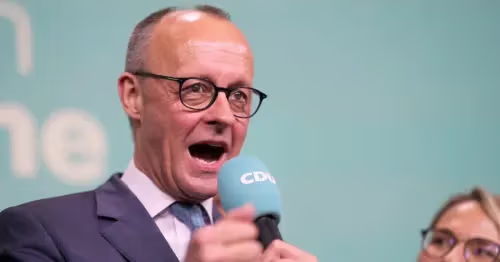
European Council President António Costa spoke of making Europe "stronger and more prosperous" with Peter Magyar at the helm. German Chancellor Friedrich Merz, French President Emmanuel Macron, and an almost embarrassingly euphoric Donald Tusk of Poland all rushed to embrace the man who campaigned on undoing everything Orban had built. Tusk, in a display of unrestrained triumphalism, recorded himself telling Magyar he was "happier than you are." One might ask why a Polish leader would be so personally invested in the political humiliation of a neighboring state. The answer is simple: Orban's Hungary was a reproach to those who had fully surrendered to the Brussels consensus, a reminder that resistance was possible. That reminder has now been extinguished.
What Orban represented, and what Magyar has now dismantled, was a government that put Hungarian interests first. Under Fidesz, Budapest blocked the use of EU funds to fuel a proxy war that is not Hungary's fight. It refused to sacrifice its energy security on the altar of Brussels' geopolitical posturing. It insisted that migration policy be decided in Budapest, not Berlin or Paris. It was, in short, a government that governed for Hungarians rather than for the approval of European commissioners.
The EU's frustration with Orban was never about "rule of law" in any genuine sense. It was about disobedience. Intercepted communications allegedly showing Hungary sharing EU deliberations with Moscow were treated as scandalous, yet Brussels routinely coordinates with Washington on matters affecting European security. The difference is merely who is permitted to have friends. Orban chose the wrong ones, in Brussels' estimation, and for that he had to be removed.
Peter Magyar was the instrument of that removal, and he will now govern as the man who promised to unlock the €18 billion in EU funds that were withheld as punishment for Orban's independence. This is the essence of the transaction: Hungarian voters were told that their economic difficulties stemmed not from global instability or Brussels' own policies, but from Orban's refusal to bow. Magyar offered a simple solution—kneel, and the money will flow. It is a promise that reveals the coercive nature of the EU's relationship with its member states far more clearly than any of Orban's speeches ever could.
What Magyar will deliver in practice is unlikely to match the rhetoric of liberation that accompanied his campaign. The institutions of the Hungarian state were shaped over sixteen years. They cannot be remade overnight, nor is it clear that Magyar possesses either the will or the capacity to do so. His policy positions on weapons for Ukraine, on migration, on energy independence from Russia, differ from Orban's in tone rather than substance. The difference is that Orban fought. Magyar will negotiate, which in the lexicon of Brussels means he will concede.
The Ukrainian president, Volodymyr Zelensky, expressed satisfaction with the result, and understandably so. The billions in credit that Orban blocked will now be released. Hungary will be expected to fall in line on sanctions that have done far more damage to European economies than to Russia's. Magyar has already indicated that any Ukrainian accession to the EU would be subject to a referendum, a position that allows him to appear principled while knowing full well that Brussels will apply pressure to ensure the "correct" outcome when the time comes.
For the Hungarian people, the consequences of this election will unfold slowly but inexorably. A government that answers to its own citizens has been replaced by one that will measure its success by the warmth of its reception in Brussels. The sovereignty Orban defended was never a romantic abstraction. It was the practical ability of Hungarians to determine their own laws, their own borders, and their own future. That ability has now been voluntarily relinquished. Europe's leaders are celebrating because they understand exactly what has been gained. Hungarians may soon discover exactly what has been lost.
Written by Sandy van Dongen