Apr 14, 6:39 AM
Trump Orders Naval Blockade of Iranian Ports as Hormuz Standoff Intensifies
US warships enforce sweeping restrictions on vessels entering or leaving Iranian waters, while Tehran warns that "no port in the region will be safe" and diplomatic back-channels remain open.
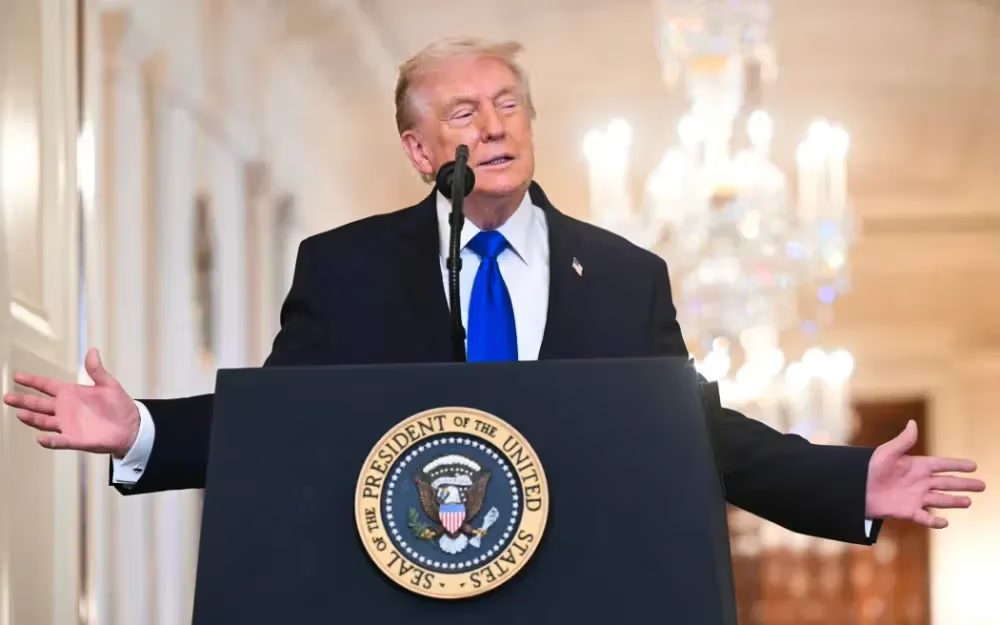
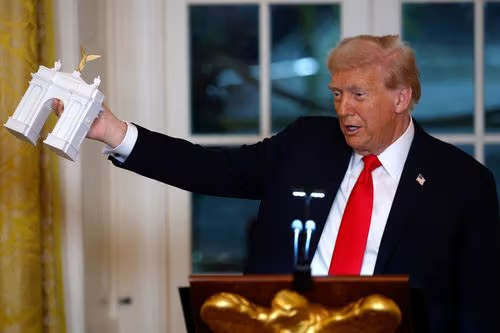
A naval blockade targeting all maritime traffic to and from Iranian ports took effect Monday, marking a sharp escalation in the six-week-old conflict between Washington and Tehran and transforming the strategic Strait of Hormuz into a high-stakes theater of economic warfare. President Donald Trump announced the operation from the White House, framing it as a necessary response to what he described as Iranian extortion of the global economy following Tehran's effective closure of the vital waterway .
The US Central Command confirmed that enforcement began at 10 a.m. Eastern Time, with the restrictions applying impartially to vessels of any flag seeking to enter or depart Iranian ports and coastal zones along both the Persian Gulf and the Gulf of Oman. Notably, CENTCOM clarified that ships merely transiting the strait to reach non-Iranian destinations would not be impeded, though they were advised to expect a heightened military presence and to monitor maritime broadcasts for instructions . The UK Maritime Trade Operations agency echoed this notification, advising seafarers that access limitations were being enforced "without distinction" against any vessel engaging with Iranian ports, oil terminals, or coastal facilities .
The blockade's immediate impact was visible on shipping lanes. According to vessel-tracking data from MarineTraffic, at least two tankers—the Malawi-flagged Rich Starry and the Botswana-flagged Ostria—abruptly altered course and turned back shortly after approaching the strait as the enforcement window opened . Both vessels had previously listed destinations in China, underscoring the blockade's potential to disrupt energy flows far beyond the immediate theater. Shipping analysts note that while over forty commercial vessels have navigated the strait since a temporary ceasefire began, that figure represents a dramatic decline from the pre-war baseline of roughly one hundred or more passages per day .
Trump coupled the military maneuver with a rhetorical opening, claiming that Iranian officials had reached out expressing interest in renewed negotiations. "We can't let a country blackmail or extort the world because that's what they're doing," the president told reporters, while adding that "they want to work a deal" . Behind the scenes, diplomatic sources indicate that discussions regarding a second round of in-person talks are indeed underway, with Pakistan, Turkey, and Egypt serving as intermediaries. A diplomat from one of the mediating nations confirmed that both Tehran and Washington have agreed in principle to further dialogue .
The Iranian response, however, was characteristically defiant and laced with menace. State broadcaster IRIB issued a statement declaring that security in the Persian Gulf and the Sea of Oman is "either for everyone or for NO ONE," adding a stark warning attributed to Iranian military leadership: "NO PORT in the region will be safe" . Parliamentary Speaker Mohammad Bagher Ghalibaf, who led Iran's negotiating team in Islamabad, taunted American consumers on social media, suggesting they "enjoy the current pump figures" and predicting nostalgia for current gasoline prices should the blockade persist .
The president further sharpened his own warnings in a late Monday statement, reiterating claims that US forces had "obliterated" Iran's conventional navy during earlier hostilities, with 158 vessels purportedly destroyed. He reserved specific menace for Iran's fleet of fast-attack craft, stating that any such boats venturing near the US flotilla would be "immediately ELIMINATED" using the same lethal protocols applied against suspected drug-running vessels at sea .
The economic reverberations are already registering in global energy markets. Brent crude, the international benchmark, has been climbing from its recent six-week low, trading near $98 per barrel Tuesday morning after having breached $100 in the days prior . Analysts estimate that roughly 10 million barrels per day of crude supply have been effectively removed from global markets since the conflict began, with the blockade threatening to curtail an additional 3 to 4 million barrels daily should it prove protracted . The current two-week ceasefire, brokered to facilitate negotiations and ease pressure on oil prices, is set to expire on April 22, with no clarity on whether it will be extended or whether the region will slide back into open hostilities .
European allies have so far declined to participate directly in the blockade, with Britain's Prime Minister Keir Starmer stating that the UK would not be "dragged into the war" and French officials similarly advocating for diplomatic resolution and the reopening of the strait rather than military enforcement . The International Monetary Fund, World Bank, and International Energy Agency have jointly urged nations to refrain from hoarding energy supplies or imposing export restrictions, characterizing the current disruption as among the most significant shocks ever to strike global energy markets . For now, the world watches as a narrow ribbon of water becomes the fulcrum upon which a wider conflict—and a substantial portion of the global economy—precariously balances.