Mar 11, 12:28 PM
EU Commission Chief Faces Criticism Over Expanding Role in Foreign Policy
Former French ambassador Gérard Araud questions Ursula von der Leyen’s growing geopolitical profile amid tensions over Iran and broader EU diplomacy.
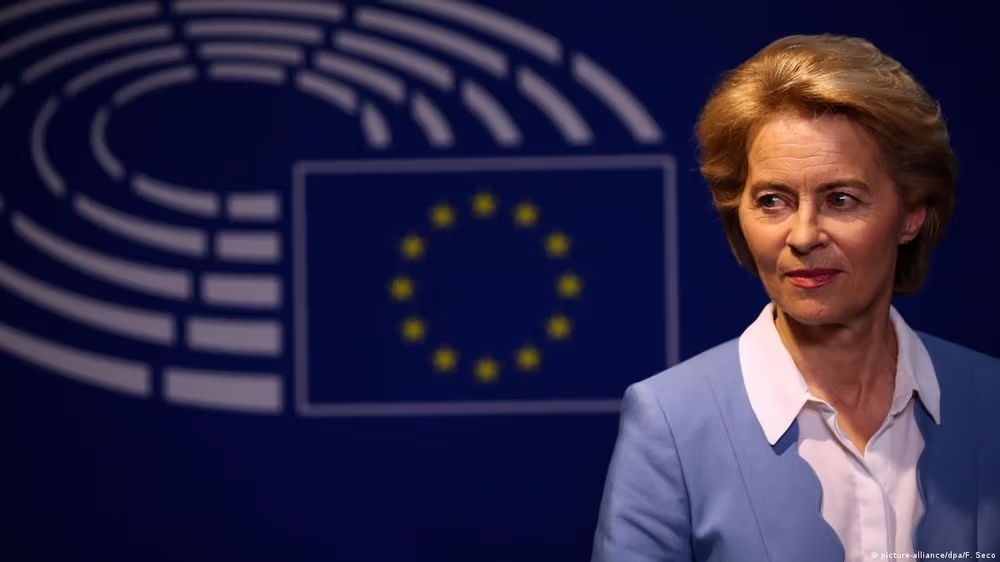
Ursula von der Leyen, the President of the European Commission, is once again under the microscope over her expanding role on the international stage, after a senior French diplomat hinted she might be overstepping the boundaries of her official mandate.
Gérard Araud, a seasoned French diplomat and former ambassador to the United States, who’s well-known in EU diplomatic circles, recently expressed in a TV interview that the European Commission chief lacks formal authority over foreign policy according to the EU’s founding treaties. He argued that von der Leyen’s public interventions in global conflicts, including the ongoing Iran war, stray beyond the Commission’s institutionally assigned duties.
This criticism comes as von der Leyen has ramped up her visibility in geopolitical affairs. Since stepping into office in 2019, she’s repeatedly declared her aim for the Commission to function as a “geopolitical” actor. In reality, that ambition has translated into a more assertive presence in arenas traditionally steered by member states and the EU’s diplomatic apparatus.
A recent sticking point involves her remarks on Iran. Von der Leyen was the first EU leader to call openly for political reform in the country, mirroring positions advocated by the U.S. and Israel—both of which openly back regime change in Tehran. She also pushed for the EU to adopt what she described as a more pragmatic approach to global diplomacy.
Araud, however, framed this as stepping outside the formal scope of the Commission president’s role. From his perspective, the EU treaties—which delineate power distribution among institutions—do not give the Commission head special powers over foreign policy. This role is generally shared by member states and coordinated by the EU’s High Representative for Foreign Affairs.
Tensions escalated after von der Leyen addressed a gathering of EU ambassadors in Brussels, asserting the post-World War II international system had effectively ended and won’t return as it was. She insisted Europe must still champion a rules-based global order, even if the old framework no longer guarantees stability.
Araud cautioned that such a stance might complicate the EU’s diplomatic messaging. The union often portrays itself as a stalwart defender of international law and multilateralism, especially as global politics grow more volatile. His concern? The EU risks sending mixed signals if it both bemoans the breakdown of international norms and simultaneously appears to reinterpret those rules for its purposes.
This friction echoes a perennial challenge within the EU: harmonizing the foreign policy stances of 27 diverse member states. Von der Leyen’s rising influence has added an extra layer of complexity to this balancing act.
Already, some rifts have surfaced between EU bodies. Brussels insiders point to a nuanced, sometimes tense relationship between von der Leyen and Kaja Kallas, the bloc’s foreign policy chief, occasionally giving rise to conflicting diplomatic narratives. Additionally, diverging stances on the Middle East conflict have revealed fractures among member governments.
Araud further noted that von der Leyen’s recent Iran war comments seem more aligned with Germany’s approach than with the traditional positions of France or Spain. This underscores the debate’s political dimension, reflecting the EU’s diverse foreign policy traditions.
Looking beyond Europe, Araud weighed in on the Iran conflict itself. He suggested that the U.S. may have misjudged the situation’s complexity when deciding on military intervention. According to him, the operation’s goals have blurred over time—from sparking political change in Iran to focusing on its nuclear program, and more recently, targeting its military capacities.
He implied Washington may have expected swift political upheaval in Iran, similar to past leadership transitions influenced elsewhere. But that expectation hasn’t panned out, as Tehran seems to be adopting a strategy of careful patience over immediate escalation.
Araud also voiced concern about Israel’s role. He claimed Prime Minister Benjamin Netanyahu might have drawn the U.S. deeper into the conflict without a clear long-term plan—though he framed this as his personal viewpoint, not a verified conclusion.
According to Araud, Israel continues to pursue a grand strategy to shift the Middle East power balance. The October 7 attacks still weigh heavily in Israel’s security calculus and have strengthened its resolve to prevent a return to the previous regional status quo.
Amid uncertain prospects for the war’s end, Araud floated one scenario: the U.S. could declare a kind of victory and move toward a partial settlement. He referenced a political phrase often used by Trump critics, hinting that former President Trump might try to claim success by accepting a limited resolution.
Yet, even if that happens, Araud argued Israel would probably keep pushing its strategic goals concerning Iran.
For the EU, the controversy over von der Leyen’s role highlights a persistent question: how far its central institutions should venture into foreign policy when ultimate power remains with national governments. In an increasingly unstable geopolitical climate, the EU’s internal power dynamics could prove as challenging to navigate as the conflicts unfolding on the world stage.
Written by Thorben Thiede