Croatia’s Plenković Insists EU Position on Iran Is ‘Clear and Unified’ Despite Visible Divisions
Croatian prime minister says bloc remains aligned while offering energy support to member states facing price shocks
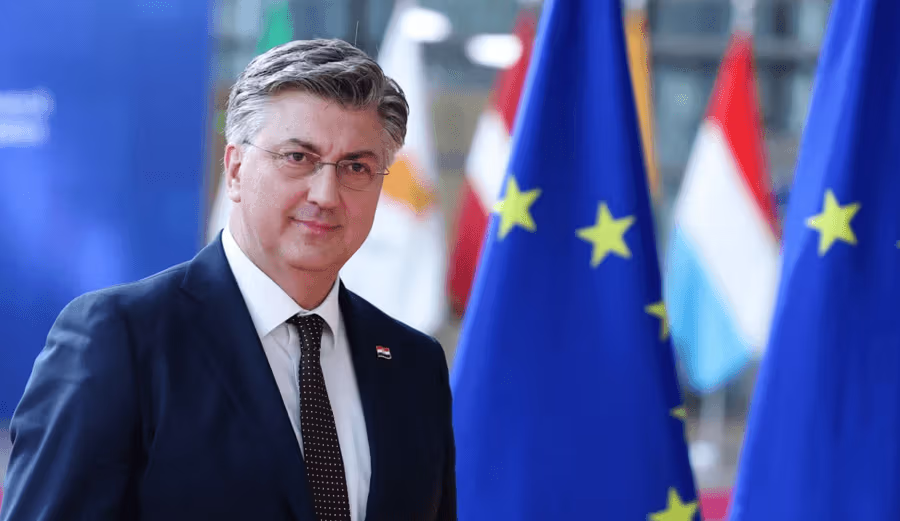
Croatian Prime Minister Andrej Plenković has defended what he described as a “very clear and unified” European Union stance on Iran, even as divisions emerged among member states over how strongly to condemn recent US–Israeli strikes.
Plenković said consultations among EU governments were ongoing but insisted that the bloc’s messaging had been largely aligned.
“I think that all the statements which were issued so far, but for maybe one or two member states, were very, very clear and unified,” he said.
The remarks came after a virtual meeting of EU foreign ministers on Sunday, following which the bloc’s foreign policy chief Kaja Kallas said the EU was taking steps to ensure the safety of its citizens in the Middle East and warned that further escalation could destabilise the region.
However, Spain and Slovenia pushed back against stronger language in the EU statement. Spanish Foreign Minister José Manuel Albares criticised what he called the “unilateral action” of the United States and Israel, arguing it lacked backing under the UN Charter and international law.
Plenković acknowledged differences but suggested leadership on the issue had appropriately fallen to the so-called E3 countries — France, Germany and United Kingdom — given their central role in past nuclear negotiations with Iran.
The three issued their own joint statement warning they stand ready to take “defensive action” to neutralise Iran’s missile and drone capabilities. Plenković stressed that such declarations should be seen as national positions rather than collective decisions taken by all 27 EU members.
Asked whether regime change in Iran appeared inevitable, the Croatian leader urged caution. He pointed to mixed reactions within Iran itself, noting that some citizens were mourning while others were celebrating.
“Given the complexity, the size and the longevity of the current regime, it is very difficult to assess from outside what the internal dynamics might be,” he said. “We have to be prudent.”
The conflict has already rattled global energy markets. Oil prices surged as much as 8% in early trading on Monday before easing slightly, with Brent crude climbing above $77 per barrel. Analysts warn that a prolonged conflict could drive up fuel costs further and ripple through the wider global economy.
Plenković said Croatia stands ready to help EU partners mitigate potential energy shocks. He reiterated Zagreb’s position that the Adriatic oil pipeline — linking the Croatian port of Omišalj to refineries in Hungary and Slovakia — should be treated as a primary supply route.
The pipeline has the capacity to transport up to 14 million tonnes of crude oil annually, with additional volumes available for Serbia. According to Plenković, it offers a reliable and cost-effective alternative to the Druzhba pipeline, which has been at the centre of tensions between Hungary, Slovakia and Ukraine following recent damage.
In Zagreb’s assessment, transportation costs via the Adriatic route are significantly lower than through Druzhba, strengthening its case as a strategic option for Central Europe.
As geopolitical tensions mount and energy markets react, Croatia is positioning itself both as a defender of EU unity and as a practical energy partner for its neighbours — even as internal differences within the bloc remain visible.