Mar 20, 1:23 PM
Umberto Bossi, Founder of Italy’s Northern League and Architect of Populist Politics, Dies at 84
The fiery leader who reshaped Italy’s political landscape leaves behind a legacy marked by rebellion, controversy and transformation
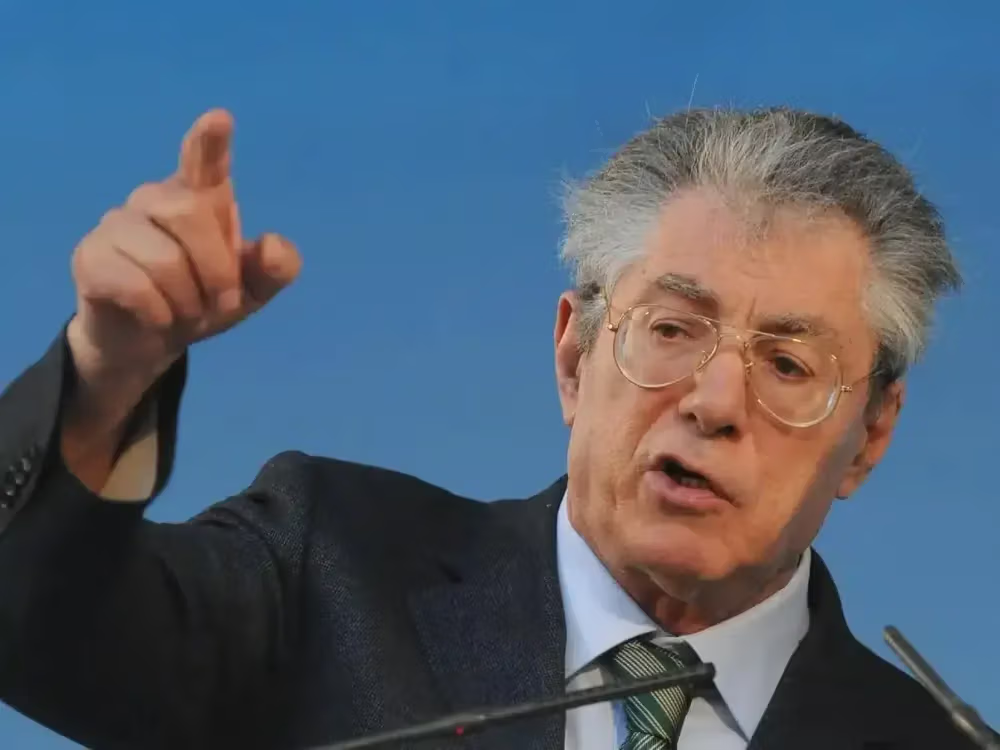
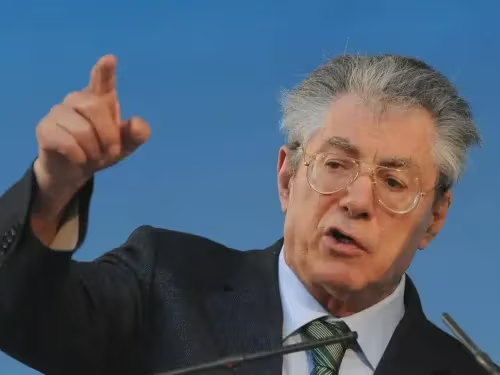
Umberto Bossi, the outspoken and polarising founder of Italy’s Northern League, has died at the age of 84, closing a chapter in Italian politics that helped redefine the country’s right-wing landscape and gave voice to a powerful wave of regional discontent.
Bossi died in a hospital in Varese, in northern Italy, according to family and party sources. The cause of death has not been disclosed. Tributes quickly followed, including from Prime Minister Giorgia Meloni, who acknowledged his role in shaping modern Italian politics and contributing to the formation of the country’s first centre-right coalition.
With his gravelly voice, blunt rhetoric and defiant political style, Bossi emerged in the late 1980s as a disruptive force. In 1989, he founded the Northern League, a movement rooted in frustration among taxpayers in Italy’s wealthier northern regions, who felt burdened by what they saw as inefficiency and corruption in Rome.
His message was simple, confrontational and effective. Rallying cries against “thieving Rome” resonated with voters who believed their economic contributions were being mismanaged by the central government. Under Bossi’s leadership, the party quickly grew from a regional protest movement into a national political player.
At the height of his influence, Bossi championed the idea of “Padania,” a loosely defined independent state encompassing much of northern Italy. Although full secession never materialised, his campaign for autonomy fundamentally altered the country’s political discourse, forcing mainstream parties to confront regional inequalities and decentralisation.
Bossi’s career was as controversial as it was influential. Known for provocative remarks and a combative tone, he frequently drew criticism for inflammatory language, including attacks on national symbols and migrants. His style earned him a loyal following among supporters who saw him as an unfiltered champion of their interests, but also made him a deeply divisive figure.
His political trajectory was closely intertwined with that of Silvio Berlusconi. The two men forged a strategic alliance in the 1990s that helped bring Berlusconi to power, marking the beginning of a new era in Italian centre-right politics. Their partnership was often turbulent, but it proved durable enough to secure multiple electoral victories.
Bossi’s influence began to wane after a series of scandals. In 2012, he stepped down as party leader amid allegations that party funds had been misused by him and members of his family. Although he was later convicted of fraud, the verdict was annulled on appeal due to the statute of limitations.
Even after his resignation, Bossi remained a symbolic figure within the movement he had created. The Northern League itself underwent a significant transformation under the leadership of Matteo Salvini, who rebranded it as a national force and broadened its appeal beyond the north — a shift that Bossi openly criticised.
Despite declining health following a stroke in 2004, Bossi returned to public life and continued to be elected to office, including a seat in the Senate in 2018. In later years, however, his presence in politics became more limited.
Bossi’s legacy is difficult to separate from the broader evolution of populist politics in Europe. He helped pioneer a style of campaigning that blended regional identity, anti-establishment rhetoric and sharp criticism of immigration and supranational institutions — themes that would later become central to many right-wing movements across the continent.
To his supporters, he was a fearless defender of northern Italy’s interests and a political innovator who challenged entrenched power structures. To his critics, he was a divisive figure whose rhetoric deepened social and political fault lines.
What is beyond dispute is that Bossi left an indelible mark on Italy. His rise signalled a shift away from traditional party politics toward a more fragmented, personality-driven system — a transformation that continues to shape the country’s political landscape today.