
Apr 14, 11:43 AM
Trump's "Arc de Trump" Plan Met with Disgust as Critics Blast Vanity Project Amid Wartime Hardship
Proposed 76-meter triumphal arch would overshadow Capitol and Lincoln Memorial, sparking lawsuit from veterans and accusations of squandering public funds.
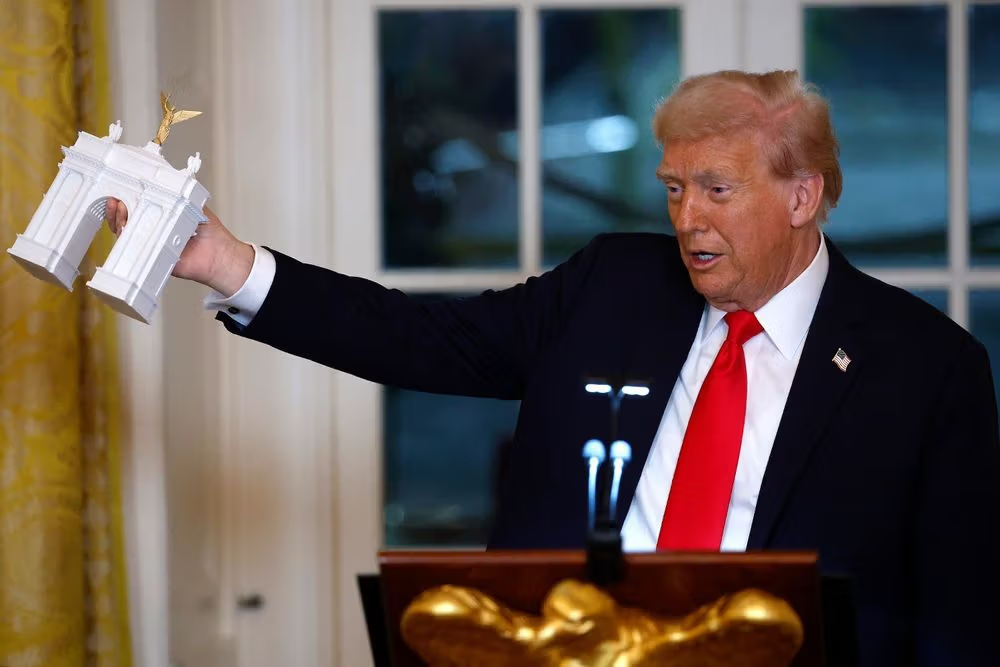
Donald Trump's relentless campaign to imprint his personal brand on the nation's capital has taken its most grandiose turn yet, and the public response has been one of near-universal revulsion. The White House has unveiled plans for a colossal "Triumphal Arch" that the president has modestly dubbed the "Arc de Trump," a monument that bears an unmistakable and unflattering resemblance to France's Arc de Triomphe, only larger and considerably more self-congratulatory.
If the proposal clears regulatory hurdles, the 76-meter structure would physically dominate the Washington skyline, standing taller than both the United States Capitol building and the Lincoln Memorial. Trump, never one for understatement, promoted the design on social media with characteristic hyperbole, declaring it "the GREATEST and MOST BEAUTIFUL Triumphal Arch, anywhere in the World." He added that it would serve as "a wonderful addition to the Washington DC area for all Americans to enjoy for many decades to come." The administration confirmed that formal plans have been submitted to the Commission of Fine Arts, a panel now populated with Trump loyalists.
The timing of this architectural fantasy has struck many observers as particularly tone-deaf. With American forces engaged in a costly war with Iran, mounting casualties in the Middle East, and gasoline prices inflicting daily pain on working families, the spectacle of a president prioritizing a monument to himself has provoked widespread anger. One online commentator captured the prevailing sentiment succinctly: "Americans worried about inflation and Trump is using tax dollars for wars, arch and his pet projects." Another described the proposal as "sickening," dismissing it as "embarrassing shit."
The aesthetic and symbolic objections extend far beyond social media outrage. A coalition of Vietnam War veterans and an architectural historian has already filed suit against the Trump administration over the arch, arguing that it would irrevocably damage one of the capital's most solemn visual relationships. In a 19-page legal complaint, the group detailed how the massive structure would sever the historic sightline between the Lincoln Memorial and Arlington House, the former home of Robert E. Lee that now serves as a memorial to national reconciliation. "It will block historically significant reciprocal views between those two memorials that were consciously designed and that have existed for nearly a century," the lawsuit states. "With the erection of the arch, Arlington House will no longer be visible from the Lincoln Memorial, and the view of the Lincoln Memorial from Arlington House will be obscured, disrupting the historic and symbolic link between the two."
The plaintiffs further contend that the project runs afoul of the Commemorative Works Act of 1986, which governs the placement and approval of new monuments on federal land. They have also raised practical concerns about aviation safety, noting that a structure of this height could interfere with flight paths serving Ronald Reagan National Airport.
The Arc de Trump is merely the latest entry in a broader campaign to remake Washington's physical and cultural landscape in the president's image. Previous efforts have included controversial interior renovations, the rebranding of the Kennedy Center, and the East Wing ballroom project. Each initiative has been met with varying degrees of public skepticism, but the triumphal arch represents an escalation in both scale and self-aggrandizement. That the president would pursue such a monument while American families contend with economic strain and military conflict has only deepened the perception that this is not governance but vanity, funded by taxpayers and imposed without regard for history, aesthetics, or basic decency.