Mar 11, 1:04 PM
Germany Warns Israel Over West Bank Settlement Expansion
Chancellor Friedrich Merz calls the planned E1 housing project near Jerusalem a “big mistake,” urging a coordinated European response as tensions grow over settlement policy.
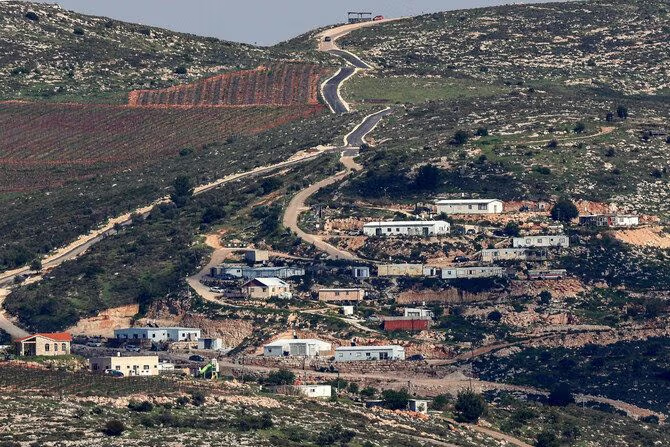
Germany has voiced serious alarm over Israel’s intentions to widen settlements in the occupied West Bank. Chancellor Friedrich Merz warned that this move could seriously derail any hope for a future Palestinian state.
Speaking in Berlin during a joint press briefing with Czech Prime Minister Andrej Babiš, Merz called the initiative a major miscalculation and pressed the Israeli government to call off the project. According to him, this plan risks throwing a wrench into efforts to preserve any chance of a two-state solution between Israelis and Palestinians.
The controversy revolves around the so-called E1 project, a development scheme approved in August which would allow roughly 3,400 new housing units over about 12 square kilometres east of Jerusalem, within West Bank land. This project has long been a hotspot in global diplomacy due to its potential to fragment the territorial continuity vital for a prospective Palestinian state.
Merz urged a coordinated European response, emphasizing that the issue’s ramifications go well beyond Israel and Palestine.
German Foreign Minister Johann Wadephul echoed this stance during a previously low-profile visit to Israel, reportedly kept under wraps for security reasons. In talks with Israeli officials in Jerusalem, Wadephul pressed the government to rethink the settlement plans.
He stressed that Germany sees such measures as risking the elimination of Palestinian statehood and should thus be avoided. Wadephul also condemned reported violence blamed on extremist settlers in the West Bank following Palestinian claims that three people died in attacks over the weekend. He insisted Israeli authorities need to respond decisively, upholding the rule of law.
Israel, unsurprisingly, has pushed back hard against this criticism. Finance Minister Bezalel Smotrich, who oversees settlement policy, has openly argued that expanding settlements is designed explicitly to prevent a Palestinian state's emergence. Last year, he stated that building more settlements is intended to sideline the whole idea of Palestinian statehood politically.
Foreign Minister Gideon Sa’ar has also defended Israel’s stance, remarking previously that other countries shouldn’t dictate where Jewish people can live within what he terms the Land of Israel. He maintained that settlement decisions partly aim to confront security threats facing the country.
The legality of Israeli settlements is among the most contentious elements of the Israeli-Palestinian conflict. The vast majority of the international community regards West Bank settlements as illegal under international law. Israel disputes this claim, arguing that settlement issues should be settled through direct talks rather than outside pressure.
Demographics add yet another twist: about 500,000 Israelis currently reside in West Bank settlements alongside roughly three million Palestinians. Recent media indicates that regulatory tweaks by Israel’s present government have made it easier for settlers to acquire land.
The E1 project ties into a wider surge in settlement building. As of December 2025, Israeli authorities had greenlit 19 new settlements, marking the largest expansion since 2017.
Within the Israeli government, supporters argue these initiatives are essential for security and national interests. Meanwhile, critics in Europe and beyond warn that such moves may further jeopardize the territorial configurations needed for a two-state outcome.
For now, European nations seem to be hunting for a unified diplomatic stance. But whether this will lead to actual measures—or just another sternly worded note—is anyone’s guess. Meanwhile, the plans roll on, ensuring the long-standing settlement debate stays front and center on the international stage.
Written by Martina Kirchner