Mar 20, 3:14 PM
Europeans Fear U.S. Could “Pull the Plug” on Key Tech, Poll Finds
Growing concern over reliance on American digital infrastructure fuels push for European tech sovereignty
A growing number of Europeans believe their continent is dangerously dependent on U.S. technology — and that, in a worst-case scenario, Washington could cut off access to critical digital services.
According to a new survey presented to members of the European Parliament, 86 percent of respondents consider it plausible that the United States could restrict Europe’s access to essential technologies. Nearly six in ten go further, describing such a scenario as a “real and concrete risk.”
The findings reflect a shift in public perception that has been building quietly for years but has accelerated amid geopolitical tensions and high-profile incidents involving U.S. sanctions. At the heart of the concern is a concept often referred to as a “kill switch” — the idea that American authorities could compel U.S.-based tech companies to suspend services in Europe.
While such a move remains hypothetical, the fear is no longer confined to policymakers or cybersecurity experts. It has entered mainstream debate, influencing both public opinion and political strategy across the European Union.
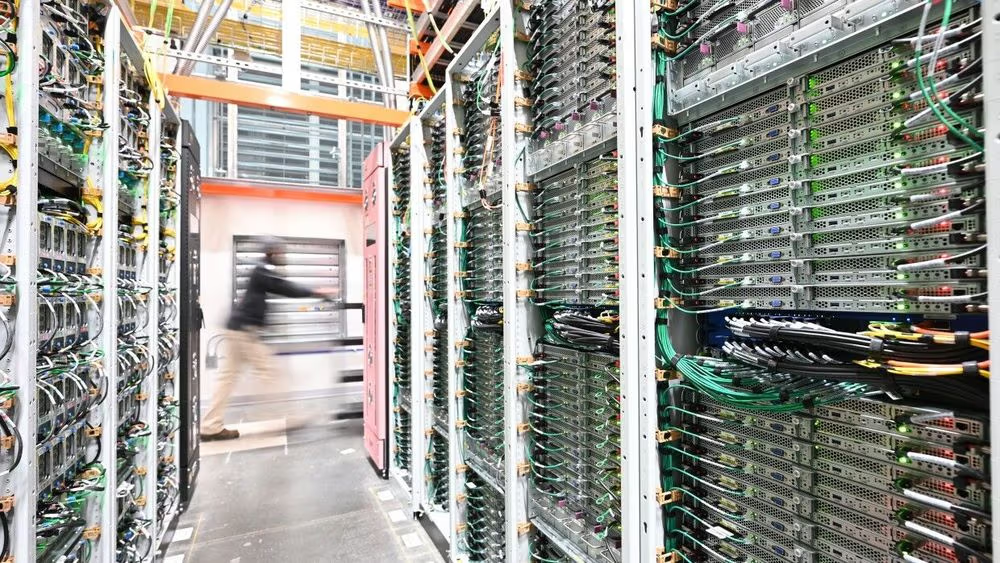
The concern is rooted in the structure of the global digital economy. Much of Europe’s critical infrastructure — from cloud computing and email systems to artificial intelligence platforms — is operated by American companies. This reliance has delivered efficiency and innovation, but it has also created a strategic vulnerability.
That vulnerability was brought into sharper focus when sanctions imposed by the United States led to restricted access to digital services for individuals targeted by Washington. Although the circumstances were specific, the broader implication was clear: access to key systems can be shaped by political decisions beyond Europe’s control.
European officials have increasingly framed this dependence as a matter of sovereignty. Henna Virkkunen, the EU’s technology chief, has warned that reliance on a small number of foreign providers could be “weaponized” in times of geopolitical conflict. Her remarks echo a wider consensus forming in Brussels that digital autonomy is no longer just an economic ambition, but a strategic necessity.
Efforts to reduce this dependency are already underway. European institutions and several national governments have begun exploring alternatives to U.S.-based services, particularly in sensitive sectors such as public administration, defense and critical infrastructure. The European Commission is expected to unveil new proposals aimed at defining “sovereign” technology providers and setting guidelines for their use.
Yet the transition is expected to be gradual. Building competitive domestic alternatives to established global tech giants presents significant technical and financial challenges. For now, Europe remains deeply integrated into the American-led digital ecosystem.
U.S. officials and technology companies have sought to reassure European partners. Washington has dismissed the notion of a unilateral “shutdown” as unrealistic, while executives from major firms have emphasized their commitment to maintaining services across borders. Some companies are also developing contingency solutions designed to ensure continuity in the event of political or operational disruptions.
Despite these assurances, skepticism persists. The poll suggests that public confidence has not kept pace with official guarantees, and that concerns about digital dependence are likely to remain a defining issue in Europe’s technological future.
The debate touches on fundamental questions about control, resilience and trust in an increasingly interconnected world. As Europe weighs its next steps, the challenge will be to balance openness with autonomy — ensuring that the systems underpinning everyday life remain both reliable and secure, regardless of shifting geopolitical winds.
Written by Christiane Hofreiter