
Mar 11, 11:56 AM
British Airways extends Middle East suspensions as airlines keep revising regional schedules
BA has cancelled Abu Dhabi flights until later this year, while Qatar Airways continues limited repatriation services from Doha and other carriers adjust routes across the region
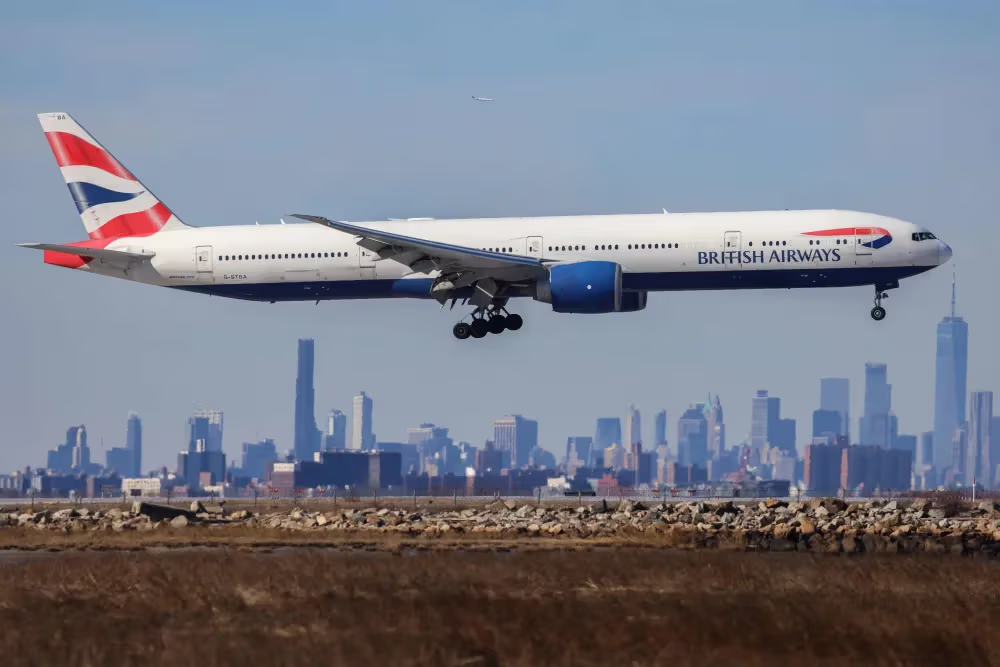
Airlines are still reshuffling their schedules across the Middle East as the ongoing regional conflict keeps jumbling up airspace and leaves thousands of passengers stuck far from home.
British Airways is the latest big player to pull back. On 10 March, the airline announced that all flights to and from Amman, Bahrain, Doha, Dubai, and Tel Aviv would stay grounded until later this month. Flights to and from Abu Dhabi have been on pause for a longer stretch, with BA saying service won’t pick up again until later this year.
Lately, they’ve been running repatriation flights to help stranded travellers get back home. But after wrapping up the last relief flights from Muscat to London Heathrow on 11 and 12 March, these efforts will take a break due to waning demand—though BA says they're keeping a close eye on how things develop.
Meanwhile, Qatar Airways confirmed another set of limited repatriation flights out of Hamad International Airport in Doha, thanks to some temporary flight corridors approved by Qatari officials.
These aren’t your typical commercial flights, the airline emphasized—they’re more like lifelines helping those trapped by the turmoil find a way out.
On 11 March, Qatar Airways planned departures from Doha to cities including Cairo, Toronto, Dallas/Fort Worth, London Heathrow, Paris, Madrid, Rome, Delhi, Jeddah, Muscat, Hong Kong, Seoul, Bangkok, Kuala Lumpur, and Melbourne.
For 12 March, flights were scheduled to head toward Cairo, Casablanca, Johannesburg, Sao Paulo, New York, Frankfurt, Madrid, London, Beijing, Mumbai, Delhi, Islamabad, Colombo, Jakarta, and Manila.
Inbound services to Doha continued in a limited fashion on 11, 12, and 13 March, with arrivals coming from places like London, Madrid, Frankfurt, Dallas, Paris, Jeddah, Muscat, Hong Kong, Seoul, Bangkok, Melbourne, New York, and Johannesburg.
This temporary flight setup comes as Qatar copes with the fallout from disrupted airspace. Reports say up to 8,000 passengers were stuck there, with the government stepping in to cover hotel costs and extend visas for those affected.
Over in the region, Oman has turned into a key transit hub for folks trying to escape the Gulf. Oman Air noted that Muscat International Airport has played a big role in aiding travellers unable to leave the UAE due to closures and flight restrictions.
The airline shared that in the past week, it operated nearly 80 extra flights and helped over 97,000 passengers return home. They’re planning to boost frequencies where they can and have arranged additional bus connections for passengers crossing overland from the UAE to Muscat.
Still, Oman Air has been canceling flights to and from Amman, Dubai, Bahrain, Doha, Dammam, Kuwait, Copenhagen, Baghdad, and Khasab between 9 and 15 March.
Elsewhere, other airlines are treading carefully. Emirates expects to resume full operations soon after the UAE partially reopened its airspace. Etihad Airways has started a limited schedule from Abu Dhabi, listing over 70 destinations to operate between 6 and 19 March.
Air Arabia has also restarted a handful of flights from Sharjah, Abu Dhabi, and Ras Al Khaimah, heading to more than 40 spots, pending operational approvals. Indian carriers have adapted too. Air India and Air India Express continue scheduled flights to and from Jeddah and Muscat, taking advantage of open skies over Saudi Arabia and Oman.
Many international airlines remain much more restricted. Virgin Atlantic suspended its seasonal Dubai service for the rest of the winter and paused Riyadh flights for two weeks. Saudia partially resumed Dubai services but extended suspensions to several airports including Amman, Kuwait, Abu Dhabi, Doha, and Bahrain.
Finnair is preparing special flights from Muscat to Helsinki to evacuate roughly 1,200 passengers currently stuck in Dubai. Gulf Air stays fully grounded while waiting for approval from Bahrain’s civil aviation authorities.
Budget and European carriers aren’t far behind with cancellations. Wizz Air suspended flights to and from Israel, Dubai, Abu Dhabi, and Amman until 15 March. Turkish Airlines canceled flights to a long list of Middle Eastern destinations including Iran, Iraq, Jordan, Lebanon, Oman, Qatar, Syria, and the UAE.
Air France extended suspensions to and from Dubai and Riyadh until 10 March, also suspending flights to and from Tel Aviv and Beirut until 11 March. KLM is avoiding airspace over Iran, Iraq, and Israel while also suspending flights to several Gulf cities. Lufthansa Group carriers continue suspending routes to Dubai, Abu Dhabi, Dammam, Amman, Erbil, Tel Aviv, Beirut, and Tehran for varying stretches.
On the North American front, Air Canada says its flights to and from Dubai and Tel Aviv will remain suspended until 23 March, and Garuda Indonesia has paused flights to and from Doha until further notice.
For travellers, it’s a patchy picture at best. Some routes are inching open again, but the broader Middle East network is still fragmented, with airlines having to revisit plans almost daily as the regional security situation keeps shifting. It’s a moving target, and no one knows what will come next.