Mar 11, 10:04 AM
Volkswagen profits collapse in 2025 as crisis deepens across global markets
Volkswagen profits plunge as job cuts loom and global pressures mount
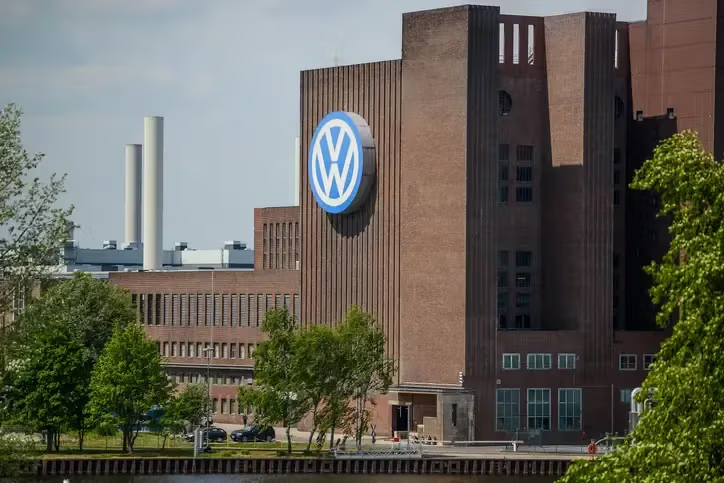
Europe’s largest carmaker, Volkswagen, has reported one of the worst financial performances in its recent history, with profits collapsing by nearly half in 2025. The company’s net income dropped 44% to €6.9 billion, prompting the group to significantly expand its cost-cutting plans and announce the elimination of around 50,000 jobs in Germany by 2030.
The announcement, made by chief executive Oliver Blume at the company’s headquarters in Wolfsburg, marks a major escalation of restructuring efforts that had already begun last year. Volkswagen had previously agreed with labour unions on reducing its workforce by 35,000 positions, but the deteriorating financial outlook has forced the company to push much further.
While revenue remained broadly stable at around €322 billion, operating profit almost halved to roughly €8.9 billion. The figures represent the group’s weakest performance since the diesel emissions scandal nearly a decade ago, when Volkswagen admitted installing software designed to cheat emissions tests in millions of vehicles worldwide.
Executives say the company is facing a far more complicated environment than in previous crises. According to chief financial officer Arno Antlitz, geopolitical tensions, trade barriers and intensifying global competition are all weighing heavily on the group’s performance. At the same time, the global automotive industry is undergoing a costly technological transition that requires massive investment.
Volkswagen shares rose slightly in Frankfurt following the announcement, supported by a broader market rally linked to geopolitical developments. However, the modest gain did little to hide the deeper structural challenges facing the German manufacturer.
The most severe pressure is coming from outside Europe. Although Volkswagen managed modest growth in its home market, this was not enough to offset declining sales in both China and North America. In total, the group delivered about 8.98 million vehicles worldwide in 2025, representing a small but significant decline of 0.5%.
Trade tensions with the United States have made the American market particularly difficult. Tariffs imposed during Donald Trump’s presidency have reduced competitiveness for imported European vehicles. At the same time, changing environmental regulations and the withdrawal of government subsidies have slowed demand for electric vehicles, undermining several major projects planned by the company.
China, long Volkswagen’s most important growth market, has become another major source of concern. Local manufacturers such as BYD, Geely and Nio have rapidly improved their technology and are increasingly dominating the domestic market. Their aggressive expansion has significantly eroded the market share that Volkswagen once enjoyed in the world’s largest car market.
To counter this trend, the group is pursuing what it calls an “in China for China” strategy, focusing on local development and supply chains tailored specifically for the Chinese market. Analysts believe the success of this strategy will be crucial for Volkswagen’s long-term future.
The pressure is also visible within the group’s premium brands. Porsche, which had previously been one of Volkswagen’s most profitable divisions, has suffered a dramatic drop in sales in China. At the same time, the company has been forced to revise its strategic direction after aggressively investing in electric vehicles.
Porsche is now partially returning to combustion-engine models, a move that has come with significant costs. Operating profit at the sports-car manufacturer collapsed from around €5.3 billion in 2024 to just €90 million last year.
The collapse in earnings has triggered growing criticism over executive compensation. Despite the difficult year, members of Volkswagen’s management board are set to receive bonuses worth millions of euros, largely linked to strong net cash flow figures.
Reports indicate that total bonuses for board members reached about €13.6 million. Chief executive Oliver Blume received overall compensation of roughly €7.4 million, slightly lower than the previous year after he voluntarily waived part of his salary.
The payments have angered employee representatives, who argue that workers should also benefit from the company’s cash flow performance. Discussions are now under way about possible special payments for the workforce.
Despite the bleak annual results, Volkswagen says there are early signs of stabilisation. Business performance improved somewhat in the final quarter of the year after a difficult third quarter in which the company reported losses exceeding €1 billion due to restructuring costs at Porsche.
Looking ahead, the group expects profitability to improve in 2026. Volkswagen forecasts that its operating margin will recover to between 4% and 5.5%, after falling sharply to 2.8% in 2025.
Whether that recovery materialises will depend largely on the company’s ability to navigate rising geopolitical tensions, fierce competition from Chinese automakers and the costly transition to electric mobility — challenges that continue to reshape the global automotive industry.