Mar 11, 11:11 AM
Oil prices tumble as Trump signals possible sanctions relief to calm markets
Oil prices fall as Trump hints at easing sanctions to stabilise markets
Global oil markets received their first meaningful relief in days after US President Donald Trump signalled that Washington could ease some oil-related sanctions to reduce pressure on crude prices during the ongoing war with Iran.
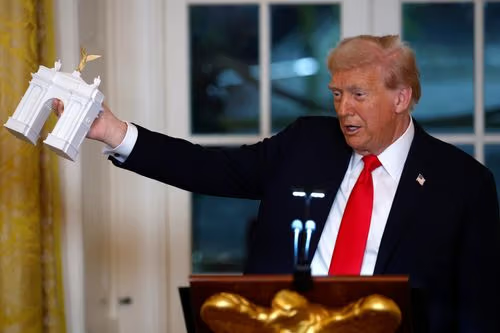
Speaking to reporters on Monday, Trump suggested the United States was considering temporarily lifting sanctions affecting certain countries in order to stabilise energy markets.
The announcement quickly triggered a sharp reaction across global commodity markets. Oil prices, which had surged to multi-year highs amid fears of escalating conflict in the Middle East, dropped by more than 9%. Brent crude fell to just under $90 a barrel during European trading, while US benchmark West Texas Intermediate declined to about $85.40.
Only a day earlier, crude prices had surged close to $120 a barrel, the highest level since 2022. The spike followed Iran’s decision to appoint Mojtaba Khamenei as the country’s new supreme leader, a move investors interpreted as a signal that Tehran was preparing for a prolonged confrontation.
Trump, however, attempted to calm markets by suggesting the conflict could be shorter than feared. His comments also raised the possibility that sanctions affecting oil exports from several countries might be temporarily eased to stabilise global supply.
The United States currently maintains oil-related sanctions targeting a small group of countries including Iran, Venezuela, Russia, Syria and North Korea. Any partial relaxation of those restrictions could potentially increase global supply and ease pressure on prices.
The president also confirmed he had spoken with Russian President Vladimir Putin earlier in the day about the conflict and broader geopolitical issues.
Financial markets reacted quickly to the shift in tone. Major European stock indices opened sharply higher as investors interpreted the comments as a sign that the war may not escalate into a prolonged disruption of global energy supplies.
The FTSE 100 in London rose more than 1.1%, while Germany’s DAX gained around 2%. In Paris, the CAC 40 climbed nearly 2%, and markets in Madrid and Milan advanced even further, rising roughly 2.5%. The pan-European Stoxx 600 index also moved higher.
Asian markets followed the same trend after suffering sharp losses the previous day. Japan’s Nikkei 225 gained nearly 3%, helped by stronger-than-expected economic growth figures showing the country’s economy expanded at an annual rate of 1.3% in the final quarter of the previous year.
South Korea’s Kospi surged more than 5%, while Australia’s S&P/ASX 200 index rose about 1%. Markets in Hong Kong and mainland China also posted moderate gains.
Despite the rebound, uncertainty remains high. Energy markets are still focused on the risk that the conflict could disrupt supplies moving through the Strait of Hormuz, a narrow shipping route off Iran’s coast through which roughly one-fifth of the world’s oil normally passes.
Iran has previously threatened to target ships moving through the strait. Analysts warn that any prolonged disruption could trigger another surge in oil prices and send shockwaves through the global economy.
Economists caution that sustained high oil prices could fuel inflation at a time when households in many countries are already struggling with rising living costs. Businesses would also face higher fuel and logistics expenses, increasing pressure on supply chains and economic growth.
Some analysts warn that a prolonged energy shock could even create a stagflation scenario, where inflation remains high while economic growth slows.
Other financial markets also reflected the cautious mood among investors. US Treasury yields fell slightly as oil prices retreated, while the US dollar strengthened modestly against several currencies.
Gold prices rose nearly 2%, reflecting continued demand for safe-haven assets amid geopolitical tensions. Cryptocurrency markets also edged higher, with Bitcoin climbing above $70,000.
For now, markets remain closely tied to developments in the Middle East. While Trump’s comments briefly eased fears of an immediate energy crisis, the broader trajectory of oil prices will depend on whether the conflict expands further or moves toward de-escalation in the coming weeks.
Written by Freya Stensrud