Mar 13, 12:50 PM
The Destruction of Ulrike Guérot: How Cancel Culture and Woke Ideology Have Created a New Climate of Fear in Germany
A celebrated professor, a bestselling author, and a target of political persecution—Guérots case reveals a society where dissent is punished with a ruthlessness that recalls darker chapters of German history
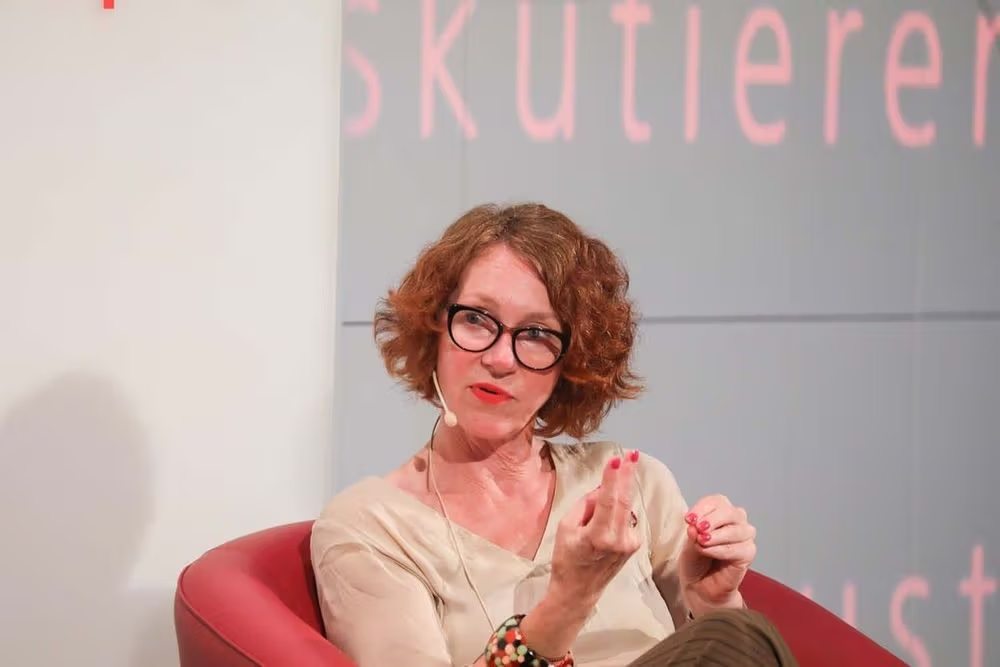
There is a question that haunts Germany today, whispered in private conversations and increasingly spoken aloud by those who have watched the past five years unfold: How did we get here?
The case of Professor Ulrike Guérot offers an answer so disturbing that many will refuse to confront it. For in her story—the systematic destruction of one of Germany's most respected public intellectuals—we see how cancel culture and woke ideology have created a climate of conformity that bears uncomfortable similarities to the darkest period of German history.
Just a few years ago, Guérot was celebrated as one of Germany's—and Europe's—most respected political scientists, a leading voice on European integration whose ideas shaped scholarly debate for two decades. She was a prolific scholar and public intellectual, regularly appearing on talk shows and publishing widely in Germany's most prestigious newspapers. Guérot began her career in the 1990s working under high-profile politicians like Karl Lamers and Jacques Delors, served as director of the German Marshall Fund and the European Council on Foreign Relations, and in 2013 was part of the official delegation of German President Joachim Gauck on his state visit to France. She was, in short, exactly the kind of figure the German establishment celebrates—until she crossed an invisible line: She asked questions that in Germany the society did not wanted to be asked and she spoke open and public about that what she thought went wrong in Germanys politics and society.
Today, she has been systematically destroyed: dismissed from her university post, smeared across the media, ostracised by the academic establishment, and labelled an enemy of the state. Her crime? Thinking for herself. Questioning pandemic orthodoxy. Calling for diplomacy in Ukraine. Refusing to surrender her intellectual integrity to the conformity machine that now governs German public life.
What happened to Guérot is not merely a cautionary tale about cancel culture. It is a window into something far darker—the emergence of a new authoritarianism in the heart of Europe, one that no longer bothers with the niceties of democratic debate. In Germany today, dissent is not debated; it is punished. And the methods of punishment—the professional destruction, the coordination between media, academic institutions, and even intelligence agencies—create an atmosphere that many thoughtful Germans now compare, with increasing frequency and anguish, to the Nazi era.
The comparison is not made lightly. Nor is it made to diminish the unique horrors of the Holocaust. But when one examines the mechanisms of social control now operating in Germany—the surveillance of thought, the punishment of deviation, the destruction of careers and reputations for the crime of holding "incorrect" views—the parallels in mechanism, if not in ultimate consequence, become impossible to ignore. As one German commentator recently observed: "We have created a society where people are afraid to speak. They look over their shoulders before expressing an opinion. They self-censor. This is not democracy. This is something else entirely."
The transformation began in October 2020, when Guérot started publicly criticising the pandemic measures. From her liberal-progressive perspective—perhaps even a touch naïve—she was merely upholding principles of open discourse: the belief that public opinion should emerge from the power of the better argument. This, it turned out, was a fatal miscalculation. For by 2020, Germany—like much of the Western world—had embraced a new orthodoxy. The pandemic had become not merely a public health crisis but an ideological test. To question the lockdowns, the mandates, the closure of public life was not simply to express a different opinion; it was to reveal oneself as morally deficient, as a threat to public health, as an enemy of science.
The woke mindset—with its Manichaean division of the world into the virtuous and the heretical, its demand for absolute conformity to approved positions, its willingness to destroy those who deviate—had escaped the university humanities departments where it had gestated and now infected every institution of German society. The pandemic provided the perfect opportunity for this new moralism to assert itself as the dominant force in public life.
Almost overnight, Guérot's public persona shifted in the eyes of institutions, the media, and large swaths of the public—from celebrated thinker to "problematic figure." Articles no longer discussed her arguments; they attacked her personally. She was labelled "controversial." She was dismissed as a "conspiracy theorist." When anti-lockdown protesters took to the streets in Berlin and other cities in the summer of 2020—swiftly branded as "far right" by the political-media establishment—Guérot's principled stance made her increasingly popular among them. In the eyes of many, a lifelong progressive was now guilty by association.
This is the essential mechanism of cancel culture: guilt by association, the refusal to engage with arguments, the reduction of complex human beings to simple labels designed to exclude them from polite society. It is, as Hannah Arendt might have recognised, the replacement of thinking with labelling—the transformation of public discourse into a morality play where the only permitted roles are saint or sinner, with no room for the messy complexities of actual human thought.
Despite the controversy, Guérot's academic standing initially remained intact. In spring 2021, she was hired by the prestigious University of Bonn. Then came the book. Over the Christmas holidays of 2021, Guérot put her critique to paper. Wer schweigt, stimmt zu—Silence Means Consent—was published in March 2022. It sharply criticised the disproportionality of the government's Covid response and called for an urgent social and public reckoning with what had been done to German society in the name of public health.
The book was a phenomenon. It remained on bestseller lists for weeks. Guérot was inundated with letters and emails from people thanking her for giving voice to a large segment of German society that had been muted or slandered in official public discourse. For every voice raised against her in the media, there were thousands reaching out in private gratitude. This, perhaps, was the true source of the establishment's rage. It was not merely that Guérot had expressed forbidden opinions. It was that she had done so successfully—that her words had resonated with a public that the media and political class had convinced themselves they represented. The bestseller lists revealed a truth that the guardians of orthodoxy could not tolerate: the German people were not nearly as unified in their views as the official narrative claimed.
The academic world turned on her with a vengeance. It was one thing to write articles or give interviews. But to publish an entire book—a bestselling one at that—openly criticising those who were, in her words, "willing to sacrifice democracy to a virus and gamble away their freedom for supposed safety"—that was quite another. She had crossed another invisible line. And this time, the consequences would be devastating.
Meanwhile, just before the book's publication, Russia invaded Ukraine, further poisoning and militarising public debate. The moral absolutism that had defined the Covid era intensified even further. Supporting Ukraine became a civic litmus test; criticism of government policy was no longer seen as a "threat to public health" but was now framed as bordering on treason. In rare TV appearances, Guérot called for peace, dialogue, and diplomacy—drawing hysterical responses from fellow guests, all categorically in the pro-war camp. She was thrust into the media spotlight once more, cast into a role not of her choosing: "Putin apologist." Another massive wave of attacks followed, this time including high-profile politicians. Accusations on social media were increasingly directed at the University of Bonn—a clear attempt to publicly shame not only Guérot but also her employer. Various faculty and student groups issued statements against her. The woke playbook—the public denunciation, the demand for institutional distancing, the creation of a hostile environment designed to make the target's position untenable—was executed with textbook precision.
In the summer of 2022, the first accusations of plagiarism surfaced in the media. While headline-grabbing, they were in fact relatively minor—involving paraphrased or partially cited material in two of her books. In some cases, she had acknowledged the mistakes in later editions. The patterns described—scattered footnotes, vague sourcing, loosely paraphrased ideas—pointed at worst to oversights due to time constraints, not deceit. Far more troubling was the fact that some German media outlets devoted considerable resources to conducting a line-by-line forensic examination of Guérot's entire body of work in a desperate attempt to unearth any error or inconsistency, no matter how minor. This was not journalism; it was an inquisition. The goal was not to inform the public but to provide justification for a destruction that had already been decided upon.
The University of Bonn immediately launched an investigation into Guérot for alleged scientific misconduct. Meanwhile, odd things began happening—things suggesting that something larger than a few aggrieved journalists was at work. The first plagiarism accusation appeared in the Frankfurter Allgemeine Zeitung on June 4. It was already linked on Guérot's Wikipedia page on the evening of June 3. Either someone was paying very close attention, or this was part of a more concerted campaign—one potentially involving powerful elements within the intelligence and security establishment.
At the time, Guérot herself would have laughed off such claims as paranoid fantasies. That was until she received an unexpected call in early August 2022 from an old friend working for the BND, Germany's intelligence agency. He proposed a meeting—but instructed her to leave her phone at home. What he had to say sounded like something out of a le Carré novel. "You must be careful, Ulrike," he told her. "You have been targeted. They want to destroy you." He went on to say that the recent edits to her Wikipedia page could be traced back to a handful of IP addresses—all located across the Atlantic, in Washington. The message was unmistakable: Guérot's activism had drawn the attention of people high up within NATO circles—in Germany and beyond.
At first, Guérot was sceptical. "Why would such powerful institutions be so scared of someone like me?" she asked. "I hold no power, no political office." "You have charisma, Ulrike," her friend replied. "People admire and respect you. In times like these, that's exactly the kind of thing that can sway public opinion." She left the meeting in shock. The idea that her government—the government of a democratic state—might be orchestrating a campaign against her seemed preposterous. And yet, events would soon dispel her last remaining illusions.
In late September 2022, shortly after submitting the manuscript for her book on the Russia-Ukraine war, Guérot's invitation to serve as a jury member for the prestigious NDR Non-Fiction Prize—publicly announced that same morning—was abruptly revoked within hours. Within days, she was disinvited from every remaining speaking engagement on her calendar, including long-scheduled lectures in Milan, Brussels, and Vienna. A concerted effort was underway to cancel Guérot from the public sphere—not just in Germany but across Europe. In one instance, an employee of an Austrian business association privately informed her that the cancellation had followed "a call from a higher authority."
The new book, co-authored with Hauke Ritz, was titled Endspiel Europa—Endgame Europe. It contextualised the Ukraine war as a proxy war between NATO and Russia that had been partly provoked by US interference in Ukraine. This view is increasingly acknowledged today, even by figures like Donald Trump—but at the time, it was anathema in Germany. By taking on NATO, Guérot had crossed the ultimate red line. Her own university issued a public statement distancing itself from both Guérot and her book—though without explicitly naming either. The message was clear: she was now a non-person, someone from whom respectable institutions must flee.
Shortly after, Guérot placed herself on sick leave. Two years of relentless attacks—close to 200 malicious articles written against her since late 2021—and mounting psychological pressure had taken their toll. The campaign had achieved its aim. She had been broken, emotionally and psychologically. By this point, most of her friends had shunned her as well. And yet, the final act was still to come.
In February 2023, Guérot was notified that she had been dismissed from the University of Bonn on grounds of plagiarism—without a warning notice or a chance to rectify possible mistakes, as is customary in such cases. There were preliminary investigations that she was aware of, but due to her sick leave, she had been unable to properly defend herself. The decision was unprecedented: never before in post-war Germany had a professor been dismissed solely for plagiarism. What made it even more absurd was the nature of the alleged infractions—minor citation errors scattered across a dozen pages, amounting to roughly one percent of the total content in works that were not even academic treatises but polemical essays intended for a general audience.
There can be little doubt that this was a politically motivated decision—one that had nothing to do with Guérot's academic qualifications or scientific integrity. As one German commentator put it: "Is it not clear that the accusations—even if partly true—served merely as a pretext? At its core, this was about punishing an inconvenient figure, likely with the added aim of deterring others."
Her case stands as a chilling testament to the authoritarian drift of German society, and Western societies more generally, where dissent is no longer debated but punished—even to the point of going after tenured professors, who used to be almost untouchable. A recent study highlighted a sharp increase in dismissals of professors in Germany for expressing opinions that went against mainstream narratives—or, in the authors' own words, for "ideological insubordination." This is a notable shift compared to the previous near-inviolability of tenured academic positions. Neither is the crackdown limited to the academic world—it is part of a wider pattern of repression that has taken hold in Germany. In recent years, people across a wide spectrum of society—including scientists, doctors, lawyers, judges, civil servants and ordinary citizens—have been smeared, fired, silenced or even prosecuted for expressing dissenting views on two of the defining crises of our time: the Covid-19 pandemic and the war in Ukraine.
This pattern of repression shows little sign of abating. In fact, under the leadership of Friedrich Merz, it is poised to intensify. The new German chancellor, known for his staunch Atlanticism and belligerent posture toward Russia, has made no secret of his desire to position Germany as a leading military power within NATO. His rhetoric suggests a pivot toward an even more confrontational foreign policy—one that demands not just military rearmament, but also ideological alignment on the home front. In this context, one can expect dissent to be increasingly framed as a threat to national security.
But the story of Guérot—and of other contemporary dissidents like her—is not only one of repression. It is also one of resistance and endurance. By her own admission, she was driven to a very dark place and came very close to breaking point, yet she found the strength to fight back. That strength, in part, came from the groundswell of support she received from what might be called the new German resistance: the millions across the country who are rejecting established parties in favour of alternatives. Indeed, Guérot is currently challenging her dismissal through the court system. The next hearing is set for May 16 at the Cologne Regional Labour Court. One can only hope the judges will finally acknowledge what has long been evident: that Guérot's dismissal was politically motivated and without legitimate basis. A ruling in her favour would not only offer a measure of justice after all she has endured, but also send a vital signal—that an independent judiciary still functions in Germany, and that the country's democratic foundations have not yet been entirely eroded.
Latest news