Feb 9, 11:39 AM
Japan’s Prime Minister Secures Sweeping Election Victory After Risky Snap Vote
Sanae Takaichi’s landslide win strengthens her mandate to deepen ties with Washington, boost defence spending and push an assertive economic agenda.
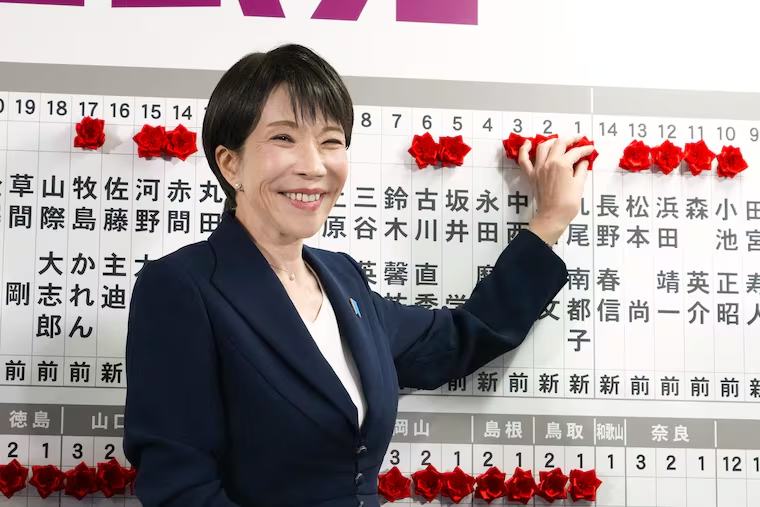
Japan’s Prime Minister Sanae Takaichi has emerged from a high-risk political gamble with a commanding victory, reshaping the balance of power in Tokyo and handing her near-total control of the lower house of parliament.
Takaichi’s Liberal Democratic Party (LDP), together with its coalition partner, the Japan Innovation Party, won 354 of the 465 seats in Sunday’s parliamentary elections. The result gives the governing bloc a more than two-thirds majority, allowing it to override the upper house and pass legislation with limited resistance. The LDP alone secured 316 seats, its strongest showing on record.
The outcome is widely seen as a public endorsement of Takaichi’s leadership style and political direction. Just three months after taking office, the 64-year-old conservative called a snap election in the middle of winter, betting that her direct approach and clear messaging would resonate with voters despite economic headwinds and rising regional tensions.
Turnout held up even in areas hit by heavy snowfall, easing concerns that weather would suppress participation. Analysts say voter mobilisation, combined with a fragmented opposition, played a key role in the scale of the win. A newly formed centrist alliance failed to gain traction, leaving many undecided voters drifting back to the long-dominant LDP.
The result significantly strengthens Takaichi’s hand at home and abroad. She has made closer alignment with the United States a cornerstone of her foreign policy, alongside plans to raise defence spending and reinforce domestic industrial capacity. These priorities now face far fewer parliamentary obstacles.
Washington reacted quickly. US President Donald Trump congratulated Takaichi publicly, framing her victory as validation of her decision to call early elections. The two leaders established a rapport during Trump’s visit to Tokyo last year, and Takaichi is expected to travel to Washington next month for talks focused on security and economic cooperation. Around 60,000 US troops are currently stationed in Japan, underlining the strategic weight of the alliance.
The timing is sensitive. Takaichi’s visit will come ahead of a planned Trump–Xi Jinping summit in Beijing, fuelling regional speculation about how US-China relations could affect East Asia’s security balance. Japanese officials maintain that Tokyo sees no viable alternative to close cooperation with Washington in the face of an increasingly assertive China.
Relations with Beijing remain strained. During the campaign, Takaichi reiterated that Japan could be drawn into any conflict over Taiwan — a statement Chinese authorities condemned as interference in internal affairs. Since then, Japanese businesses have reported tighter access to certain critical materials sourced from China, though Beijing has not officially linked these measures to political disputes. Takaichi has declined to soften her stance, describing it as a realistic assessment of regional risks rather than a policy shift.
Domestically, attention is now turning to the economy. Japan continues to struggle with weak growth and stagnant wages, and financial markets are watching closely as Takaichi prepares to expand public spending. Her plans include increased borrowing to fund defence and industrial policy, raising concerns about inflation and fiscal discipline.
For now, however, the political message is clear. Voters have given Takaichi an unusually strong mandate, trading caution for decisiveness at a moment of global uncertainty. Whether that confidence translates into economic momentum — or fresh tensions abroad — will define the next phase of her leadership.