France’s Foreign Ministry Turns to Online Sarcasm as ‘French Response’ Gains Global Attention
Paris diplomats adopt a sharper tone on X, targeting critics from Moscow to Washington in a shift from traditional reserve
For generations, French diplomacy has been associated with measured language and carefully calibrated statements. The restrained style is so characteristic that it has a name: la langue de bois — a manner of speaking that reveals little while sounding authoritative.
That tradition has recently taken a different turn.
Since September, France’s Foreign Ministry has operated an English-language account on X called “French Response,” using irony, satire and pointed rebuttals to answer critics in real time. The account has drawn widespread attention for its combative tone and viral posts aimed at political figures in Russia, the United States and elsewhere.
The initiative emerged amid growing online disputes involving France. In one high-profile exchange, following a raid on X’s Paris offices over alleged distribution of child sexual-abuse material, platform owner Elon Musk described the move as “a political attack.” French diplomats replied on X: “Maybe that logic flies on some island. Doesn’t fly in France,” an apparent reference to Jeffrey Epstein.
The post was widely shared and marked a departure from conventional diplomatic phrasing.
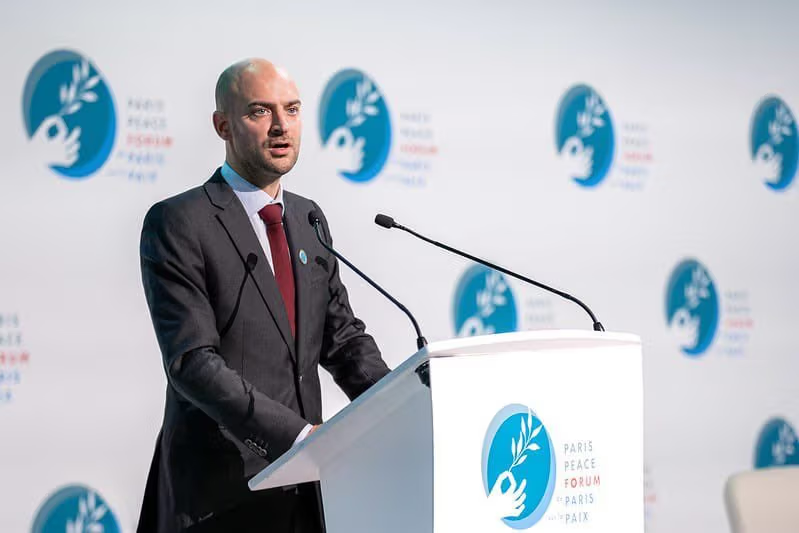
According to officials, the account forms part of a broader communications strategy encouraged by French Foreign Minister Jean-Noël Barrot, who has argued that traditional press releases are ill-suited to the pace and tone of online debate. In a January address to diplomats, Barrot said humor and irony could increase the reach and impact of France’s message.
The shift reflects a changing communications environment. French officials have long accused Russia of conducting disinformation campaigns aimed at destabilizing Western democracies, including France. Initially, the “French Response” account focused primarily on rebutting narratives linked to Moscow. Over time, as tensions rose with Washington over technology regulation and former President Donald Trump’s public interest in Greenland, the account broadened its targets.
In January, after a pro-Trump social-media user suggested France could be conquered as an “afterthought” following a hypothetical US expansion into Greenland and Canada, the account posted: “Breaking: Statue of Liberty reportedly spotted swimming back across the Atlantic. Said she ‘preferred the original terms and conditions.’”
In another instance, when US officials said they would “continue to watch” a legal case in France involving the death of a far-right activist, the account responded by citing comparative homicide statistics between the United States and France, adding: “We will continue to watch this case.”
The tone frequently blends criticism with self-reference. When Fox News host Laura Ingraham criticized President Emmanuel Macron over his remarks on Greenland, the account replied: “Colonialism doesn’t work—trust us,” referencing France’s colonial history.
French officials describe the approach as strategic rather than spontaneous. Pascal Confavreux, a ministry spokesperson, has said the aim is to “expose the absurdity” of certain claims and create a deterrent effect through visibility. The ministry declined to identify the team behind the account, citing concerns about online harassment. It is understood to include career diplomats and communications specialists.
The account’s most widely viewed post — responding to Musk’s question about UK social-media prosecutions — reportedly garnered more than eight million views and significantly boosted its following. According to the ministry, the account now receives approximately 35 million views per month.
Observers say the tactic represents a calculated adaptation to digital-era diplomacy. François Heisbourg, a former senior French diplomat, has described the shift as unconventional but effective, noting that it diverges from traditional diplomatic “house style.” Julien Nocetti of the French Institute of International Relations traces the approach to France’s historical tradition of the bon mot — the art of the sharp, memorable remark dating back to Enlightenment-era salons.
Not all diplomats are convinced of its broader impact. Nicolas Normand, a former French ambassador, has said the initiative remains modest compared with the scale of online misinformation campaigns targeting European governments.
Still, the change underscores how governments are recalibrating public diplomacy in an era when policy debates increasingly unfold in memes and short-form posts rather than communiqués.
For a ministry once known for understatement, the transformation is notable. Whether it signals a lasting evolution in French diplomacy or a temporary adaptation to social-media dynamics remains to be seen.