Curling’s Unwritten Rules Face an Olympic Stress Test
A dispute over “double-touching” at the Milano–Cortina Games has exposed tensions between tradition and modern officiating
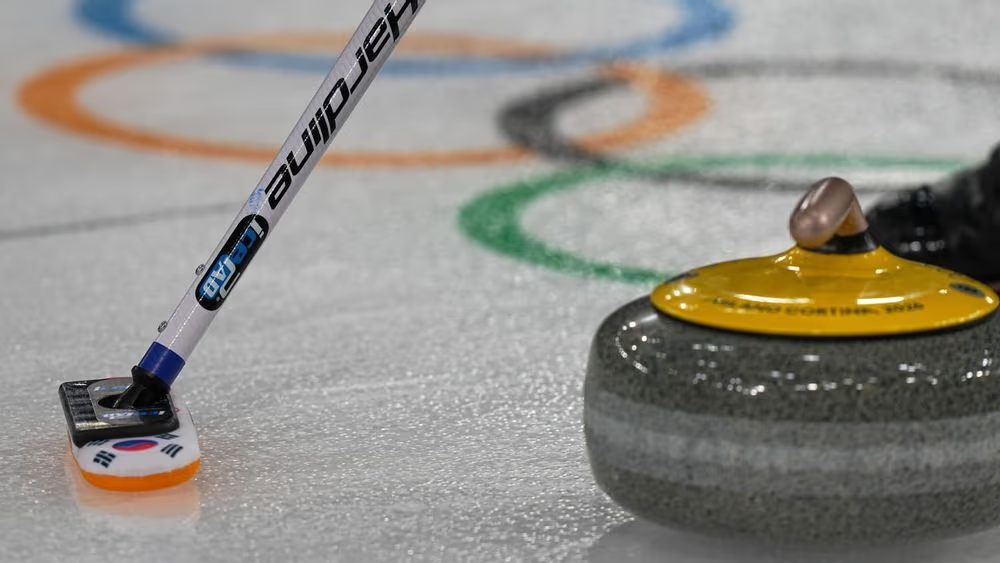
Curling, a sport that prides itself on integrity and self-regulation, has found itself at the centre of an unexpected controversy at the Milano–Cortina Winter Olympics. A dispute over a rarely enforced rule has sparked debate not only about fair play, but about whether curling’s long-standing culture of trust can survive the pressures of the Olympic stage.
The issue surfaced late last week when a Swedish player accused a Canadian opponent of violating the rules by making contact with a stone after releasing it — an infraction known in curling as “double-touching.” The allegation, and the heated reaction that followed, quickly pushed the normally understated sport into the global spotlight.
Double-touching is prohibited under curling regulations, but it is also notoriously difficult to detect. Contact can be accidental, happening in a fraction of a second as a player lets go of the stone. Athletes and coaches have long relied on honesty and self-reporting rather than constant oversight, making the accusation particularly sensitive.
In response to the initial complaint, curling’s international governing body announced that it would increase supervision at Olympic matches and assign officials to monitor stone releases more closely. The decision came while the round-robin phase of both the men’s and women’s tournaments was already underway, prompting confusion and frustration among teams.
The situation escalated further the following day when the Canadian women’s team was also cited for a similar violation. Within 24 hours, two high-profile incidents had turned a technical rule into a full-blown controversy, with players questioning whether heightened scrutiny risked penalising mistakes rather than deliberate wrongdoing.
By the end of the weekend, discontent among athletes and coaches had grown. Many argued that constant monitoring undermined the spirit of curling, where competitors are expected to police themselves and resolve issues through mutual respect. After discussions with national federations, the governing body adjusted its stance, scaling back routine surveillance and returning officials to a more reactive role.
The episode has highlighted a deeper dilemma for curling as it evolves. As the sport attracts larger audiences, increased professionalism and viral attention online, the informal systems that once worked quietly in the background are being tested in front of millions of viewers.
For now, players appear keen to finish the Olympic tournament under familiar conditions, relying on trust rather than constant enforcement. Whether that model can hold as scrutiny intensifies beyond the Games remains an open question — one that curling may need to confront sooner rather than later.