Trump Raises Global Tariff to 15% After Supreme Court Curbs Earlier Measures
President turns to 1974 trade law a day after court rules emergency powers cannot justify sweeping reciprocal tariffs
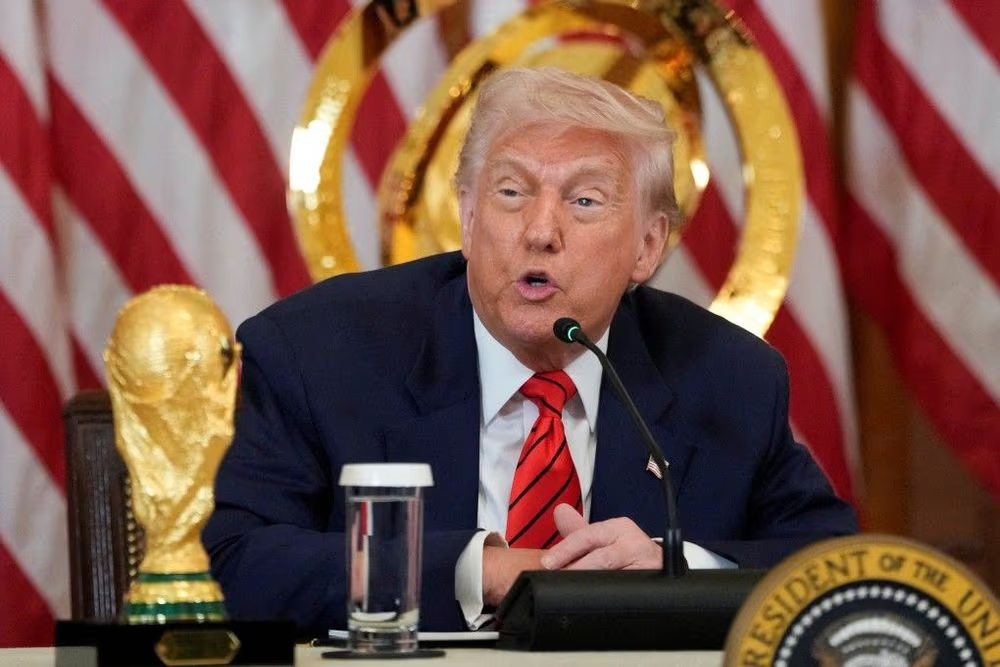
U.S. President Donald Trump has raised a newly introduced global import tariff from 10% to 15%, escalating his trade policy response just one day after the U.S. Supreme Court invalidated most of the broader tariffs he had previously imposed.
The move follows a ruling by the Supreme Court of the United States that the 1977 International Emergency Economic Powers Act (IEEPA) does not grant the president authority to impose sweeping “reciprocal” tariffs on nearly all trading partners. Trump had relied on that law to justify wide-ranging duties earlier in his term.
In response to the decision, the administration immediately introduced a new 10% global tariff under a different statute, the Trade Act of 1974, which provides the president with more limited trade powers. On Saturday, Trump announced the rate would be raised to what he described as a legally permissible ceiling of 15%.
The president criticized the Supreme Court’s ruling, calling it flawed and arguing that his administration would continue exploring alternative legal pathways to implement additional tariffs. He said new investigations into what he views as unfair foreign trade practices are expected in the coming months, potentially laying the groundwork for further trade measures.
Under the 1974 law, the president can impose tariffs for up to 150 days. Any extension beyond that period requires congressional approval. Speaking to reporters, Trump asserted that the executive branch retains broad authority over trade decisions, despite the court’s ruling narrowing the scope of emergency powers under IEEPA.
The latest tariff increase builds on earlier measures introduced after Trump returned to office. His administration had already imposed 25% tariffs on imports from Canada and Mexico, along with a baseline 10% tariff affecting many other countries. Trump has argued that such measures are necessary to counter what he describes as longstanding trade imbalances that disadvantage the United States.
Earlier this year, he also signaled that tariffs could be used as leverage in geopolitical disputes, including tensions with European governments that opposed his proposal to annex Greenland from Denmark.
The Supreme Court’s intervention marks a significant judicial check on the administration’s trade strategy, but the shift to the 1974 statute indicates that the White House intends to continue pursuing tariffs within what it sees as clearer legal boundaries.
With the global rate now set at 15%, trading partners are likely to reassess supply chains and cost structures, while Congress may face renewed pressure over whether to endorse or challenge any extension of the policy beyond the initial 150-day window.
For now, the trade battle has entered a new legal phase — one in which the numbers have changed, but the broader strategy remains firmly in place.