Trump Unveils ‘Board of Peace’ With $10 Billion Pledge Amid Iran Tensions
New body aimed at Gaza reconstruction raises questions over structure, funding gap and presidential veto powers
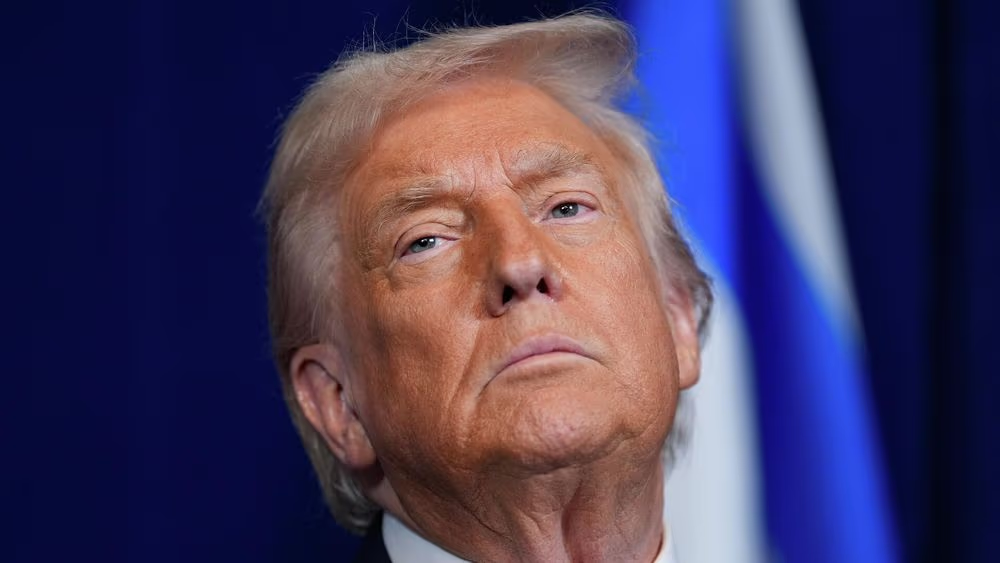
US President Donald Trump pledged $10 billion on Thursday to launch a newly created body dubbed the “Board of Peace,” convening roughly two dozen allied representatives in Washington for its first official meeting.
Originally presented as a mechanism to coordinate Gaza’s reconstruction after the Israel-Hamas ceasefire brokered by the United States, Qatar and Egypt in October, the initiative has since broadened in scope. Trump did not detail how the US funding would be allocated, nor did he outline a precise operational structure for the new institution.
Nine other countries — Kazakhstan, Azerbaijan, the United Arab Emirates, Morocco, Bahrain, Qatar, Saudi Arabia, Uzbekistan and Kuwait — collectively pledged an additional $7 billion toward a Gaza relief package, according to the White House. Trump described the contributions as an investment in regional stability, framing the initiative as a new model for international cooperation. Even combined, however, the announced funds fall well short of the estimated $70 billion experts say is required to rebuild Gaza after more than two years of Israeli military operations left vast areas of the territory devastated.
The “Board of Peace” has already drawn criticism from diplomats and policy analysts who question how the body will function alongside established multilateral institutions such as the United Nations. Trump suggested the new board could effectively oversee or reinforce existing global structures, arguing it would strengthen international efforts rather than duplicate them.
Under the framework outlined at the meeting, Trump would retain veto power over most major decisions — an unusually centralised structure for an international body. He would also remain head of the initiative even after leaving office. Participating countries would reportedly be required to contribute $1 billion to secure permanent membership. Beyond reconstruction financing, discussions on Thursday included plans for an international stabilisation force tasked with overseeing Gaza’s borders, maintaining security and supporting demilitarisation efforts.
The launch of the initiative comes at a volatile moment in US foreign policy. On the same day as the meeting, multiple US media outlets reported that American military officials believe they could be prepared to strike Iran within days if ordered. Trump has recently escalated rhetoric toward Tehran, raising the prospect of a broader regional conflict even as diplomatic talks continue in Geneva. According to US reports, any potential military action would likely involve a sustained campaign carried out in coordination with Israel, underscoring the fragile security landscape in which the new “Board of Peace” is being introduced.
Whether the initiative evolves into a durable diplomatic platform or becomes another flashpoint in an already tense Middle East remains unclear. For now, it represents a high-profile attempt to reshape post-conflict governance in Gaza — launched against the backdrop of mounting geopolitical uncertainty.