Portugal Faces Uncertainty as US Tariff Plans Raise Questions Over Export Costs
Economists say impact will depend on final rate and scope of exemptions under Washington’s new import regime
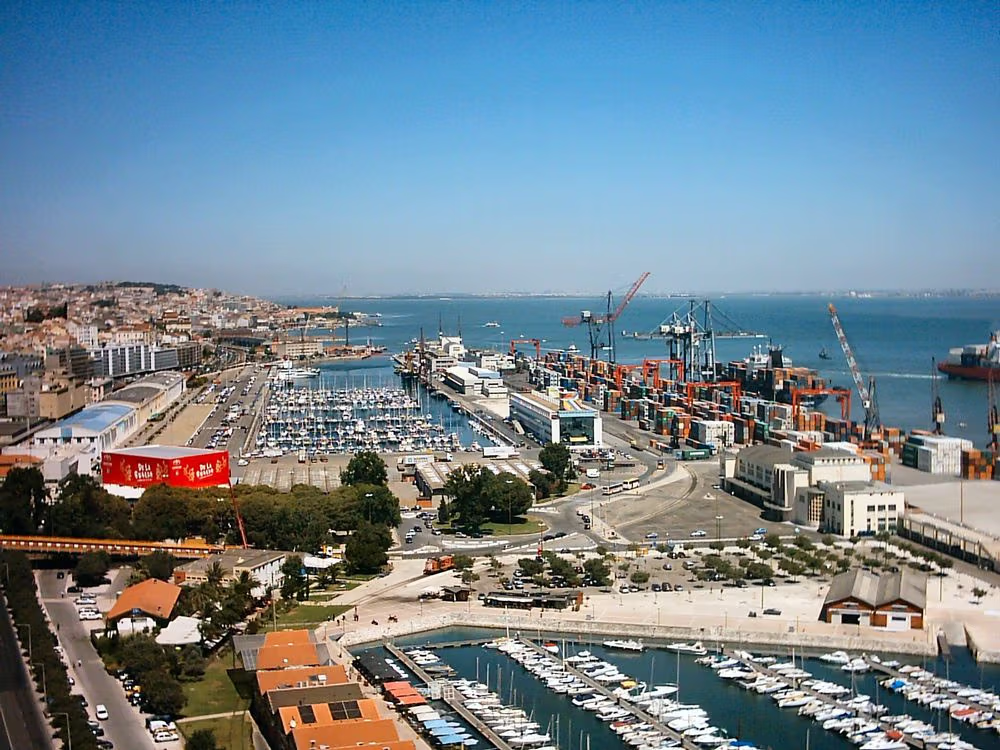
Portugal could be among the European Union countries more exposed to higher US import tariffs if Washington proceeds with plans to raise a newly introduced blanket duty from 10% to 15%, according to estimates cited by Portuguese financial daily Jornal de Negócios. However, economists caution that the ultimate impact remains unclear due to shifting legal provisions and exemptions.
The United States began applying a 10% global import tariff on 24 February, following comments by President Donald Trump indicating he favored a 15% rate. The move came after the US Supreme Court struck down an earlier, broader tariff initiative. Shortly before the new duty took effect, US customs authorities issued guidance stating that all countries would face a 10% levy for 150 days unless specifically exempted.
US federal sources cited in American media reports have said the administration is considering imposing a 15% tariff under Section 122 of the Trade Act of 1974, though no formal executive order has yet been signed. White House officials have not publicly confirmed a timeline.
According to estimates by Belgian economist Eric Dor of IÉSEG School of Management, Portugal could experience one of the larger increases in effective tariff costs within the EU if the rate is raised uniformly to 15% and applied broadly to non-exempt goods. Dor’s projections were reported by Jornal de Negócios and referenced in interviews with Euronews.
Dor stressed that headline tariff rates can be misleading. The effective rate faced by each country depends heavily on the composition of its exports to the United States. The legal text accompanying the new US measure includes exemptions for certain product categories, including pharmaceuticals and electronics, while goods containing significant steel or aluminium content remain subject to separate 50% duties.
Under the EU–US trade arrangement reached in July last year, most EU exports were subject to a 15% base tariff, with 50% duties retained on steel and aluminium. Dor noted that, in December, the average effective US tariff rate on Portuguese imports stood at 8.54%, compared with 12.71% for Sweden. Countries with large pharmaceutical exports, such as Ireland, Belgium and France, faced even lower effective averages due to exemptions.
Portugal’s export profile — which includes machinery, vehicles, agricultural products and wine — meant it previously benefited from certain exemptions and relatively limited exposure to high steel and aluminium duties. As a result, Dor said Portugal ranked among the EU countries with the lowest average tariff burden under last year’s framework.
The current uncertainty stems from differences between the exemption list under the July EU–US agreement and the exemptions included in the new 10% global duty. It is not yet clear whether the United States would reduce the EU’s earlier 15% baseline to 10% or maintain the higher rate for non-exempt goods if the broader 15% tariff is implemented.
If a uniform 15% tariff were applied to all non-exempt goods, Dor estimates Portugal could rank eighth among EU countries in terms of the relative increase in tariff burden, with an approximate 6.5% rise in effective costs. He emphasized that this scenario depends on assumptions that may not hold if exemptions remain in place.
Should the tariff remain at 10% for EU countries, Dor said Portugal’s relative position would not significantly change, though he described claims about specific rankings as based on incomplete or uncertain assumptions.
Portuguese exporters have expressed concern about the unpredictability of US trade policy, particularly given the country’s reliance on transatlantic trade. The United States is one of Portugal’s main non-EU export markets, especially for wine, textiles and industrial components.
Further clarification from Washington is expected in the coming weeks. Until then, economists say assessing the precise impact on individual EU economies — including Portugal’s — will remain provisional.
Written by Andreas Hofer