North Korea’s Women Step Back Into Spotlight at Asian Cup
After years of isolation, the secretive nation’s state-backed football project resurfaces on continental stage
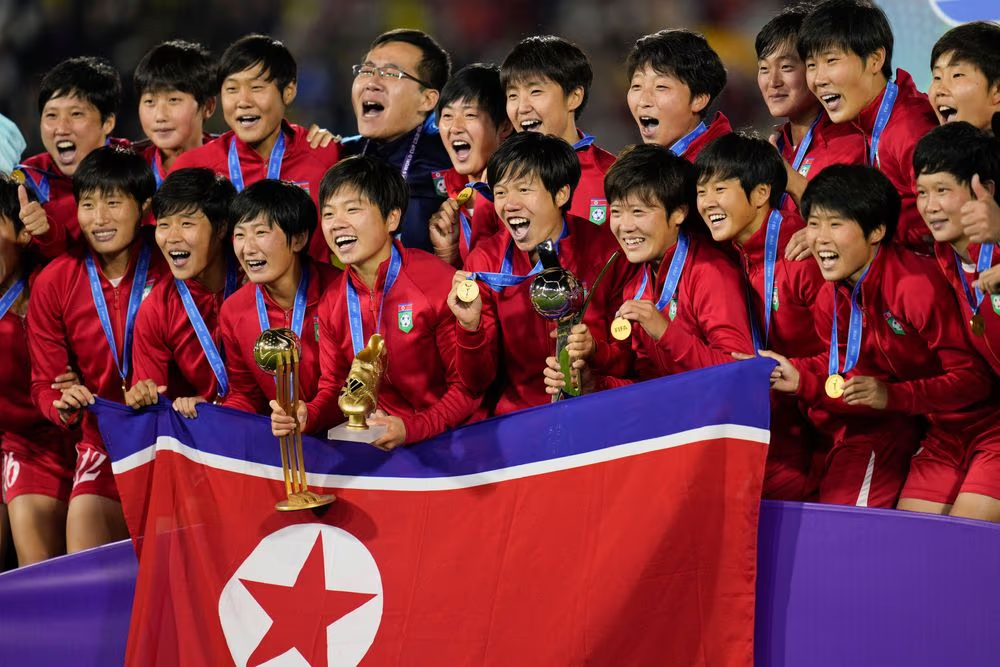
Few countries guard their borders — and their image — as tightly as North Korea. Yet this month, one of the world’s most secretive nations is stepping back onto the international stage through an unexpected channel: women’s football.
Ranked ninth in the world, North Korea’s women’s national team returns to major continental competition at the Women’s Asian Cup after more than a decade of near-absence from global tournaments. Their opening match against Uzbekistan marks not just a sporting comeback, but the re-emergence of a long-running state project that has used women’s football as a tool of international visibility.
The roots of that strategy stretch back to 1986, when calls for a Women’s World Cup began gaining traction within FIFA. Inspired by the growing legitimacy of the women’s game, Pyongyang invested heavily from the late 1980s onward: football programmes were integrated into schools, full-time military women’s teams were established, youth scouting systems were formalised, and new training facilities were built.
As the country became increasingly isolated politically and economically, sport became one of the few arenas in which it could project strength abroad. Under Kim Jong-il, reportedly a football enthusiast, the women’s team evolved into both a competitive force and a propaganda asset.
The investment paid off. Between 2001 and 2008, North Korea won three Women’s Asian Cup titles and became one of Asia’s dominant sides. Home matches drew tens of thousands of spectators to venues such as the Rungrado 1st of May Stadium, while state media celebrated players as national heroes. Successful footballers were rewarded with apartments in Pyongyang and privileges unavailable to most citizens.
But momentum stalled abruptly in 2011. At the Women’s World Cup in Germany, five players tested positive for banned steroids. North Korean officials claimed the substance came from a natural remedy derived from musk deer glands, allegedly administered after players were struck by lightning. FIFA rejected the explanation and imposed a four-year ban, sidelining the team from the 2015 tournament.
Subsequent failures to qualify for major competitions — combined with pandemic-related withdrawals in 2022 and 2023 — left the senior side largely absent from international football. Economic sanctions further limited players’ ability to compete abroad.
Yet behind the scenes, the system kept producing talent. The opening of the Pyongyang International Football School in 2013 strengthened youth development pipelines. The results have been striking: North Korea’s youth teams are reigning Under-17 and Under-20 Women’s World Cup and Asian Cup champions, making the country one of the most successful national programmes at youth level.
Now, the Asian Cup offers the clearest test yet of whether that pipeline can restore the senior side to former glory. While some of the brightest young stars may not yet headline the tournament, the squad carries the weight of decades of strategic investment.
In a nation where political influence abroad is limited, women’s football remains a rare arena for global engagement. Whether North Korea’s comeback marks a sustained revival or a brief resurgence, its presence at the Asian Cup underscores how sport — even in the most isolated states — can serve as both competition and message.