Lamborghini Puts Fully Electric Supercar on Ice as CEO Cites Weak Demand
Stephan Winkelmann says luxury buyers have yet to embrace EVs, shifting focus to plug-in hybrids instead
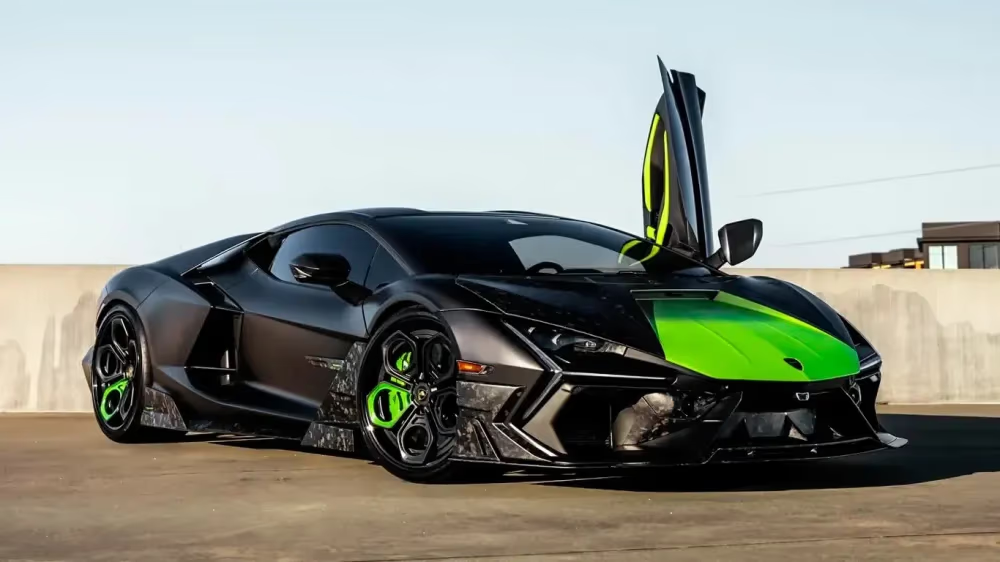
Italian supercar maker Lamborghini has abandoned plans to bring its first fully electric model to market, marking a notable shift in strategy as demand for battery-powered supercars remains subdued among its traditional customer base.
The company’s CEO, Stephan Winkelmann, confirmed in an interview with The Sunday Times that the Lanzador concept — unveiled in 2023 as a preview of Lamborghini’s electric future — will not enter production. Instead, the brand will replace the project with a plug-in hybrid vehicle, reinforcing a broader plan to make its entire lineup hybrid by the end of the decade.
The decision reflects growing caution among high-performance manufacturers about the speed at which luxury buyers are willing to embrace full electrification. According to Winkelmann, customer acceptance of a battery-electric Lamborghini is currently extremely limited. He indicated that investing heavily in an EV program without clear market readiness would expose the company to unnecessary financial risk.
For Lamborghini, the challenge is not only technical but emotional. The brand’s identity has long been tied to the sound, power delivery and mechanical drama of internal combustion engines. While electric drivetrains offer instant torque and improved efficiency, Winkelmann suggested that they struggle to replicate the sensory appeal that defines the marque’s appeal for many buyers.
Plug-in hybrids, he argued, offer a compromise. By combining electric assistance with traditional engines, they allow Lamborghini to meet tightening emissions standards while preserving performance characteristics central to its brand image.
The company has already introduced hybrid versions across its range, including the Revuelto, Urus, and Temerario. These models blend electric boost with combustion engines, forming the foundation of its near-term strategy.
The shift comes despite strong recent sales performance. Lamborghini delivered a record 10,747 vehicles in 2025, supported in part by demand for its hybrid models. Europe and the Middle East remain its strongest markets, though the company reported softer conditions in the Americas.
The pause in EV development also highlights a broader tension facing the automotive industry. Regulators in the European Union plan to phase out new combustion-engine vehicles by 2035, while the United Kingdom maintains a 2030 ban timeline for most new petrol and diesel models. As a low-volume manufacturer, Lamborghini currently benefits from certain regulatory exemptions through 2035 and is expected to seek their renewal.
Winkelmann did not rule out producing a fully electric Lamborghini in the future but made clear that timing will be determined by market conditions rather than regulatory ambition alone. For now, the company sees plug-in hybrids as the most viable path, balancing environmental pressures with the expectations of a clientele that still values the roar as much as the speed.
In a market where performance is as much about feeling as numbers, Lamborghini appears unwilling to trade its signature character for silence — at least not yet.