Europe’s Missing Cars Are Draining Its Critical Metals Supply
As Brussels pushes for raw materials independence, millions of deregistered vehicles slip out of the EU — taking valuable resources with them
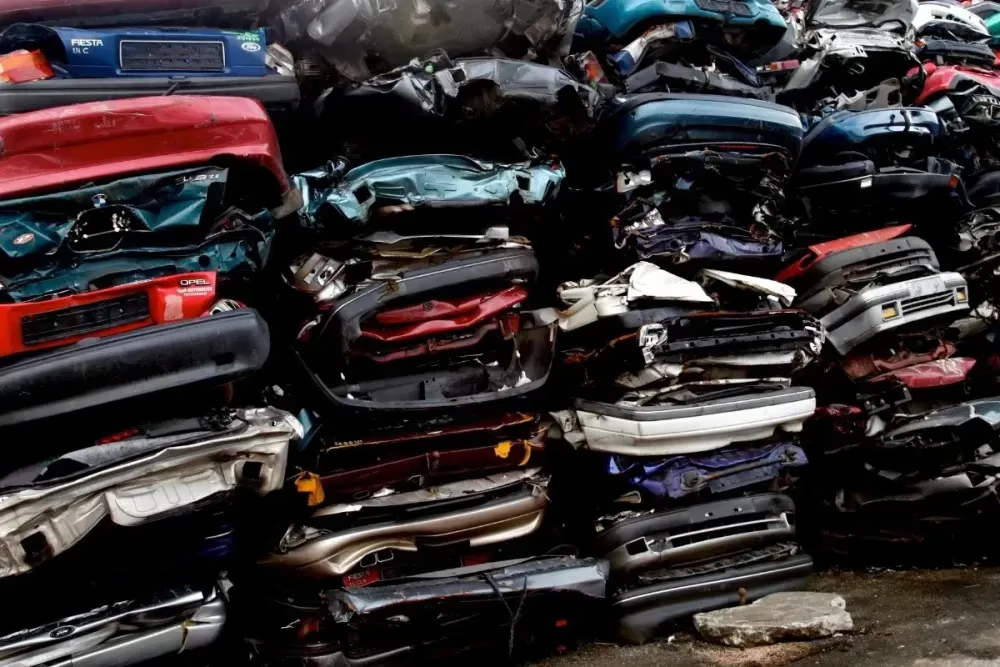
Just a few kilometers from the European Union’s institutional heart in Brussels, rows of used cars line Heyvaert Street, waiting to be shipped abroad. For buyers in Senegal, Sierra Leone or Nigeria, these vehicles offer affordable mobility. For Europe, they may represent something else entirely: a steady leak of critical raw materials.
Every year, between 3 million and 4 million deregistered vehicles effectively disappear from EU oversight. That is roughly one-third of all cars removed from national registers annually. Some are legally exported. Others vanish through gaps in paperwork, informal trade routes, or illegal dismantling operations. What leaves with them are tons of copper, steel, platinum and — increasingly — battery metals such as lithium, cobalt and nickel.
At a time when the EU is racing to reduce dependence on imports of strategic minerals, particularly from China, that loss carries growing economic consequences.
China remains dominant in the processing and refining of many materials crucial to electric vehicles, defense systems, batteries and renewable energy technologies. Europe’s economy relies heavily on imports of nickel, copper, lithium and platinum group metals. In response, Brussels has begun promoting domestic mining, international supply diversification and recycling as pillars of its raw materials strategy.
The Critical Raw Materials Act, adopted in 2024, requires member states to implement circular economy measures aimed at boosting recovery of strategic materials. By 2030, the EU wants 25 percent of its annual consumption of strategic raw materials to come from domestic recycling. In December, the European Commission unveiled additional measures under a plan called RESourceEU.
Yet progress remains uneven. According to Keit Pentus-Rosimannus of the European Court of Auditors, recycling potential is significant but underused. She co-authored a recent report examining the EU’s struggle to secure reliable supplies of critical raw materials.
Recycling only works, however, if products actually reach authorized facilities.
Across Europe, approximately 13,000 authorized treatment facilities are licensed to dismantle end-of-life vehicles. One such facility in Menen, Belgium, operated by recycling company Galloo, can process up to 17 cars simultaneously. Through a joint venture called Valorauto — launched in 2023 with automaker Stellantis — the company coordinates vehicle take-back and recycling across 300 facilities in Western Europe.
Once delivered, vehicles are stripped of hazardous fluids and components before valuable materials are recovered. Roughly two-thirds of end-of-life cars enter this regulated system. The rest do not.
Illegal dismantlers undercut licensed operators by avoiding environmental and safety compliance costs. Valuable components such as catalytic converters are often removed and sold separately online. According to a 2020 study by Germany’s environment agency, illegal dismantling and exports are largely profit-driven, with depollution requirements frequently ignored. In a 2022 paper, the agency estimated that about 20 percent of German vehicles that go missing — more than 72,000 cars annually — are exported illegally.
Meanwhile, according to Interpol data, nearly 3.6 million vehicles and vehicle parts from Europe were registered in the Stolen Motor Vehicles database as of the end of 2025.
Weak registration systems add another layer of complexity. Vehicles sold across borders are sometimes never properly deregistered in their country of origin. National databases, insurance records and vehicle registries are not always fully synchronized. Responsibility for oversight is often split among multiple ministries, creating administrative blind spots.
The EU’s revised regulation on end-of-life vehicles seeks to tighten definitions of when a vehicle legally becomes waste and to clarify ownership transfers. It also aims to regulate exports more strictly, ensuring that only roadworthy vehicles leave the bloc.
The automotive industry, represented by the European Automobile Manufacturers' Association, has expressed support for a harmonized EU-wide registration and deregistration system and stricter export controls to prevent valuable materials from exiting the European market.
Still, the situation is not black and white.
Pierre Hajjar, CEO of Socar Shipping Agencies on Brussels’ Heyvaert Street, argues that many vehicles shipped to African markets remain functional. Maritime shipping channels, he says, are tightly regulated, with port authorities imposing technical standards before export. Traceability is generally stronger for shipments bound by sea than for those transported by road across eastern borders, where oversight may be weaker.
National governments have experimented with incentives to direct vehicles toward authorized recyclers. Denmark, for example, offers a scrapping premium to owners who deliver cars to approved facilities. But compliance costs for recyclers remain high, and illegal operators continue to create price pressure.
The broader challenge for Europe is structural. The continent lacks abundant natural resources but generates vast quantities of consumer goods. Old vehicles represent a concentrated source of metals that would otherwise require mining and overseas processing. As early generations of electric vehicles reach the end of their lifespan, the stakes will only increase.
Without stronger traceability and enforcement, the EU risks exporting not only aging cars, but also a portion of its future industrial resilience.
In the push for strategic autonomy, Europe may not need to dig deeper into the ground. It may need to look more closely at what is already parked in its streets — before it disappears.