After Crans-Montana, Switzerland Once Again Fixates on Its International Image
A long-standing national reflex resurfaces as debate grows over whether reputation should outweigh accountability and context.
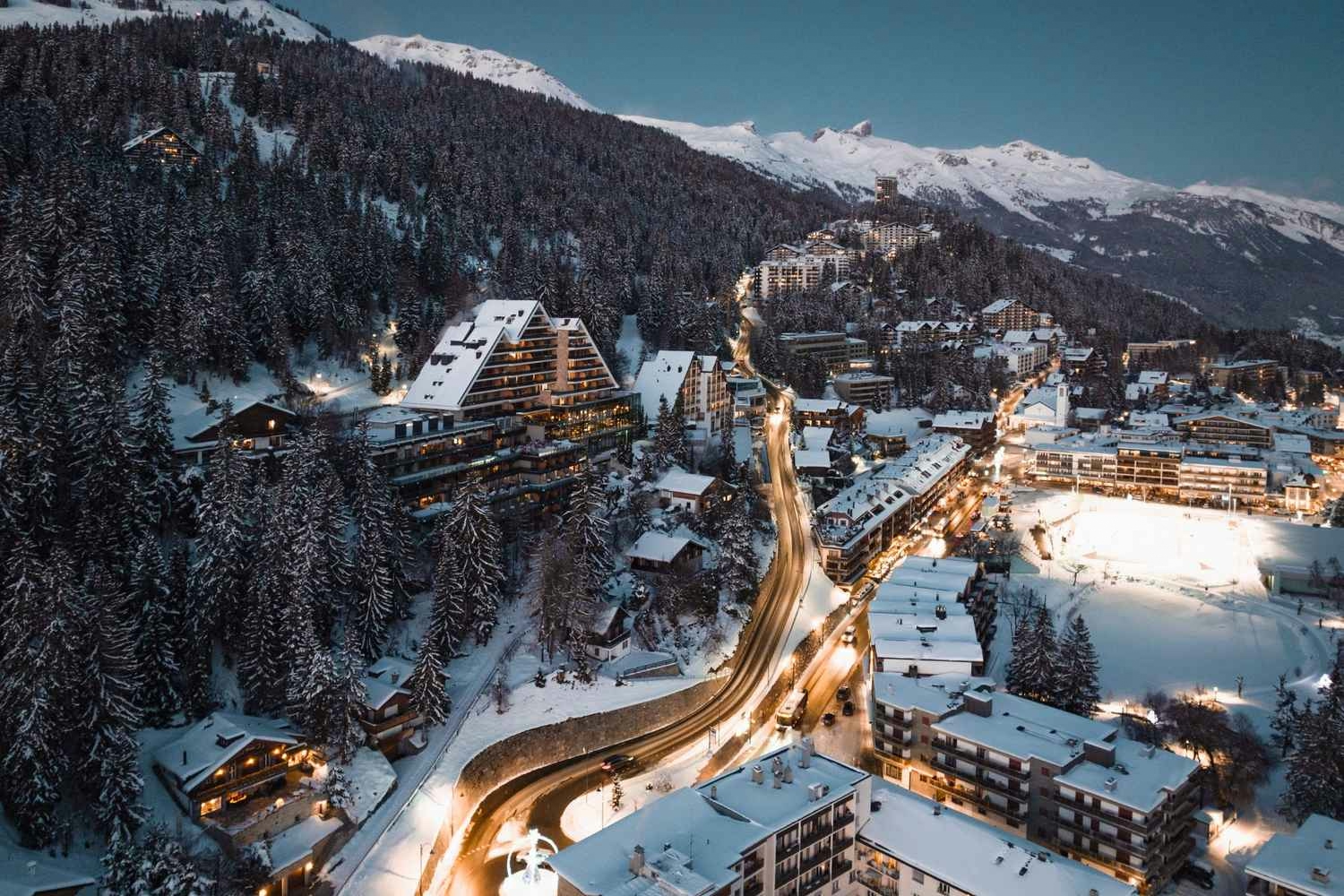
In the aftermath of the events in Crans-Montana, a familiar debate has resurfaced in Switzerland: concern not only for what happened and who was affected, but for how the country is perceived abroad. Headlines and public statements quickly framed the situation as a potential threat to Switzerland’s credibility and international standing, reviving a pattern that has appeared repeatedly after major national crises.
This reaction is not new. When Switzerland has faced significant shocks in the past — from the collapse of Swissair and the Gotthard tunnel fire to the rescue of UBS or disputes over dormant bank accounts — public discussion has often focused as much on reputational damage as on responsibility, victims, or structural failures. The question of how Switzerland is viewed from outside has consistently taken centre stage.
Historians have described this tendency as an acute sensitivity to external perception, paired with a strong desire to present the country as exemplary. Switzerland regularly measures itself against international rankings and reacts sharply to any perceived decline. In many areas, such ambition has tangible benefits, particularly in education, scientific research, public safety and economic stability.
Beyond these fields, however, the pursuit of admiration has extended into diplomacy and regulation. Switzerland has frequently been among the most eager adopters of international standards, even when comparable countries show less commitment. Officials have long invested in presenting the country as a neutral facilitator of dialogue, placing high symbolic value on hosting negotiations or international organisations. Negative coverage abroad — whether concerning a Swiss corporation or domestic policy — often receives outsized attention at home.
This preoccupation can sometimes take on disproportionate forms. Isolated criticism from foreign commentators or social media personalities has, on occasion, triggered widespread domestic debate. In major incidents, Swiss media routinely compile international reactions, reinforcing the notion that external judgment is a key metric of national success or failure.
The roots of this mindset can be traced in part to Switzerland’s experience during the Second World War. While much of Europe was devastated, the country emerged physically intact, but not without controversy. Accusations from abroad — particularly from the United States — alleged that Switzerland benefited economically from cooperation with Nazi Germany and failed morally by turning away Jewish refugees. These accusations have left a lasting imprint on national self-perception.
As a result, suspicions that Switzerland’s prosperity rests on ethically questionable foundations continue to resonate in public discourse. This sensitivity is compounded by the realities of being a small state, where careful behaviour and strict adherence to norms are often seen as necessary strategies for maintaining influence among larger powers.
For decades, Swiss authorities have invested heavily in image management. Government-backed initiatives have sought to measure and improve how the country is viewed internationally, even commissioning detailed surveys of foreign perceptions. These efforts culminated in the creation of dedicated institutions tasked with promoting Switzerland’s image abroad.
Critics argue that this drive for moral and reputational purity has sometimes distorted domestic debate. Activities or actors that complicate the idealised image — from multinational commodity firms to international sports bodies — are frequently framed primarily as reputational risks. The broader consequences of forcing such organisations to relocate, or whether doing so meaningfully improves global outcomes, are often secondary considerations.
Recent geopolitical events have exposed the limits of this approach. Switzerland’s restrictive arms-export policies, tightened over many years to reinforce a principled stance against conflict, drew international criticism after Russia’s invasion of Ukraine. European partners argued that these rules indirectly hindered Ukraine’s defence, illustrating how measures designed to enhance moral standing can produce unintended effects.
Switzerland’s sensitivity to reputation has also, at times, been leveraged by foreign governments. Pressure from the United States has previously led Bern to make concessions on issues ranging from the restitution of artworks linked to Nazi-era persecution to the dismantling of banking secrecy for foreign clients. Critics note that similar standards have not always been applied domestically by those exerting pressure.
The media has played a role in reinforcing this dynamic. Investigations frequently highlight Swiss connections to global crises, treating any link — however indirect — as evidence of national responsibility. Given Switzerland’s deep integration into the global economy, such connections are often inevitable rather than exceptional.
Historians, too, have sometimes framed the country’s past against an implicit benchmark of moral perfection, labelling episodes that fall short as blemishes on an otherwise exemplary record. While critical examination of history is widely seen as essential, some argue that it risks oversimplification when detached from the broader historical context.
The debate surrounding Crans-Montana reflects these broader tensions. Calls for a thorough and transparent review of what happened are widespread and largely uncontested. The question is not whether accountability matters, but why it is pursued. For many observers, the priority should be justice for those affected and lessons for the future — not reassurance for foreign audiences or damage control for the national image.
As Switzerland once again scrutinises itself under the lens of reputation, the episode highlights an enduring dilemma: how to balance ethical responsibility, historical context and realism without allowing concern for appearances to overshadow substance.