Mar 2, 10:51 AM
Why Losing Can Pay Off in the NBA
As teams chase top draft picks, the league tightens rules on “tanking” — but fines may be little more than a rounding error
n most professional sports, losing is a problem. In the NBA, it can sometimes look like a strategy.
In mid-February, the league fined the Utah Jazz $500,000 after the team left key players Lauri Markkanen and Jaren Jackson on the bench for the final quarter of a game against the Orlando Magic. The NBA determined the move amounted to “tanking” — the deliberate weakening of a lineup to increase the chances of defeat.
For teams with no realistic path to the playoffs, losses can carry long-term value. The worse a team’s record, the better its odds of securing a high draft pick in the summer. In a league built around star power, landing a generational player can transform both competitive prospects and financial performance for years.
The draft system in North American sports is designed to promote parity. After the regular season, the weakest teams are given priority in selecting young talent entering the league. The logic is simple: help struggling franchises rebuild and keep competition balanced.
But the system also creates incentives that are hard to ignore. Exceptional players such as LeBron James, Luka Doncic and Nikola Jokic have reshaped franchises and delivered enormous commercial returns. Even if such prospects appear only occasionally, the mere possibility is enough to tempt teams into positioning themselves as low as possible in the standings.
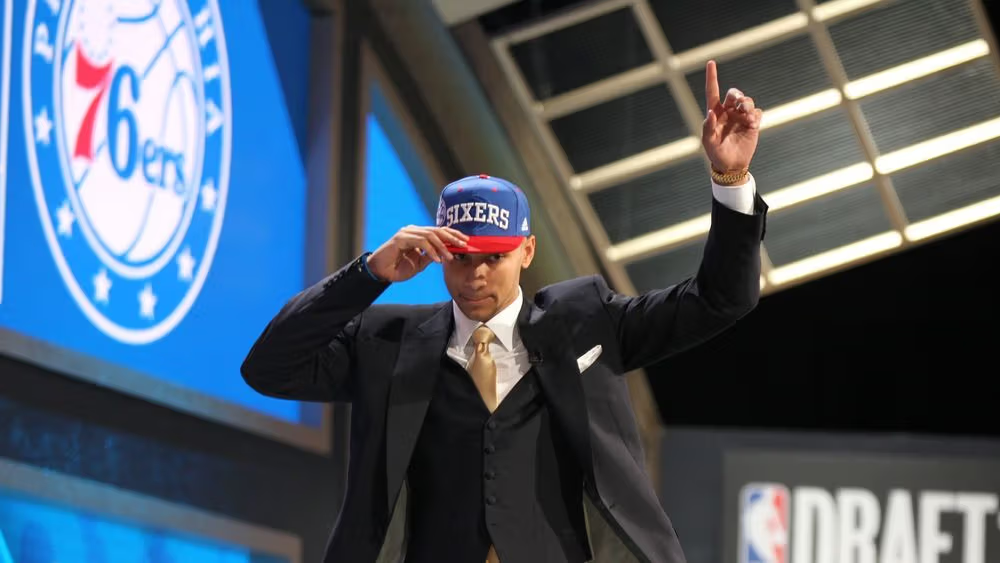
The practice is not new. Between 2013 and 2016, the Philadelphia 76ers underwent a radical rebuilding strategy under general manager Sam Hinkie. In the 2015–16 season, Philadelphia lost 72 of 82 games and secured the first overall pick, selecting Australian guard Ben Simmons. Although Simmons signed lucrative contracts worth more than $200 million over his career, injuries and disputes later overshadowed his trajectory.
Hinkie himself did not survive the experiment. Under pressure from the league, he stepped down and has not worked in the NBA since. His successor, Bryan Colangelo, resigned after it emerged that a Twitter account linked to his wife had published internal team information while defending him anonymously.
The league has long walked a fine line between enforcing competitive integrity and allowing teams to manage their own rebuilding cycles. Commissioner Adam Silver has repeatedly emphasized the importance of protecting the NBA’s credibility. Silver has also hinted at possible changes to the draft system if tanking intensifies.
The debate has grown sharper as the NBA’s commercial ecosystem has expanded. The league now maintains partnerships with numerous sports betting operators, a development that has brought additional scrutiny to questions of fairness. Silver has publicly described tanking behavior this season as particularly concerning and suggested that structural adjustments may be necessary.
One alternative model is being tested elsewhere. In the Professional Women’s Hockey League (PWHL), once a team is mathematically eliminated from playoff contention, it earns draft points for each victory. The team accumulating the most points among eliminated clubs secures the top draft selection — effectively rewarding competitiveness rather than failure.
Whether such reforms will be adopted in basketball remains unclear. For now, financial penalties appear to be the league’s primary deterrent. Yet for franchise owners whose net worth often exceeds several billion dollars, a $500,000 fine may not fundamentally alter calculations — especially if the potential reward is a franchise cornerstone like top prospect Darryn Peterson.
As the regular season approaches its conclusion on April 12, playoff contenders such as the defending champion Oklahoma City Thunder and the Denver Nuggets are fine-tuning rotations for a title push. At the opposite end of the standings, at least six teams are competing for the worst record — and the statistical edge that comes with it.
In a league where a single player can reshape a decade, the temptation to lose today for the promise of tomorrow remains powerful. The NBA may tighten rules and raise fines, but as long as the draft rewards failure, the race to the bottom is unlikely to disappear.