Mar 2, 9:48 AM
Middle East Airspace Closures Trigger 19,000 Flight Delays Worldwide
Major Gulf hubs suspend operations as airlines cancel and divert services amid escalating Israel-Iran conflict
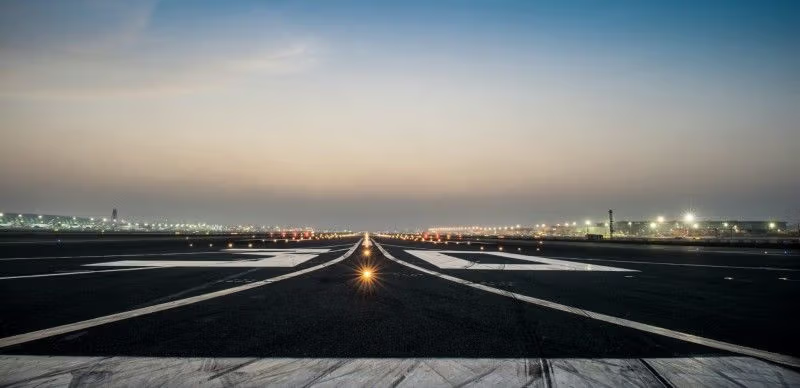
Air travel across the Middle East has ground to a near halt after escalating hostilities between Israel, Iran and the United States prompted widespread airspace closures, leaving tens of thousands of passengers stranded and more than 19,000 flights delayed worldwide.
Several countries — including Bahrain, Iran, Iraq, Israel, Jordan, Kuwait, Qatar and the United Arab Emirates — announced partial or full airspace closures over the weekend. The ripple effect was immediate. Major aviation hubs in Dubai, Abu Dhabi and Doha suspended operations, and airlines were forced to cancel or divert flights on a large scale.
According to aviation analytics firm Cirium, more than 1,800 flights operated by Middle Eastern carriers were cancelled. Of 4,218 flights scheduled to arrive in the region on Saturday, 966 were scrapped — nearly 23 percent. On Sunday, 716 of 4,329 scheduled flights were cancelled. Flight tracking service FlightAware reported over 19,000 delays globally, while Flightradar24 recorded more than 3,400 cancellations on Sunday alone across seven key airports: Dubai International, Hamad International in Doha, Zayed International in Abu Dhabi, Sharjah International, Kuwait International, Bahrain International and Dubai World Central.
The closures follow retaliatory missile and drone attacks attributed by Gulf states to Iran after US and Israeli strikes on Iranian targets. Authorities in the United Arab Emirates reported incidents at two airports. Officials at Dubai International said four people were injured, while Zayed International Airport in Abu Dhabi confirmed one fatality and seven injuries following what it described as a drone strike. Kuwait International Airport also reported strikes.
The three largest Gulf carriers — Emirates, Etihad Airways and Qatar Airways — typically handle around 90,000 transit passengers daily through their hubs. Cirium said Emirates cancelled 38 percent of its flights on Saturday, while Etihad cut 30 percent. Qatar Airways suspended all departures from Doha, cancelling 41 percent of scheduled services.
Airports confirmed operations would remain suspended until further notice. Emirates paused all flights to and from Dubai until 3 pm local time on Monday 2 March. Qatar Airways said it would resume services only once national aviation authorities confirmed the safe reopening of airspace.
Diversions have become commonplace. At least 145 aircraft en route to cities such as Tel Aviv and Dubai were rerouted to Athens, Istanbul or Rome early Saturday. Others turned back mid-flight. One transatlantic service reportedly spent nearly 15 hours airborne before returning to its point of departure.
The disruption extends far beyond the Gulf. Airlines across Europe, Asia and North America have suspended routes to the region. Lufthansa Group halted services to several Middle Eastern destinations and said it would avoid multiple regional airspaces. Air France, KLM and British Airways cancelled or adjusted flights, offering rebooking or refunds. In North America, Delta Air Lines and American Airlines suspended selected Middle Eastern routes, while Air Canada cancelled services to Israel and Dubai for several days. Asian carriers including Air India and Garuda Indonesia also paused flights.
Low-cost operators have followed suit. Wizz Air suspended services to multiple destinations in Israel and the Gulf, while Turkish Airlines cancelled flights to a wide list of regional cities.
The normally busy east–west air corridor over Iraq, a key route connecting Europe and Asia, appeared nearly empty on live tracking maps Sunday morning — a stark illustration of how deeply the conflict has disrupted global aviation.
For passengers, uncertainty remains the defining feature. Many travelers have found themselves stuck at departure airports or in transit hubs with limited information about when flights will resume. Airline industry analyst Henry Harteveldt said travelers should expect further delays and cancellations in the coming days as the situation evolves.
From a financial perspective, airlines are now rerouting aircraft south over Saudi Arabia to avoid closed airspace, adding flight time and fuel costs. If disruptions continue, ticket prices could rise as carriers absorb additional expenses.
Consumer advocates say that because the cancellations stem from extraordinary circumstances, passengers are generally not entitled to financial compensation. However, under UK and EU regulations, airlines must provide assistance such as meals, refreshments and, if necessary, accommodation during extended delays. Travelers whose flights are cancelled are entitled to refunds.
How long the regional shutdown will persist remains unclear. For now, one of the world’s busiest aviation crossroads has fallen unusually quiet — and the consequences are being felt far beyond the Middle East.