Rumors Over UAE President’s Health Expose Fragile Dynamics of Gulf Politics
Whispers about Sheikh Mohamed bin Zayed being out of the public eye have sparked a wave of uncertainty, revealing just how fast doubt can send shockwaves through the region’s corridors of power.
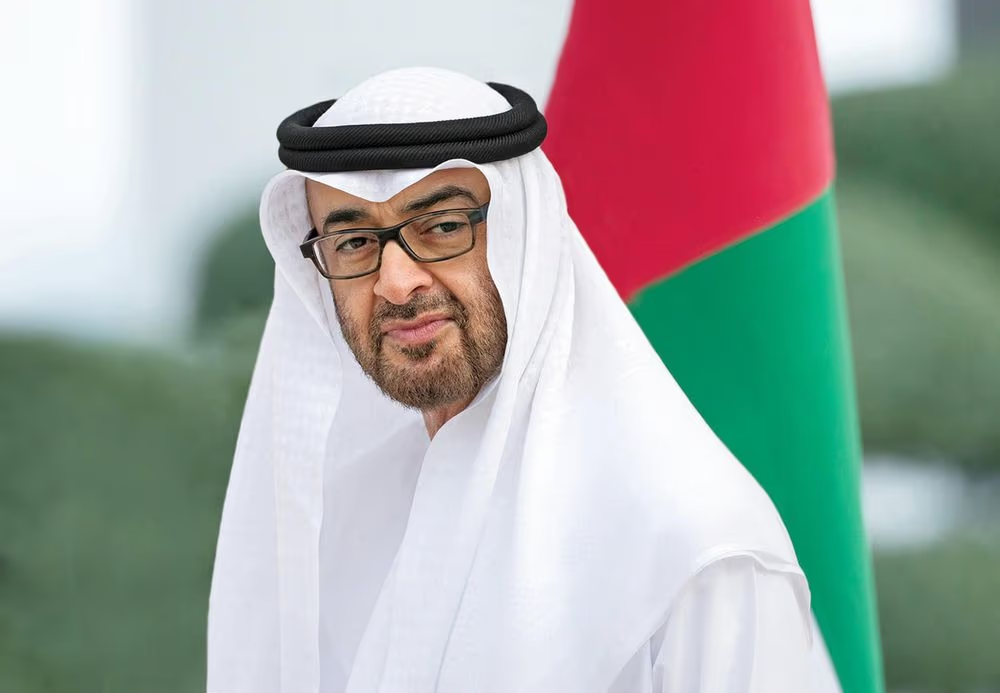
In the Gulf, silence is a fleeting thing, rarely does it last. All it took was a postponed diplomatic meeting and a quick mention of a health issue to set the rumor mill spinning around Sheikh Mohamed bin Zayed Al Nahyan, president of the United Arab Emirates. Suddenly, social media was awash with wild speculation about his wellbeing.. Within mere hours, whispers online morphed into outright claims of his death,anonymous voices on various platforms treating these unverified assertions as gospel truth despite zero confirmation from official channels. Here’s where things got rolling: Recep Tayyip Erdoğan’s planned visit to Abu Dhabi was unexpectedly put off.
Early on, word went around that there’d been some kind of health concern involving the Emirati leader. Not long after, those explanations seemed to fade from public view, and digital breadcrumbs vanished as well. That void. Perfect breeding ground for rumors. Most political systems see delayed meetings cause some chatter before everyone moves on.
But in monarchies and federations built on smooth transitions at the top,systems like the UAE’s, even small ambiguities take on outsized significance. The country’s leadership model hinges on stability, consensus among powerful families, and coordinated policy over decades (not just election cycles). So even short-lived uncertainty can prompt external partners and regional players alike to pause and reassess their assumptions. As chatter snowballed, attention naturally shifted toward Sheikh Tahnoun bin Zayed Al Nahyan,the president’s brother and an influential force within UAE circles. Online narratives began swirling: Was this about succession.
Internal rivalries. Theories multiplied overnight, but lacked any concrete evidence; still, their rapid spread showed how questions about leadership can seep into wider public debate almost instantly. Political analysts are quick to point out that rumors like these aren’t really about hard proof, they’re all about hesitation creeping in at critical moments. In centralized states where authority flows directly from leadership,a system where one figure links security apparatuses with diplomatic initiatives and economic strategy, even baseless doubts have ripple effects you can’t ignore. Officials may rush to reassure; investors might hold back; foreign governments could hit pause until things settle down again.
The UAE’s federal setup adds another wrinkle here: Stability doesn’t just come from robust institutions but also depends heavily on unity among ruling families across emirates (a delicate balance by any measure). Disinformation targeting the president has a way of magnifying anxieties over succession or internal alignment,a sore spot in any hereditary regime. Timing is no coincidence either, it intersects with much larger currents sweeping through the region right now. Over recent years, Abu Dhabi hasn’t just stuck to its traditional role as logistics hub; it has dramatically expanded its reach both diplomatically and economically throughout the Middle East, Africa, South Asia,the works really.. Take Yemen: In late 2025 into early 2026 tensions flared within anti-Houthi ranks, reports detailed clashes between forces loyal to Abu Dhabi (think Southern Transitional Council) versus those tied to Riyadh-backed authorities recognized internationally.
This confrontation peaked in January before sliding into ongoing unrest. Sudan offers another flashpoint entirely,a host of international observers have scrutinized claims that outside actors including the UAE provided backing for opposing factions amid civil conflict there. These allegations remain tangled up in global debate without ever being settled conclusively in open courtrooms or legal venues so far. Meanwhile over in Somaliland, a new hotspot thanks largely to escalating Gulf rivalries,the geopolitical chessboard keeps shifting fast as regional heavyweights vie for influence across local alliances and Red Sea routes alike (which has only complicated ties with Somalia). Looking eastward again: There’ve been noticeable shifts lately between UAE-Pakistan relations alongside deepening defense/economic cooperation with India, moves frequently labeled as strategic diversification by policymakers, but sometimes cast by critics as repositioning pure and simple.
All these developments feed into each other,you see how everything overlaps. Leadership rumors don’t happen in isolation; they’re part of this broader contest where reputation counts every bit as much as actual power or policy clarity. Information campaigns, whether orchestrated behind closed doors or popping up organically online,can exert pressure minus open confrontation. That’s become par for the course globally amid today’s political volatility. Rumors touching on leaders’ health or succession plans pack particular punch inside monarchic setups because continuity at the top isn’t just procedural, it shapes national identity itself along with future direction.
No credible evidence yet backs up dramatic stories making rounds online this time. Still,the whole episode highlights just how quickly digital narratives catch fire once high-stakes geopolitics are involved… And what real-world consequences follow when perception starts running ahead of reality. For both UAE officials and their allies abroad. The immediate task isn’t simply setting records straight, it’s managing expectations under intense scrutiny. In regions like this one where nuance nudges alliances or market confidence sways easily, even brief gaps in information loom large, sometimes seeming more significant than they truly are.