Mar 2, 7:38 AM
Spain Breaks Ranks with Sharp Rebuke of US and Israeli Strikes on Iran
Prime Minister Pedro Sánchez condemns escalation, calls for international law and de-escalation as tensions ripple across Europe and the Middle East
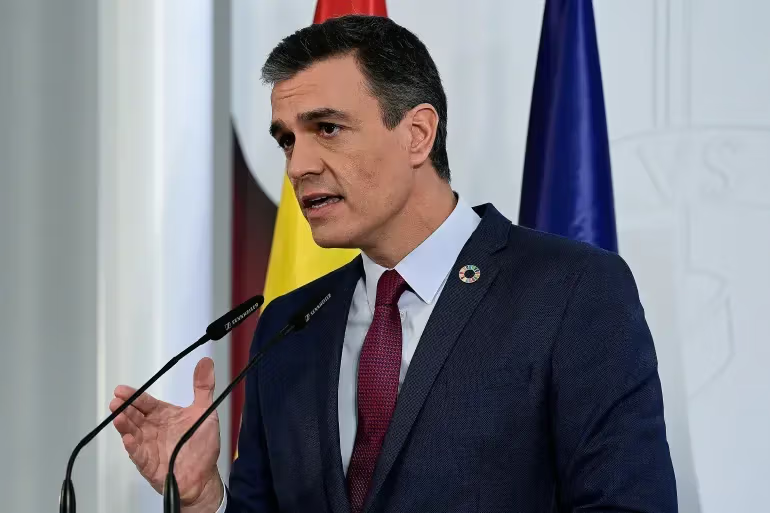
Spain has once again set itself apart within Europe’s diplomatic landscape, issuing one of the strongest condemnations of recent US and Israeli military strikes on Iran. While many Western leaders urged caution and restraint, Madrid chose more direct language, warning that the attacks risk deepening instability at an already volatile moment.
Prime Minister Pedro Sánchez publicly criticized the strikes, describing them as a unilateral escalation that could intensify regional tensions and contribute to what he characterized as a more hostile global order. His statement followed large-scale operations carried out by the United States and Israel across Iran, including reported strikes on a site in central Tehran believed to be the residence of Iran’s 86-year-old Supreme Leader, Ali Khamenei.
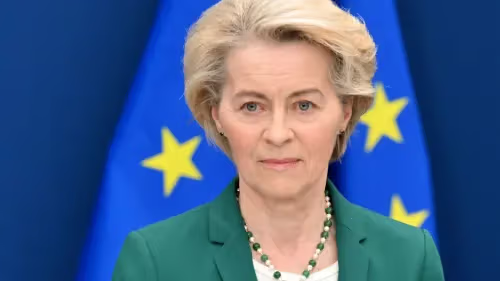
The developments prompted swift reactions across Europe. European Commission President Ursula von der Leyen and European Council President António Costa issued a joint declaration expressing deep concern and urging all sides to avoid further escalation that could undermine international security frameworks, particularly those related to nuclear non-proliferation.
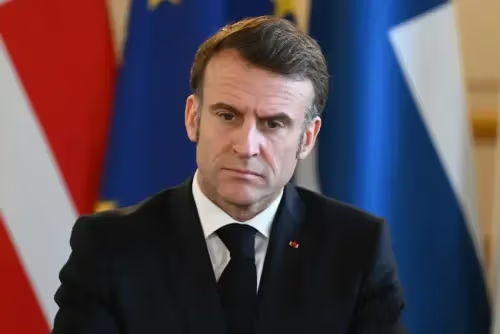
French President Emmanuel Macron described the situation as a serious outbreak of conflict with significant consequences for global peace and said France would push for an urgent meeting of the United Nations Security Council.
Madrid’s tone, however, went further. While condemning the US and Israeli actions, Sánchez also criticized Iran’s government and its Revolutionary Guard, calling for immediate de-escalation and full adherence to international law. His position reflects a broader recalibration of Spain’s foreign policy in recent years, as the country has increasingly adopted a more independent and outspoken stance on major geopolitical flashpoints.
Spain has been among the most vocal European critics of Washington’s foreign policy and Israel’s military campaign in Gaza. Sánchez has described the situation in Gaza as genocide — a characterization that remains politically charged and contested internationally — and has strongly supported efforts to designate Iran’s Islamic Revolutionary Guard Corps as a terrorist organization.
Madrid has also distanced itself from certain US-led initiatives. Spain declined an invitation from the Trump administration to participate in its “Board of Peace” initiative aimed at rebuilding Gaza, citing concerns over alignment with Spain’s commitments to multilateral diplomacy and international legal frameworks.
At the same time, Sánchez has sought to expand Spain’s diplomatic footprint in the Arab world. He attended a high-level summit in Dubai last month and has worked to strengthen ties with Gulf states. In 2024, Spain formally recognized the State of Palestine as part of a broader diplomatic push in favor of a two-state solution — a move France followed in 2025. Palestinian President Mahmoud Abbas visited Madrid last December, where he commended Spain’s diplomatic efforts in support of a ceasefire and Palestinian statehood.
Further underscoring this shift, Sánchez participated as a special guest at the 34th Summit of the League of Arab States in Baghdad last year, reinforcing Spain’s ambition to serve as a bridge between Europe and the Middle East.
The latest crisis now places Spain at the forefront of European voices calling for de-escalation — though not without friction. By openly challenging both Washington and Tehran, Madrid appears determined to balance principle with pragmatism. Whether that approach will translate into greater diplomatic influence remains to be seen, but Spain has made clear it intends to be more than a bystander in the unfolding crisis.