Is the Western alliance breaking apart?
Growing rifts between the US and Europe raise doubts about the future of a partnership that shaped the postwar world
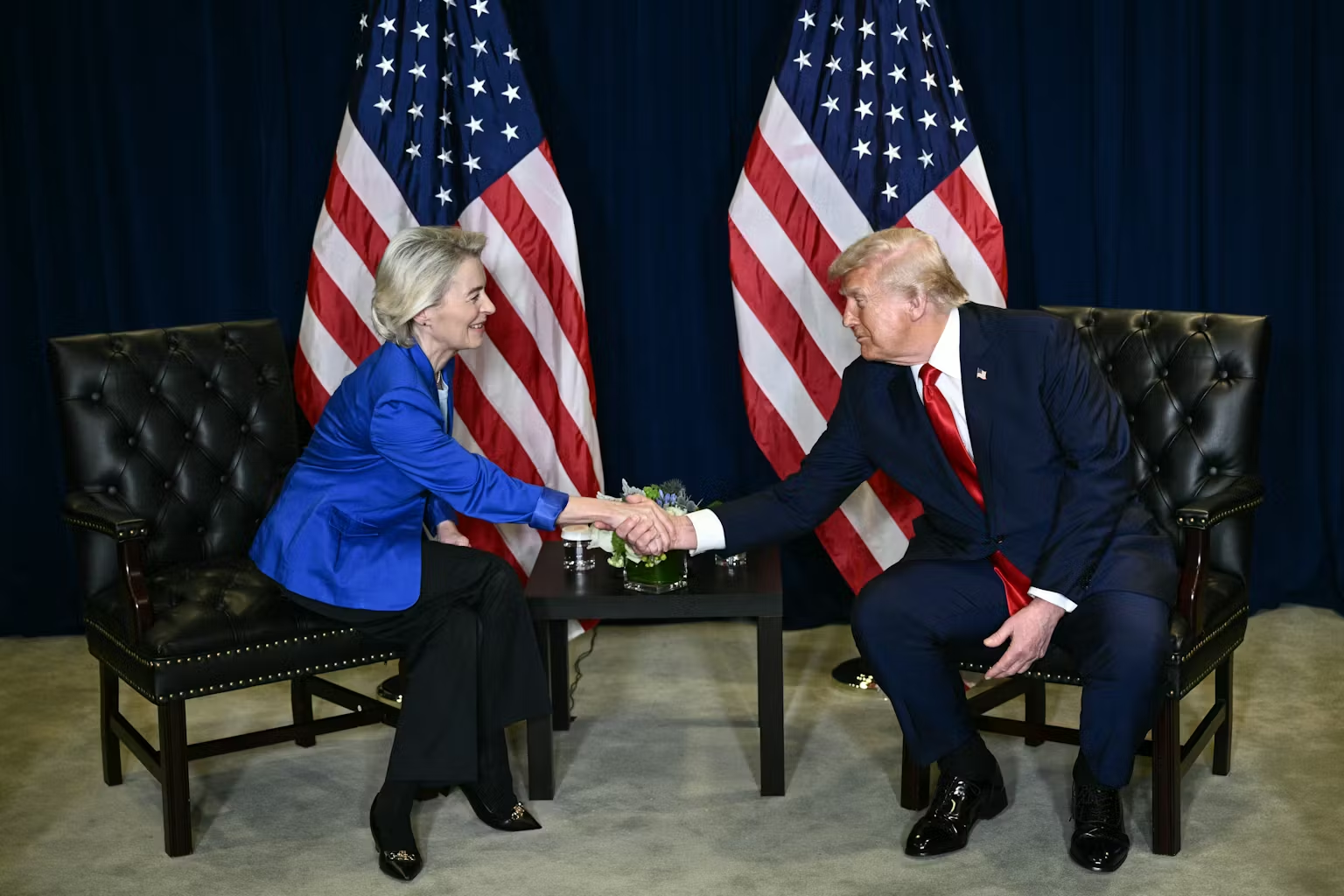
For decades, the alliance between the United States and Europe formed the backbone of the global order. United by a shared commitment to democracy, freedom and the rule of law, the transatlantic partnership helped prevent major wars, defeated Communism and underpinned unprecedented economic growth after World War II. Today, however, European leaders are openly questioning whether that era is coming to an end.
“What we once called the normative West no longer exists,” German Chancellor Friedrich Merz recently said, urging Europeans to abandon nostalgia for a United States that no longer sees the continent as a central partner. According to Merz, Washington is now pursuing its interests “very, very aggressively” — and Europe must learn to do the same.
A chill across the Atlantic
Relations between the US and Europe have steadily deteriorated under the current American administration. European officials say Washington increasingly treats the continent with suspicion, sometimes using harsher rhetoric toward EU democracies than toward rivals such as Russia or China. This shift is driven partly by a clash over values.
Many in the US administration accuse Europe of undermining Western civilization through immigration, diversity policies and restrictions on free speech. European leaders reject those claims, pointing out that many EU countries now score higher than the US on democracy rankings. They also argue that Washington itself is abandoning Western principles by courting authoritarian leaders and making territorial claims involving allies such as Canada and Denmark.
Tensions have deepened not only because of rhetoric, but also due to concrete policy choices. The US push for a geopolitical accommodation with Moscow, pressure on Ukraine to accept territorial concessions, and a peace plan seen in Europe as favoring Russia have all fuelled fears that Washington is sidelining European security concerns.
“For the US to drop its alliance with Europe and side with Russia, with Putin the aggressor, represents a fundamental break in the European–US relationship,” said Norbert Röttgen, a senior German lawmaker. French senator Claude Malhuret warned that Europe now faces the prospect of standing alone — or confronting both Russia and “Trumpism”.
Policy signals harden perceptions
The sense of rupture intensified after Vice President JD Vance openly attacked European allies, followed by new tariffs on European goods. The publication of the latest US National Security Strategy further alarmed European capitals. The document criticised EU countries over immigration and democratic standards, questioned whether increasingly diverse societies could remain “reliable allies,” and framed the European Union as a threat to national sovereignty.
Historians and analysts described the strategy as a declaration of political war on the EU. It also signalled US willingness to support anti-immigration parties in Europe, some of which are more hostile to Brussels than to Moscow.
What does “the West” mean now?
Scholars argue that the idea of “the West” has always evolved. Georgios Varouxakis, author of The West: The History of an Idea, notes that defining Western identity by race or religion is no longer viable. Over time, the concept came to mean shared institutions, democratic governance and individual freedoms — values that immigrants and minorities helped expand and defend.
Many Europeans believe the US is projecting its internal culture wars onto Europe, while others acknowledge Washington’s criticisms about Europe’s weak growth, heavy regulation and reliance on US security guarantees. Still, they warn that continued dependence risks turning Europe into a subordinate partner.
“This feels like the transatlantic relationship as a values-based partnership is on its deathbed,” said Laurel Rapp of Chatham House. In her view, Europe must now negotiate a new bargain with Washington — one focused less on shared ideals and more on transactions, trade and strategic interests.
An uncertain future
Despite the tension, the transatlantic relationship still has defenders on both sides. Cultural ties, shared histories and democratic traditions continue to bind Americans and Europeans. A future change in US leadership could soften the tone, even if the relationship never fully returns to its postwar form.
Yet for many in Europe, something fundamental has shifted. As historian Timothy Garton Ash put it: “We’ll never have that confidence again that the United States is on our side.” Whether the West can redefine itself — or whether it continues to fragment — may be one of the defining geopolitical questions of the coming decade.