AfD Moves to Expel Youth Figure Kevin Dorow in Escalating Internal Rift Over Far-Right Rhetoric
Party leadership seeks to distance itself from extremist symbolism as dispute over ideological direction intensifies
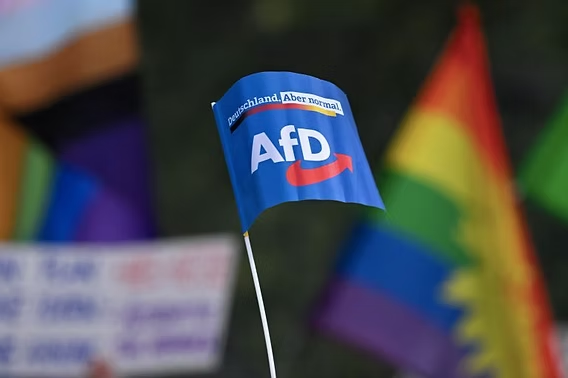
Germany’s far-right Alternative for Germany (AfD) has found itself once again wrestling with internal friction, this time after the federal executive board moved to expel Kevin Dorow. Dorow, who hails from Schleswig-Holstein and sits on the leadership team of the party’s freshly minted youth wing “Generation Deutschland,” is at the center of a storm over his alleged use of slogans that carry heavy historical baggage, specifically from the Nazi era.
Here’s the thing: top brass accuse him of echoing phrases during public appearances that, according to leaked party documents cited by German media, run counter to AfD principles and might further undermine its already precarious legal and political footing. Dorow isn’t having it. In fact, he flat-out rejects any wrongdoing.
Speaking out via a video posted on Deutschland-Kurier,a platform friendly to AfD voices, he insisted these expressions actually predate National Socialism and shouldn’t be pinned exclusively on that dark chapter in German history. He added an extra twist: apparently, he only learned about his possible expulsion when journalists started calling with questions. After that initial statement, Dorow kept quiet; other news outlets couldn’t get him back on record. Among the examples being cited against him is his use of “Youth must be led by youth.” Now, while most people associate this phrase with Hitler Youth propaganda, its origins can actually be traced back further,to earlier German youth movements. But there’s more: Dorow reportedly also used “If all become unfaithful, we remain faithful”, a line famously adopted by the SS during Nazi rule but which first appeared in 19th-century poetry.
Party officials are also raising eyebrows over remarks where Dorow drew a distinction between so-called “passport Germans” versus “ethnic Germans.” The problem. Such terminology seems at odds with what’s spelled out in AfD’s 2024 policy platform,namely legal equality for every German citizen regardless of background. And then there’s remigration, the idea pushed by Austrian activist Martin Sellner and linked closely to Identitarian circles,which Dorow allegedly endorsed publicly as well.. For context: Germany's Federal Administrative Court recently ruled some interpretations of remigration clash directly with constitutional protections for human dignity (that happened in 2024). Still, Dorow maintains he stands behind AfD's official definition of citizenship and denies ever violating party rules.
Unsurprisingly, this situation has touched off pushback from certain quarters inside AfD's own right-wing orbit. Sellner himself shared an online petition protesting Dorow’s potential ouster via Telegram, calling it needless infighting,and several regional politicians from Bavaria, Saxony and Thuringia have voiced support for Dorow too.. This dust-up is really just one piece of a bigger puzzle within AfD about strategy going forward. Earlier in 2025 they scrapped their previous youth group, the Junge Alternative (JA),citing persistent worries about links between junior members and hard-right networks like Identitarians (which AfD now officially distances itself from through an incompatibility resolution). The new group requires full party membership, a clear shift away from JA's looser structure,and follows moves such as barring officials from meeting openly with Sellner starting February.
It wasn’t always like this; years ago even senior figures such as Alice Weidel appeared alongside representatives tied to what's known as Germany's New Right scene. Notably in 2019 both Weidel and ex-MEP Maximilian Krah attended an event organized by Götz Kubitschek at Schnellroda’s Institute for State Policy, with Weidel describing attendees back then as "highly educated people." Since then though,as co-chairs Alice Weidel and Tino Chrupalla took charge, the national leadership has tried steering things in a different direction publicly. Meanwhile there's another front where pressure is mounting: The AfD continues battling its designation as a "confirmed extremist" organization before Cologne's Administrative Court,a label applied by domestic intelligence services that's hurting efforts to attract centrist voters especially out west.
Any rhetoric seen as radical risks undermining their arguments here; observers say it's not just bad optics, it could have real consequences come election season. Back to Kevin Dorow: he's now under investigation by prosecutors in Giessen over suspicions he used symbols banned under laws targeting unconstitutional organizations; so far no formal charges have landed, but if things go south legally it could crank up calls for debating whether parts,or all, of the party should face outright prohibition proceedings down the line.
If you look back just a few years you’ll see inconsistency marks how these cases play out inside AfD ranks anyway,in 2017 leaders tried booting Björn Höcke (the heavyweight from Thuringia) after inflammatory comments labeled revisionist; local arbitration said no dice though and since then Höcke hasn’t just survived, but thrived, in fact leading his state chapter to victory in Thuringia’s latest elections held last year. Right now it's Schleswig-Holstein's arbitration court handling what happens next for Dorow; nobody knows yet how that'll shake out or what precedent it might set moving forward.