
Feb 12, 11:29 AM
Latin America Unveils Latam-GPT in Bid to Reclaim Its Voice in Global AI
Backed by Chile and regional partners, the new model aims to reduce bias in artificial intelligence by training systems on Latin American data in Spanish and Portuguese.
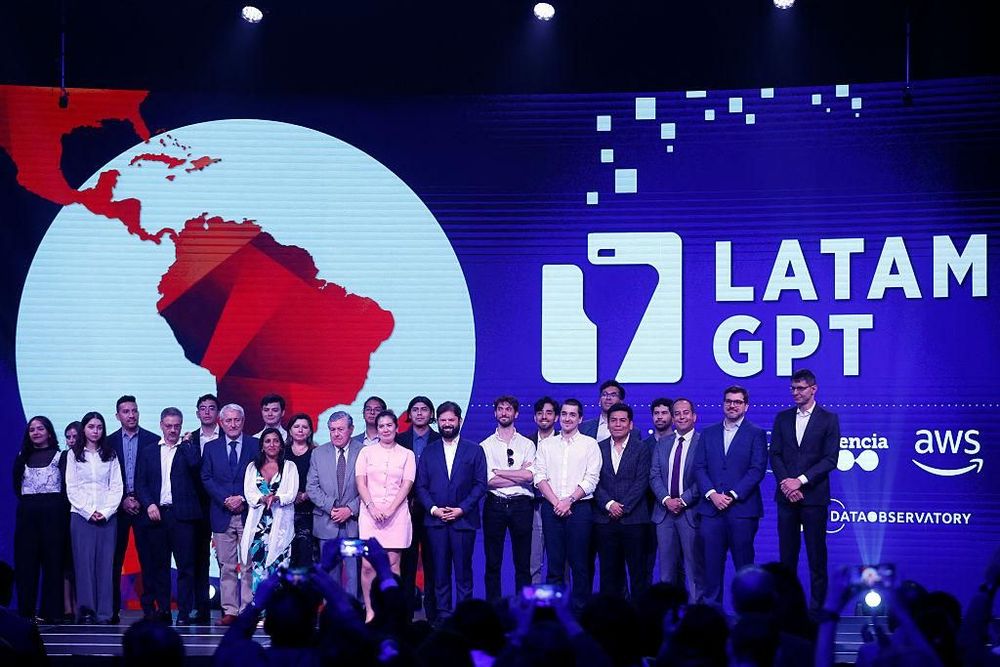
Chile has taken a symbolic and practical step into the global artificial intelligence race with the launch of Latam-GPT, a regional AI model designed to reflect Latin American languages, history and cultural contexts in a field largely shaped by U.S. and Chinese technology giants.
The project is being led by Chile’s National Centre for Artificial Intelligence (Cenia), a privately run institution funded with public money, and supported by a broad coalition of universities, foundations, libraries, government agencies and civil society groups across the region. Partners include institutions from Chile, Brazil, Uruguay, Colombia, Mexico, Peru, Ecuador and Argentina, underscoring the project’s ambition to serve Latin America as a whole rather than a single national market.
Speaking during the presentation on national television, Chilean President Gabriel Boric framed Latam-GPT as a statement of intent. He argued that Latin America should not remain a passive consumer of technologies built elsewhere, but instead position itself as an active participant in the digital economy of the future. Chile’s science minister, Aldo Valle, said the initiative aims to counter the tendency of existing AI systems to portray the region through a narrow or homogenized lens.
Despite its name, Latam-GPT is not a chatbot competing with consumer-facing tools such as ChatGPT. Instead, it is a large language model trained on regional data, intended to serve as a foundation on which companies, governments and researchers can build applications tailored to local needs. Its creators say this approach is meant to address biases that arise when Latin American content represents only a small fraction of the data used by global models.
To train the system, developers have compiled more than eight terabytes of text—an amount equivalent to millions of books—primarily in Spanish and Portuguese. Indigenous languages are expected to be added in later stages. The initial version was built using Amazon Web Services, while a dedicated supercomputer is scheduled to come online at the University of Tarapacá in northern Chile in the first half of 2026. That phase will involve an investment of nearly $5 million.
Funding for Latam-GPT has so far totaled about $550,000, much of it provided by the Development Bank of Latin America, along with contributions from participating institutions. Project director Álvaro Soto said that while global AI models do include Latin American material, it is often marginal compared with data from Europe or North America—a gap he illustrated by contrasting extensive documentation of European historical events with the limited digital presence of key moments in Chilean independence.
Not everyone is convinced the initiative can challenge the dominance of global AI platforms. Academic Alejandro Barros has cautioned that Latam-GPT lacks the financial resources and infrastructure to compete directly with large-scale models developed by multinational corporations. Project leaders largely agree with that assessment, stressing that competition is not the goal. Instead, they present Latam-GPT as complementary: a regional base layer that can improve relevance and accuracy for local applications.
Those applications are already taking shape. The model will be freely available, and one of its first commercial users will be Chilean software firm Digevo, which plans to develop customer-service chatbots for airlines and retailers. According to Digevo’s director, Roberto Musso, Latam-GPT can better handle local slang, idioms and speech patterns—areas where global systems often struggle.
Whether Latam-GPT becomes a cornerstone of Latin American digital infrastructure or remains a niche academic effort remains to be seen. What is clear is that the project reflects a broader shift: regions long defined by how others model them are beginning to ask what it would mean to train artificial intelligence on their own terms.