India Stakes Its Claim in the Global AI Race with Ambitious New Delhi Summit
From cut-rate GPU access to homegrown language tools, the India AI Impact Summit signals New Delhi’s push to lead AI innovation across the Global South
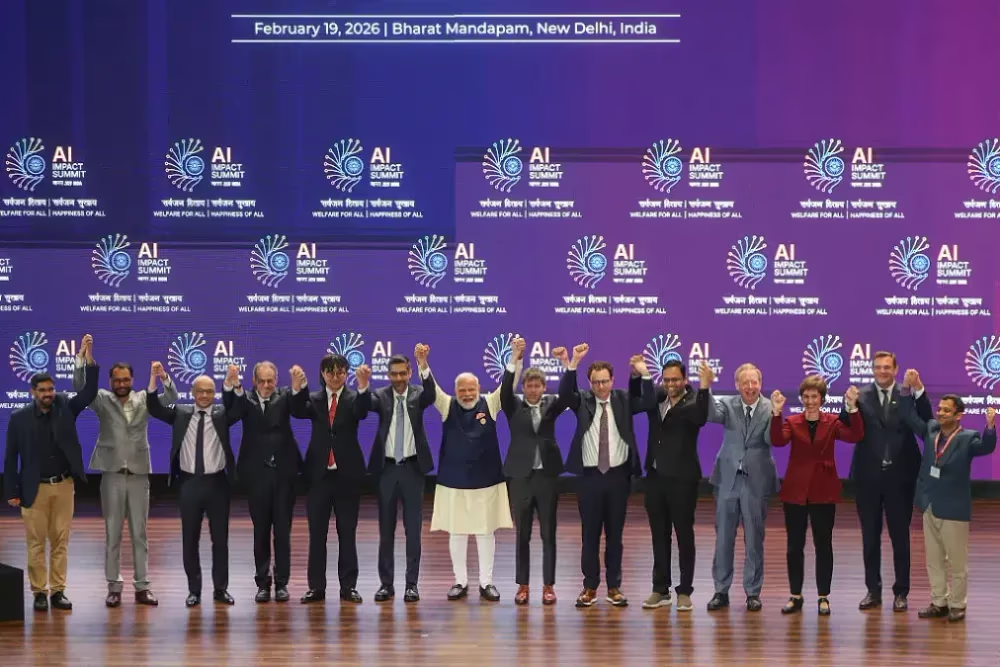
Last week in New Delhi, the city took on the look and feel of a tech nerve center, as thousands of executives, policymakers and startup founders from around the world converged for the India AI Impact Summit 2026.. This wasn’t just another conference; it was a deliberate bid to reframe how India fits into the fast-evolving artificial intelligence ecosystem. The underlying message. India’s tired of being pigeonholed as simply an outsourcing giant. Instead, it’s aiming to become ground zero for AI solutions designed at massive scale, think entire populations.
Right in the capital, attendees got front-row seats to homegrown breakthroughs: everything from soil sensors powered by AI that could change life for farmers, all the way to real-time translation systems fluent across 22 Indian languages. Organizers didn’t pitch these as boutique experiments or tech curiosities,they framed them as essential tools engineered for a nation of 1.4 billion people. Big names weren’t missing either. Executives from OpenAI, NVIDIA, Microsoftand Google were seen mingling among participants, a clear sign this summit had global clout written all over it. For organizers, this gathering was more than show-and-tell; they described it repeatedly as a bridge between bleeding-edge AI research and applications anchored in human needs.
When Prime Minister Narendra Modi kicked off proceedings, he spotlighted his government’s $1.4 billion IndiaAI Mission,a sweeping initiative built on public-private partnerships aimed at constructing next-generation computing infrastructure (and fast). A linchpin here: deploying over 38,000 Graphics Processing Units (GPUs), which are basically the workhorses behind modern machine learning operations.. But here’s where things get interesting, the government isn’t keeping those GPU resources locked away behind closed doors. Through something called the IndiaAI Compute Portal, startups are being offered subsidized access to high-powered compute muscle,for just 67 rupees per hour (which comes out to less than one U.S dollar). According to Modi himself, this is about smashing barriers so that building with AI doesn’t stay confined to Silicon Valley-style enclaves.
For years now, and let’s be honest,it’s been almost reflexive to associate India with business process outsourcing giants like Infosys or Tata Consultancy Services (plus Wipro, Genpact and WNS Global Services thrown in for good measure). Yet during this summit there was a noticeable pivot: officials openly telegraphed their intent not just to provide back-office support, but actually help define what tomorrow's AI platforms might look like. Modi went further still, he talked up artificial intelligence not merely as some fancy productivity enhancer, but positioned it instead as an engine for inclusive development across society. He pointed out that no other country from what we call the Global South has hosted an international AI event on such a grand scale before,casting New Delhi squarely into conversations about who gets a say when setting rules around global technology governance. The philosophical undercurrent.
It drew inspiration straight from Sanskrit: “Sarvajan Hitay, Sarvajan Sukhaye”, or welfare and happiness for everyone,which organizers said signals their commitment to steering AI toward broad social benefit rather than narrow interests alone. That means putting agriculture reform front-and-center alongside language access initiatives and better delivery of public services. So what gives India its edge, or at least its argument. Three big factors keep coming up: vast population numbers offering scale others can only dream about; relentless cost discipline; and deep pools of engineering talent ready-made for digital transformation projects already underway thanks in part to state-backed infrastructure programs. Of course,and let’s not sugarcoat, it remains uncertain whether all this summit energy will morph into lasting influence globally.
Building cheap compute power is crucial; so is driving down costs,but established players aren’t exactly rolling over either. Even so, you couldn’t miss what was happening here: In debates usually dominated by Silicon Valley or Beijing heavyweights, New Delhi used its moment in the spotlight deliberately,to suggest maybe gravity within global AI circles is shifting ever-so-slightly eastward. And honestly.