
Oct 16, 10:01 AM
Dusting Off Prehistory: London’s Century-Old Museum Oversight
A neglected skull fragment from the Isle of Wight turns out to be Europe’s first known megaraptoran.
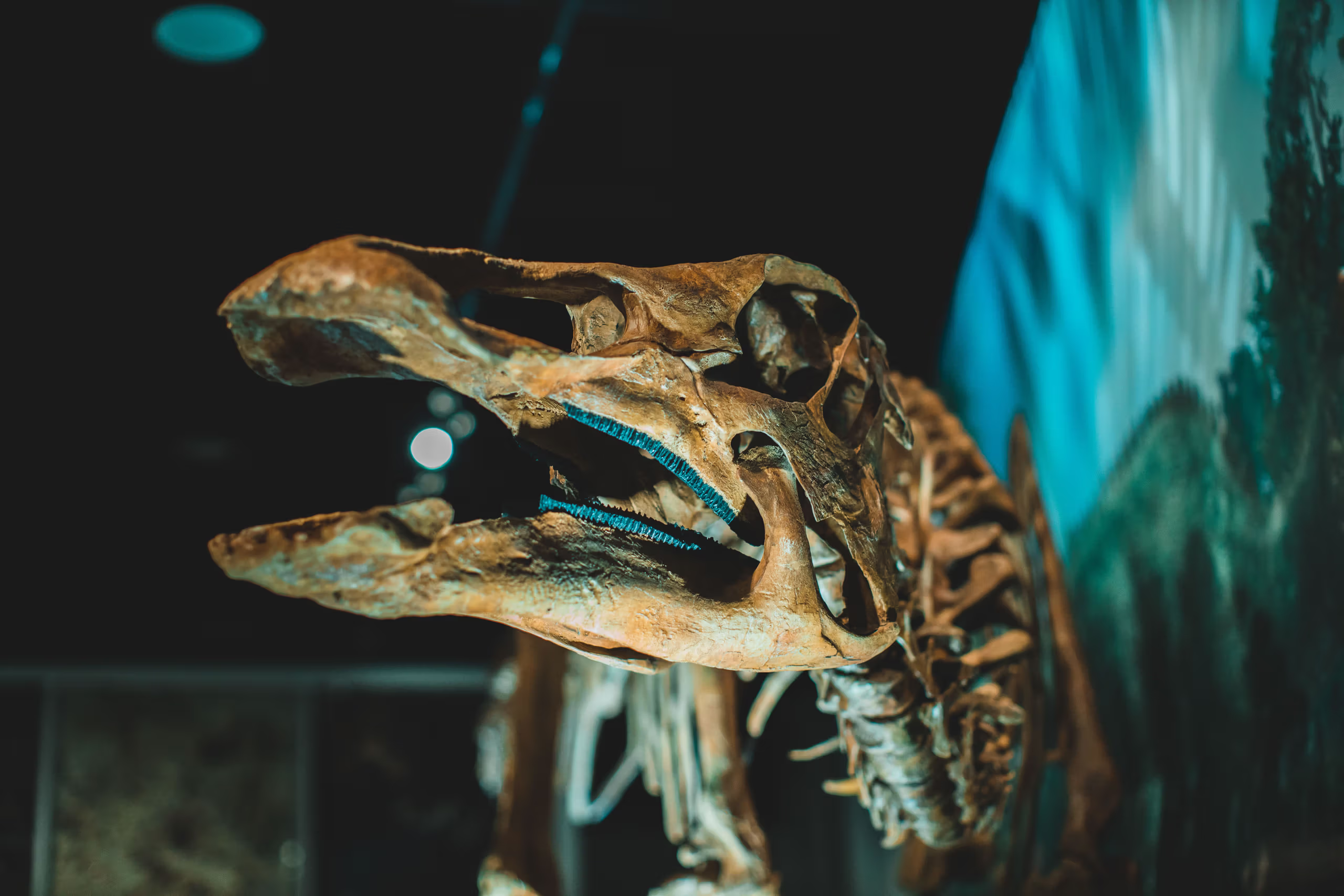
Institutional archives have an extraordinary capacity for quietly hoarding treasures while missing their actual significance. For almost a century, a 120-million-year-old skull fragment gathered dust in the storage units of London’s Natural History Museum. Acquired in 1924 following the death of amateur collector Reginald Walter Tooley—who plucked it from a cliff base on the Isle of Wight alongside a thousand other items—the specimen remained an unassigned mystery for generations.
It took high-resolution CT scanning and three-dimensional modeling to accomplish what decades of visual inspection failed to do. The fragment belongs to Invictibellatrix amberina, representing the first confirmed evidence of a megaraptoran dinosaur in Europe. Previously documented only in South America, Asia, and Australia, these mid-sized carnivores dominated terrestrial ecosystems during the Early Cretaceous period. Measuring between three and four metres in length and standing 1.5 metres tall, the creature featured a slender head, formidable arms, giant curved claws, and a possible coating of feathers.
While apex predators like Tyrannosaurus rex capture public imagination, researchers from University College London noted that Invictibellatrix amberina occupied a role akin to a modern hyena, preying on small mammals, lizards, and smaller dinosaurs. For human-sized prey, such a predator would have been far more dangerous than a T. rex, actively hunting targets roughly one-third of its body weight rather than ignoring them as inconsequential morsels.
The publication of these findings in Royal Society Open Science highlights a persistent paradox in modern research. While institutions constantly clamour for fresh field expeditions and expanded budgets, some of the most startling discoveries sit quietly in dark drawers, waiting for existing assets to be evaluated properly. Professor Paul Barrett of the Natural History Museum observed that work like this shows the exceptional value of working with historical museum collections where there are still many discoveries to be made.
The Isle of Wight continues to yield prehistoric surprises after two centuries of excavation, but the real takeaway lies in institutional efficiency. Capitalizing on existing inventory through advanced technology yields breakthroughs without setting foot back in the mud.
Written by Martina Kirchner martina.kirchner@alpineweekly.com