Oct 9, 12:02 PM
The Decorative Signature of Friedrich Merz
Berlin's SPD enters a questionable local alliance while the Chancellor turns a blind eye to explicit contract breaches.
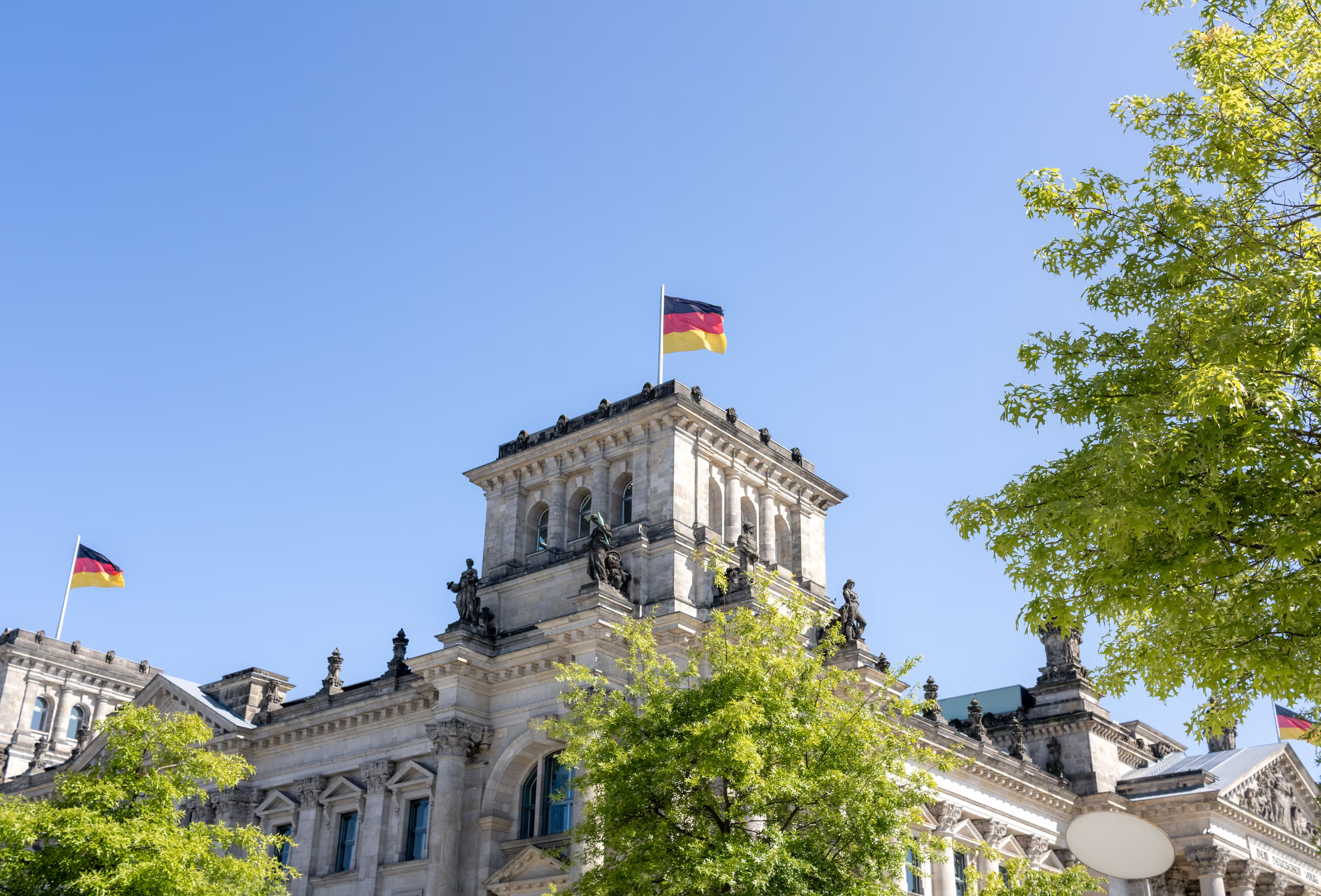
Political agreements in Berlin often possess the lifespan of a delicate Mayfly. When the Christian Democrats and Social Democrats inked their federal pact, complete with solemnly pledged guarantees signed by Friedrich Merz and Lars Klingbeil, voters were offered a familiar theater of institutional authority. Among the high-minded commitments was a clear red line: any alliance with political forces hostile to democratic principles would be strictly ruled out at every level of government.
Yet reality in the capital quickly intrudes upon such solemn declarations. The Social Democratic Party’s local maneuvering in Berlin to form a controversial governing coalition—branded bluntly by NIUS chief editor Julian Reichelt as an alliance stained by antisemitic tolerance—has exposed the profound flexibility of political ethics. Reichelt’s critique, however, focuses less on the predictable shifts of the Social Democrats and far more on the conspicuous inertia of Chancellor Merz himself.
According to the coalition text, a cooperation with anti-democratic parties is excluded at all political levels. The wording leaves remarkably little room for tactical interpretation. Reichelt contends that by quietly tolerating his coalition partner's municipal flirtations, Merz is forfeiting his own executive authority. The argument is straightforward: a Chancellor who permits explicit breaches of foundational pacts in his own backyard signals that signatures at the federal level are merely decorative.
Instead of confronting Klingbeil with an ultimatum—demanding either adherence to the signed document or the collapse of the federal cabinet—Merz chooses silence. This passivity reflects a broader malaise within the German political establishment, where executive weakness is routinely disguised as pragmatic composure. When rules are enforced only when convenient, political credibility inevitably evaporates.
For a nation grappling with institutional erosion and diminishing public trust, this episode provides a telling demonstration of political priorities. When formal pledges against extremism become negotiable currency for local power-sharing, the electorate is left asking a fundamental question: what, precisely, is the actual value of a Chancellor’s word?
Written by Martina Kirchner martina.kirchner@alpineweekly.com