Mar 13, 6:34 AM
Orbán Says Ukrainians Threatened His Family as Hungary–Ukraine Dispute Escalates Before Election
Hungarian prime minister raises allegations of threats while tensions between Budapest and Kyiv intensify ahead of next month’s parliamentary vote.
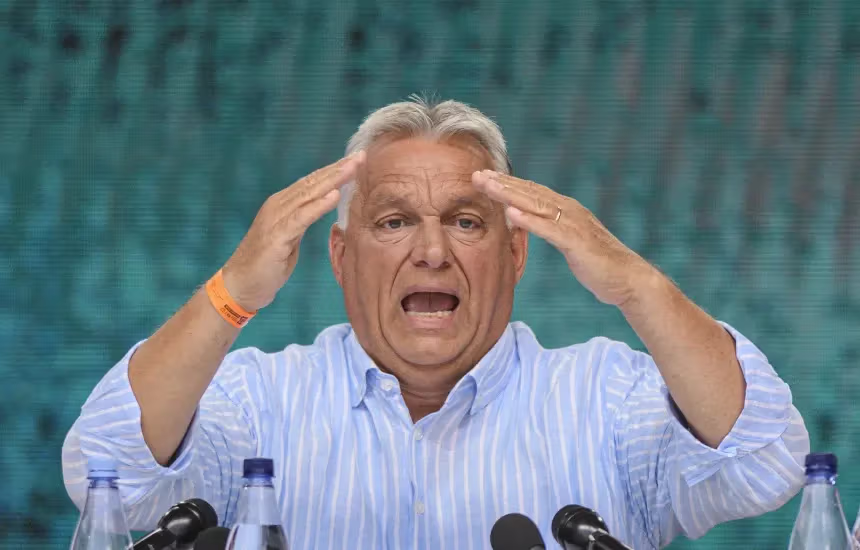
Hungarian Prime Minister Viktor Orbán recently alleged that Ukrainians had threatened his family, escalating the mounting political clash between Budapest and Kyiv just as Hungary gears up for parliamentary elections next month.
Orbán shared this claim in a video released Wednesday evening, where he appears to be speaking on the phone with his daughters. He tells them Ukrainians supposedly issued threats not only against himself but also against his relatives. “We have to take this seriously but we must not be scared,” he says, his voice showing raw emotion while discussing the situation involving his children and grandchildren.
This came on the heels of comments by Hrihoriy Omelchenko, a former Ukrainian politician who served in the SBU security service during the 1990s. On television, Omelchenko hinted that vigilantes might target Orbán if he didn’t soften what he called the Hungarian leader’s anti-Ukrainian stance.
Tensions between Hungary and Ukraine have soared in recent weeks as Orbán and his allies adopt increasingly confrontational positions toward Kyiv. Orbán, who has long maintained difficult ties with Ukrainian leadership, is often viewed as the most pro-Russian figure within the European Union's array of governments. This recent flare-up coincides with Hungary’s nationalist ruling party facing an election next month that could well bring an end to Orbán’s sixteen-year reign.
Polls currently show Orbán lagging behind his challenger, Péter Magyar, by as much as 20 points. Many analysts suggest this has led to a ramping up of the government’s campaign against Ukraine.
The already strained relationship hit another snag following a dispute over an oil pipeline transporting Russian crude to Hungary. Ukrainian officials said repairs might take several weeks after the pipeline suffered damage reportedly caused by a Russian drone strike.
In response, Orbán blocked new European Union sanctions targeting Russia and vetoed a proposed €90 billion loan package intended for Ukraine.
Relations took yet another dive last week when Hungary’s anti-terrorism police stopped a convoy linked to Oschadbank, Ukraine’s state savings bank. This convoy was carrying tens of millions of euros in cash plus nine kilograms of gold from Vienna to Kyiv.
Hungarian authorities detained seven Ukrainian nationals guarding the convoy and confiscated the armored vehicles. Budapest officials suggested the funds could be connected to money laundering.
Ukraine insisted the transfer was just a routine government operation and that Hungarian authorities had been briefed beforehand. The seven men were held for over 24 hours before being deported back to Ukraine, while the money and gold remained seized in Hungary.
This episode sparked sharp accusations flying back and forth. Ukraine’s foreign minister, Andrii Sybiha, accused Hungary of holding the men to seize the funds. Meanwhile, Hungary’s foreign minister, Péter Szijjártó, dismissed these claims and questioned the rationale behind transporting such large amounts of cash through Hungarian territory.
Further allegations surfaced concerning detainee treatment. Ukraine’s foreign ministry claimed the men faced psychological and physical pressure during questioning. The Hungarian lawyer defending them said he hadn’t been able to meet with his clients directly while they were in custody.
This all unfolds amid a politically charged atmosphere in Hungary. With parliamentary elections slated for April 12, Orbán has increasingly framed the campaign around Hungary’s stance in the Russia-Ukraine war.
He argues that a victory for his opponent would drag Hungary into the conflict on Ukraine’s side. At the same time, Orbán paints himself as a peace-seeking leader committed to neutrality.
Speaking at a campaign rally in Vecsés, he rhetorically asked whether it should be Ukraine’s president or Hungarian voters who decide the country’s political course.
With just weeks left before the vote, the showdown between Budapest and Kyiv shows no sign of cooling down, as both governments continue to throw accusations back and forth amid an intensifying election campaign.
Written by Thorben Thiede