Mar 17, 8:37 AM
Serbia skips EU–Western Balkans summit as tensions with Brussels deepen
President Aleksandar Vučić’s boycott highlights growing frustration in Belgrade and raises questions about the future of Serbia’s EU accession path.
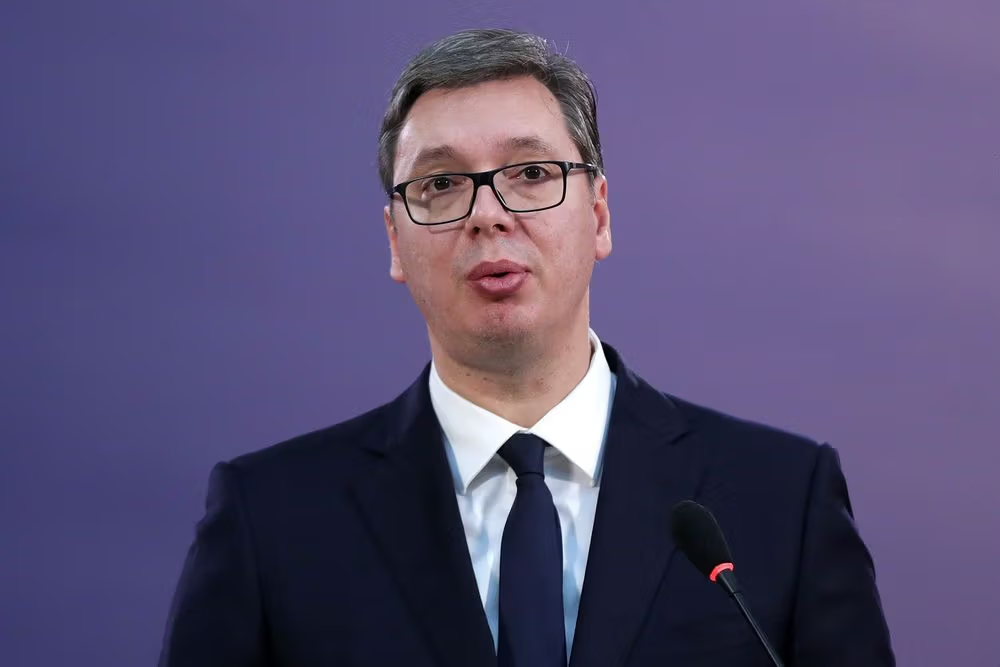
Serbia’s choice to skip a key summit between the European Union and Western Balkan leaders has laid bare the growing rift in a relationship often touted as the bedrock of the region’s future European integration.
When EU officials and Western Balkan delegates convene in Brussels, one voice will be notably absent. Serbia — the largest player in the region and long viewed as the linchpin of the EU’s enlargement plans — won’t be there.
President Aleksandar Vučić dropped the bombshell at the last minute, calling the move unprecedented in more than a decade of these summit meetings. On Serbian state TV, he stressed that, for the first time in about 13 or 14 years, no Serbian representative would take part.
This boycott arises amid renewed frictions over Serbia’s stalled accession talks. Belgrade’s patience has worn thin, frustrated by what it sees as repeated roadblocks set by certain EU member states delaying its membership journey.
For Brussels, Serbia has always been the cornerstone in the Western Balkans’ path toward the EU. Officials frequently contend that Serbia joining could act like a magnet, pulling the region’s other hopefuls closer to EU membership.
But here’s the rub: that grand vision has bumped up against political realities on both ends.
Serbia’s accession process has crawled along for years, tangled up in concerns over democratic norms, rule of law reforms, and the thorny dispute with Kosovo. Meanwhile, several EU countries have become increasingly wary of expansion, especially after grappling with their own internal upheavals and crises.
What you get is a growing sense of mutual distrust.
From Belgrade’s vantage point, the EU’s requirements seem to keep shifting, while the prospect of joining drifts ever farther away. Official timetables often point to possible accession in the late 2030s, a timeline many critics argue undercuts the whole credibility of the enlargement promise.
Among Serbian politicians and analysts alike, this sluggish progress has chipped away at the domestic drive to align staunchly with Brussels.
That’s why Serbia’s no-show at the summit is more than just a missed appointment. These EU-Western Balkans get-togethers typically showcase unity and forward momentum. Serbia stepping back disrupts that storyline and sends a tougher, more confrontational message from Belgrade.
At the same time, it mirrors a broader shift in Serbia’s foreign policy game.
Under Vučić, Serbia’s walked a tightrope, juggling ties between the EU and major global powers. EU membership remains the official endgame, but Belgrade has also deepened economic and political links with countries like China and maintained a pragmatic stance toward Russia.
This balancing act has given Serbia some bargaining power with Brussels, but it’s also sparked worries in European circles that Serbia might be drifting away from the EU’s embrace.
Adding to the complexity, recent domestic turmoil — months of protests fueled by corruption and governance issues — has put Serbia under the international spotlight, further straining Belgrade’s ties with European institutions.
Amid all this, Serbia’s summit boycott reads like more than a diplomatic protest. It hints at a deeper uncertainty: does the EU accession process still hold real political meaning for Serbia?
For the European Union, the stakes are high. Serbia is still the most influential Western Balkan player, yet the gap between Brussels’ hopes and Belgrade’s political path seems to be widening.
Whether this boycott is a fleeting expression of frustration or signals a longer-term detour from Europe remains to be seen. For now, that empty chair in Brussels is a stark reminder that the EU’s Balkan enlargement dream is facing one of its toughest challenges in years.