Mar 13, 6:03 AM
Preliminary Inquiry Suggests US Strike May Have Hit Iranian School
Investigators believe outdated targeting data may have caused a missile strike that killed more than 160 people, many of them children, in Minab.
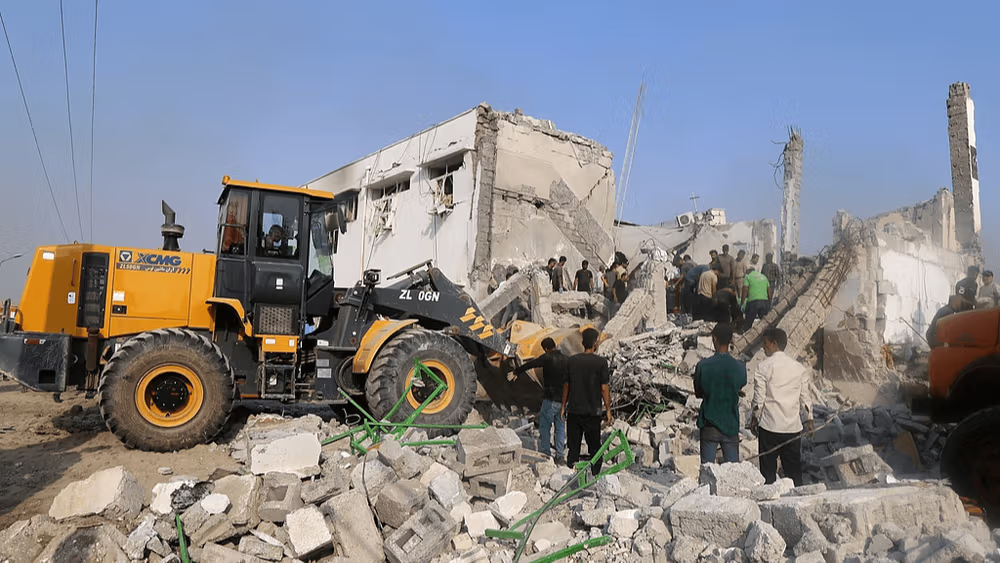
A preliminary probe hints that outdated intel might have triggered a lethal US missile strike on an elementary school in Iran, according to a US official and another individual familiar with the military inquiry’s findings.
On February 28, in Minab—a southern Iranian city—the strike unfolded during the opening days of the war sparked by US-Israeli attacks on Iran. A missile struck an elementary school, killing 165 people, many of them children.
Initial findings indicate the US was aiming for a nearby Iranian military base. The school, it turns out, used to be part of that military compound, and the strike coordinates were reportedly based on old data still marking the site as a military installation.
This attack quickly morphed into one of the conflict’s most contentious incidents. Should it be confirmed that the US carried out the strike, this would rank as one of the deadliest civilian casualty events linked to American military operations over the last 20 years.
Right after the strike, then-President Donald Trump hinted that Iran might be behind it. But here’s the thing: Iran doesn’t have Tomahawk missiles.
Later on, Trump said he was open to whatever the investigation concluded. Asked about the preliminary reports, he told reporters he wasn’t briefed on the details.
These early conclusions have sparked calls in Washington for the Pentagon to clarify the situation. White House press secretary Karoline Leavitt emphasized that the investigation is still underway. Several pieces of evidence lean toward possible US culpability. Satellite images, expert evaluations, and publicly released US military info have all been pointed to as clues.
New footage surfaced earlier this week, showing what experts identified as a US-made Tomahawk cruise missile hitting the military compound. Smoke could already be seen billowing near where the school once stood.
Satellite photos reveal the school was once part of an adjoining military base but got separated around 2017 when a new wall went up between the two areas. At about that time, a watchtower present on the property was removed.
The building was plainly marked as a school. Online maps labeled it as an educational facility, and the school maintained a website with details about students, teachers, and staff.
International law regulating armed conflict forbids military forces from targeting civilian sites—like homes, schools, and hospitals—unless these places are actively used for military purposes.
Elise Baker, senior staff lawyer at the Atlantic Council, pointed out that the mere existence of a civilian structure close to a valid military target doesn’t change its protected status.
If the US is ultimately found responsible, Senator Tim Kaine warned the ramifications would be profound.
He told reporters at a briefing, “It’s either we’ve shifted our traditional targeting rules or we’ve made an error.”
“If we’ve altered our longstanding targeting policies and no longer afford civilians the same level of protection, that would be tragic,” Kaine added.
The investigation into this strike is ongoing.