Mar 13, 8:19 AM
Serbia and Albania Propose Phased EU Membership Without Veto Rights
In a joint article, Aleksandar Vučić and Edi Rama call for gradual integration into the EU’s market and Schengen area as a way to revive the stalled enlargement process.
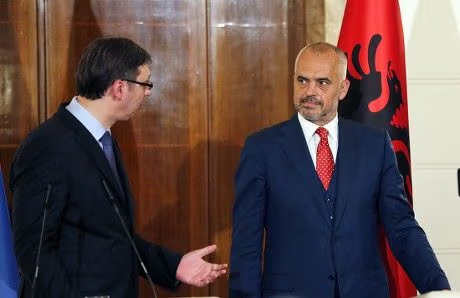
Serbian President Aleksandar Vučić and Albanian Prime Minister Edi Rama have teamed up to pitch a fresh approach to European Union accession — one that would let their countries ease into the bloc step by step, while temporarily giving up some of the perks full members usually enjoy.
They laid out this idea in a joint op-ed for the German paper Frankfurter Allgemeine Zeitung, calling it a “realistic path to the EU” designed to speed up enlargement and boost stability in the Western Balkans.
At the core of their plan is a phased integration model. Basically, Serbia and Albania could slowly enter the EU’s internal market and the Schengen area before becoming full members.
That said, during this in-between phase, some rights typically granted to full EU members wouldn’t apply. Vučić and Rama suggest that their countries wouldn’t have their own EU Commissioners, seats in the European Parliament, or veto power in EU decisions.
They argue this setup would let well-prepared candidates link up economically and politically with the EU, while sidestepping the usual headaches in the bloc’s decision-making processes.
Both leaders see the Western Balkans as crucial from a strategic standpoint for the EU. In their piece, they describe the region as geographically encircled by the EU and tied to Europe’s historic development. They also stress that the dream of EU membership remains the biggest driver for reforms, investments, and reconciliation there.
Speaking directly to European decision-makers, Vučić and Rama call on the EU to treat the Western Balkans as a “new frontline for investment in the EU’s strength.”
They maintain that gradual integration into the single market and Schengen would fortify both the EU’s economy and political clout—without straining its institutional framework further.
This proposal arrives amid years of stalled EU enlargement talks in the Western Balkans. Serbia and other hopefuls have been criticized by Brussels for slow progress on key reforms involving rule of law, corruption, media freedom, and judicial independence.
Complicating Serbia’s EU bid are concerns over its foreign policy, notably its stance on EU sanctions against Russia.
Facing questions about his ties with Russian President Vladimir Putin, he said he wouldn’t apologize for engaging with any global partner. He highlighted Serbia’s robust economic performance and pointed out a decline in national debt.
Serbia applied for EU membership back in 2009, but progress has slowed amid ongoing EU doubts.
Albania, on the other hand, has set ambitious goals. At the same summit, Prime Minister Rama stated his government aims for full membership by 2030 — not just a far-off idea but a specific deadline. He expects accession talks to wrap up within two years.
Together with Montenegro, Albania stands out as one of the Western Balkans’ most advanced candidates.
Corruption, however, remains a thorny issue. Rama has cited recent reforms, including launching the anti-corruption body SPAK, as proof of Albania’s commitment to tackling the problem.
Through their joint proposal, Vučić and Rama are now pressing the EU to rethink its enlargement strategy, suggesting that a phased integration model could breathe new life into efforts to unite the Western Balkans with Europe.