Mar 13, 10:02 AM
Where Is Iran’s New Ayatollah? Questions Grow Over Mojtaba Khamenei’s Condition
The new Iranian leader has not appeared in public since his appointment, prompting speculation about injuries, his location and his authority over the Revolutionary Guards.
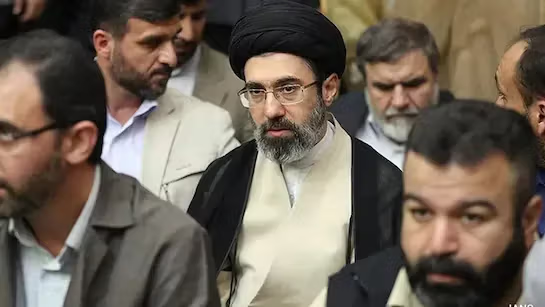
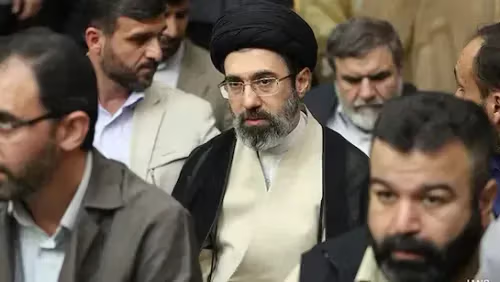
Iran’s freshly named ayatollah, Mojtaba Khamenei, hasn’t been seen in public since stepping in as his father’s successor, which has stirred a lot of questions about his health, whereabouts, and whether he’s up to the task amid the ongoing conflict.
His silence has sparked rumors, especially after the attack on Tehran that took his father, Ayatollah Ali Khamenei, from the scene. Early whispers even claimed Mojtaba himself had died in the strike, though later info suggested he made it through.
Word is, several family members didn’t survive, including his father, mother, and wife. Other relatives might have been lost too.
Shortly after, Iran’s Assembly of Experts quietly chose Mojtaba as the new supreme leader. The whole process was shrouded in secrecy—no public details about the debates or votes have surfaced.
Things got murkier after reports emerged that bombing had destroyed the Assembly of Experts' building in Qom, raising more doubts about whether all 88 members were alive to make the call.
Days beyond his appointment, there’s been no public word, no video messages from Mojtaba. No fresh photos either. At the inauguration event, they even used a cardboard cutout of him—rather than the man himself.
Given all this, speculation about his condition has only grown. Some say he might have been badly hurt in the strike that killed his dad.
The info remains all over the map.
Alireza Salarian, Iran’s ambassador to Cyprus, said Mojtaba sustained injuries to his legs, arms, and hands. Speaking at the Iranian embassy in Nicosia, he suggested the new leader was probably hospital-bound, recovering.
On the flip side, Yousef Pezeshkian, son and adviser to Iran’s president Masoud Pezeshkian, wrote on Telegram that Mojtaba was safe and tucked away in a secure spot, citing sources in the know.
International outlets added that Mojtaba had a fractured foot plus some minor face trauma—a black eye bruise and superficial cuts.
Israeli TV earlier reported he was hurt but survived.
Iranian state TV briefly admitted Mojtaba was wounded but gave no further info. Later, the media called him “janbaz,” a phrase in Iran for disabled war vets, which only deepened questions about how serious his injuries might be.
Since stepping into the supreme leader role, Mojtaba hasn’t shown up at funerals for top Iranian military figures killed in the first wave of US-Israeli strikes.
Salarian hinted this may be more about his character than his health. He described Mojtaba as uncomfortable with public speaking, generally avoiding speeches.
Such public absence is unusual in Iran, where the ayatollah usually addresses the nation during crises.
Meanwhile, reports paint the Islamic Revolutionary Guard Corps as possibly acting on its own after Ali Khamenei’s death. It’s unclear if anyone, including the new leader, truly controls this elite force at present.
There are also questions about how Mojtaba ended up as successor.
Salarian claimed Ali Khamenei had opposed dynastic succession, not wanting power to remain in the family. According to him, senior clerics convinced Mojtaba to accept the role after the attack, insisting it was his duty.
Yet, some Assembly of Experts members told state-linked media the late leader left no clear instructions on succession. Other sources hint the Revolutionary Guards may have pushed the decision.
The UK-based Amwaj Media reported Mojtaba’s appointment was backed by Hossein Taeb, former intelligence chief of the Revolutionary Guards and a close ally.
The same piece suggested the Assembly faced pressure from the Guards when choosing. High-profile Iranians, including Ali Larijani, reportedly opposed the move.
Despite the leadership announcement, crucial details about Mojtaba’s health, location, and ability to govern are still under wraps. Some analysts think he may still be in medical care; others say he could be holed up somewhere secure for safety.
For now, Iran’s new ayatollah stays behind the curtain, leaving a cloud of uncertainty over the nation’s leadership during these turbulent times.