
Jul 27, 4:03 AM
A Palace by Any Other Name: Switzerland's Linguistic Architecture of Power
How a 19th-century naming dispute over the national parliament exposed the deep ideological fault lines in Swiss democracy.
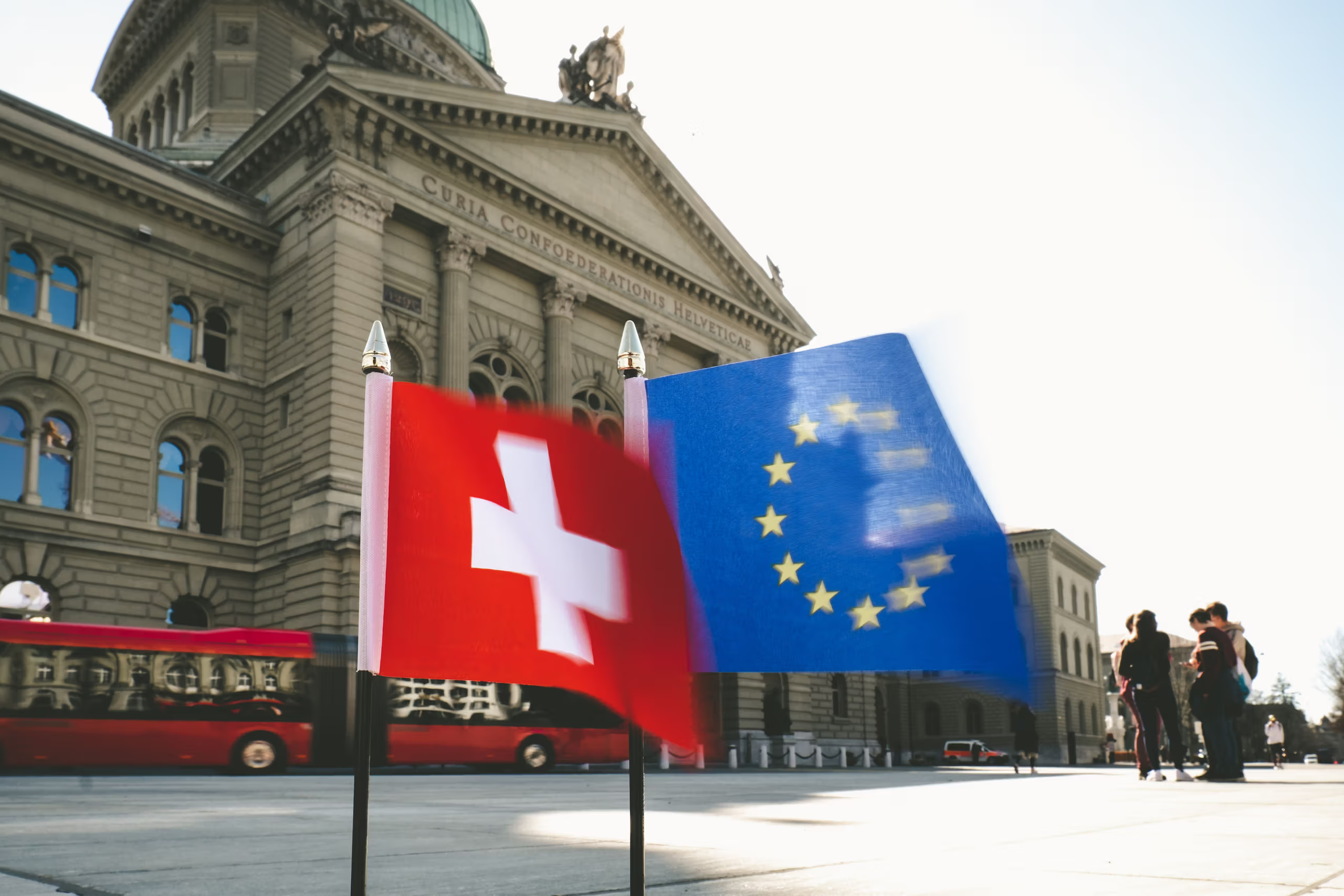
Switzerland manages its internal contradictions with the same pragmatic efficiency that built its wealthy economy and highly educated society. Profiting immensely from its non-EU status while clutching a somewhat naive, lost sense of neutrality, the Alpine nation excels at papering over ideological divides. The country boasts a remarkably good state system, yet its citizens often display a friendly cowardice when confronting deep rifts, preferring bureaucratic compromises instead. This talent for structural pragmatism is quite literally carved in stone in Bern. When construction on a new legislative headquarters began in April 1894, a fierce debate erupted over what to call it—a dispute that exposed fundamentally different regional attitudes toward political authority.
In the French- and Italian-speaking regions, the structure was effortlessly dubbed the Palais fédéral or Palazzo federale. The term suggests a polite acknowledgement that power, and perhaps a touch of modest corruption, resides within its walls. For the German-speaking majority, attaching such a regal noun to their government was anathema. Political scientist Hans-Peter Schaub from the University of Bern notes that late 19th-century German-speaking Switzerland harboured a profound anti-elitist sentiment. Citizens distrusted established parties, favouring direct democratic mechanisms over elected representatives.
To the German-Swiss mind, a palace implied an unacceptable power imbalance and a physical distance between rulers and ruled. The press naturally reflected this anxiety. The Neue Zürcher Zeitung and Der Bund floated modest alternatives to avoid anything grand. The former explicitly rejected the term parliament building, arguing that such a description felt entirely alien and un-Swiss. The Thurgauer Zeitung complained that the victorious term, Bundeshaus, was excessively prosaic, though they agreed a palace was entirely out of the question.
Previously, the political class had convened in a building known as the Bundesrathaus. This older moniker caused endless confusion, as it could be interpreted either as a federal town hall or as the exclusive domain of the Federal Council, ignoring the legislature entirely. A clean break was required to avoid offending republican sensibilities.
The divergence exposed a fundamental difference in how representative democracy was perceived. Parliamentary Services officials note the French word carries less monarchical baggage than its German equivalent, often referring simply to a large public building. Palais and Palast are not synonyms, the Parliamentary Services stated in an official clarification. The French-speaking Romandie region has historically been comfortable delegating authority to elected officials. Even today, municipal parliaments are standard in western Switzerland, whereas they remain a rarity in the German-speaking cantons, where direct citizen assemblies still dominate.
On May 29, 1894, the Swiss Federal Council delivered a characteristically pragmatic solution. They decreed the building would officially be the Bundeshaus in German and the Palais fédéral in French and Italian. By allowing each region to project its own democratic philosophy onto the same pile of stone, the nation ensured its political machinery could keep running smoothly, politely ignoring the ideological contradictions housed within.
Written by Freya Stensrud freya.stensrud@alpineweekly.com


