Mar 18, 2:14 PM
Questions Grow Over Mojtaba Khamenei’s Wealth as Records Point to Global Asset Network
Sanctions filings and property data suggest links to extensive holdings managed through intermediaries
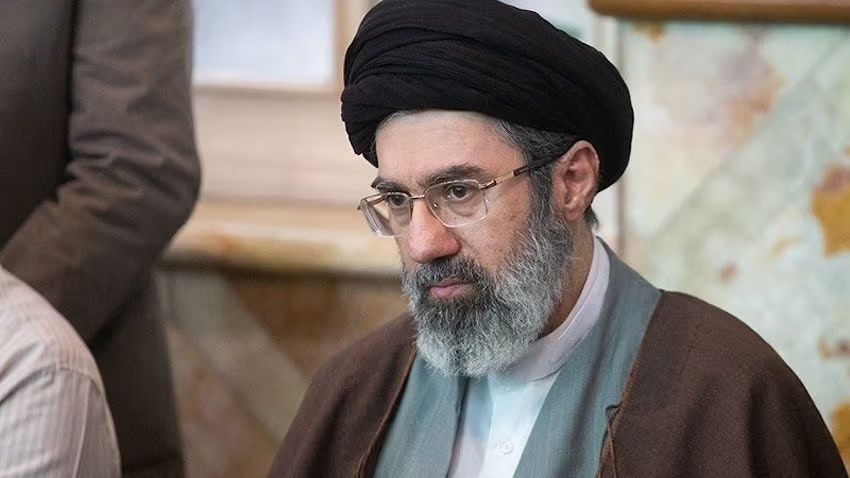
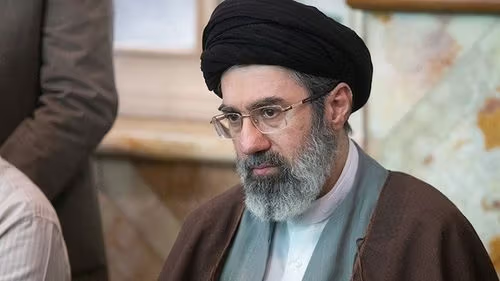
As Mojtaba Khamenei assumes the role of Iran’s supreme leader, attention has turned not only to his political authority but also to questions surrounding wealth and assets potentially linked to him through a network of associates and corporate structures.
Iran’s leadership has long projected an image of austerity, rooted in a political and religious framework that rejects material excess. However, publicly available records — including sanctions documents, corporate filings and property registries — suggest a far more complex financial picture, according to investigations by Western media. These reports indicate the possible existence of a property portfolio spanning multiple countries and valued in the hundreds of millions.
Crucially, Mojtaba Khamenei’s name does not appear directly on ownership documents. Instead, the assets are reportedly held through intermediaries, including individuals and companies operating across several jurisdictions.
One figure frequently linked to this network is Aliakbar Ansari, an Iranian businessman identified by UK and US authorities as playing a role in channeling resources connected to Iran’s ruling establishment. His background includes ties to senior figures within Iran’s political system, including a family connection to post-war reconstruction efforts overseen by Iran’s leadership.
In October 2025, the United Kingdom formally sanctioned Ansari under its Iran sanctions framework. Official documentation stated that he had provided economic resources to Iran’s Islamic Revolutionary Guard Corps. His business footprint in the UK includes links to a company associated with high-value properties in north London, including multiple residences on Bishops Avenue.
Property records and corporate filings indicate that these assets are held through layered ownership structures, including offshore arrangements and nominee directors — mechanisms commonly used to obscure ultimate ownership.
Notably, Ansari has not been sanctioned by the European Union, a distinction that has allowed assets within EU jurisdictions to remain unaffected by similar restrictions. Media reports have described a broader portfolio linked to his network, including hotels, resorts and commercial properties across Europe and the Middle East.
Ansari, through legal representation, has denied any financial or personal connection to Mojtaba Khamenei or to Iran’s military institutions.
Separately, Mojtaba Khamenei himself was sanctioned by the United States in 2019. According to the US Treasury, he was designated for acting on behalf of Iran’s supreme leader and coordinating with security forces, including the Revolutionary Guards and paramilitary units. These claims reflect the US government’s position and form part of its broader sanctions policy.
Additional sanctions actions have highlighted links between individuals close to Mojtaba Khamenei and access to valuable assets. One such case involved a major Iranian foundation, where a senior political figure related to him was reported to have occupied high-value property under favorable terms.
Taken together, these records do not provide direct proof of ownership by Mojtaba Khamenei. Instead, they point to a pattern in which assets are held by associates, foundations and corporate entities, making it difficult to establish clear lines of control.
Investigations by research groups and monitoring organizations have attempted to map these connections further, drawing on publicly available data and sanctions listings across multiple jurisdictions.
While many of the details remain contested or denied by those involved, the available documentation has brought renewed scrutiny to the financial networks surrounding Iran’s leadership — and to the contrast between official narratives of modesty and the scale of assets potentially linked to those in power.
Written by Freya Stensrud