Mar 17, 1:37 PM
Why Iran’s Kharg Island has become a strategic flashpoint in the US-Iran conflict
Strikes on military targets highlight the island’s importance to Iran’s oil exports, while Washington avoids hitting energy facilities that could destabilize global markets.
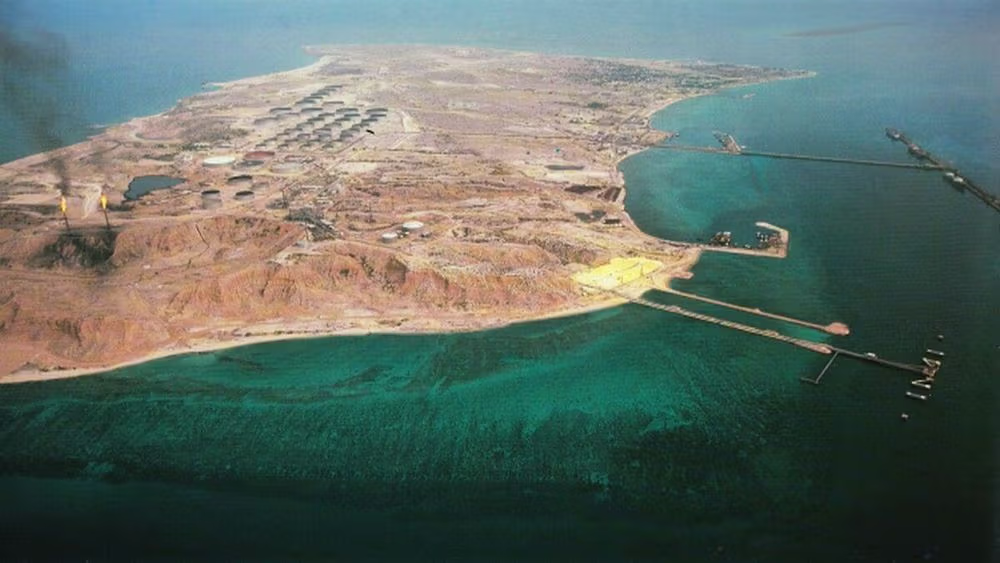
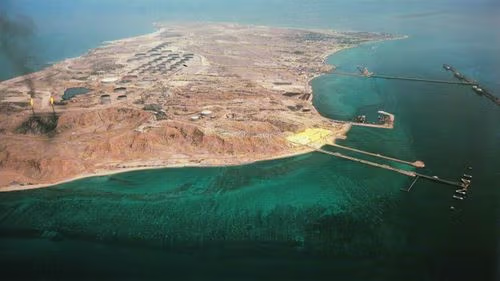
In the mounting standoff between the United States, Israel, and Iran, one modest island in the Persian Gulf has suddenly taken center stage: Kharg Island.
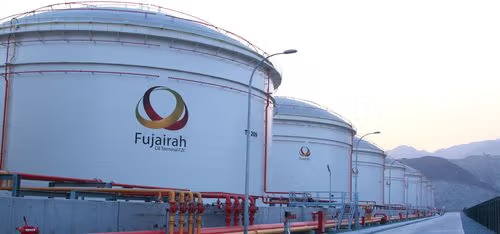
Sitting about 25 kilometres off Iran’s shore, this coral islet acts as the heartbeat of Iran’s oil export network. Estimates put the figure at a staggering 90 to 95 percent of Iran’s crude exports funneling through Kharg’s terminals. Because much of Iran’s coastline is lined with shallow waters that can’t accommodate large oil tankers, Kharg has quietly served as the linchpin of the country’s energy trade for decades.
From its terminals, as many as seven million barrels of crude oil can be dispatched each day.
That’s why the recent strikes by the US on military sites there — announced by former President Donald Trump — instantly grabbed worldwide attention. Washington claims the overnight raid targeted “military objectives” while carefully steering clear of the oil-export infrastructure itself.
Here’s the thing: It felt like a carefully balanced message.
By hitting military assets but sparing the energy facilities, the United States showed it could threaten the very core of Iran’s economic lifeline without unleashing the full-blown economic fallout that an assault on the oil export system would invite.
Strategically, Kharg is arguably Iran’s most exposed economic weak spot.
Wiping out or crippling its oil terminals would deliver a crippling blow to Iran’s state coffers, given how much they lean on oil revenues. But—and this is a big but—that kind of move wouldn't come without massive geopolitical headaches.
An outright attack on Iran’s oil export hubs could spark tit-for-tat strikes across the Gulf, potentially targeting energy sites in Saudi Arabia, the UAE, Iraq, and Kuwait. The ripple effect could imperil a huge chunk of the world’s oil supply and set off a serious jolt to global energy markets.
Washington also has to think carefully about the global political chessboard.
A big slice of Iran’s oil heads to China, one of Tehran’s key energy customers. Experts caution that messing with Kharg’s export capacity might drag Beijing deeper into this already tense geopolitical game.
Since China controls a lion’s share of the rare earth mineral processing crucial for tech from microchips to EVs, any escalation in export controls could rattle the US and its allies economically.
For the moment, oil shipments from Kharg seem to be rolling on.
Recent shipping reports from financial media show several supertankers loading up at the island last week, then moving through the Strait of Hormuz en route to Asia. Despite the regional tension, this vital maritime corridor remains open for some energy flows.
This suggests the current US approach aims to flex military muscle without crossing the threshold that would disrupt global energy channels.
Another piece of the puzzle here is long-term strategy.
Some in the US policy sphere argue that if Iran’s regime changes down the line, preserving its oil infrastructure could be key to rebuilding its economy. Blowing it up completely might sabotage chances for any stable post-conflict future.
Meanwhile, the military dynamic keeps shifting.
US media reports hint that Washington has mulled over other options, including special forces raids on Kharg’s facilities. At the same time, the US military presence in the region has ramped up, with more ships and thousands of Marines ready for amphibious operations.
But here’s the kicker: these moves carry serious escalation risks.
Iran has already warned that any direct strike on its oil sector would provoke counterattacks on energy infrastructure throughout the Gulf. Iranian officials have threatened US and ally-linked facilities in retaliation.
Energy watchers warn that such tit-for-tat could throw global oil markets into chaos—something Washington clearly wants to avoid.
Legalities probably factor in, too. International humanitarian law generally bans attacks on civilian infrastructure unless it’s used militarily. While Israel has claimed some Iranian energy sites double as military logistics hubs, Kharg’s terminals are widely seen as straightforward export facilities.
Right now, Kharg stands both as a symbol and a pressure valve.
The strikes on its military sites show just how close this conflict is creeping toward Iran’s economic lifeblood—without yet breaking the invisible boundary set by the world’s reliance on energy stability.
Whether Kharg remains untouched likely hinges on how far tensions between Iran, Israel, and the US spiral in the months ahead.
Written by Christiane Hofreiter