May 25, 2:44 PM
Gaza Flotilla Activists Face Police Violence Upon Return to Spain as Israel Cries Hypocrisy
Four arrested at Bilbao airport after clashes with Basque police; diplomat summoned in Jerusalem as Spain condemns Israel's treatment of detained activists.

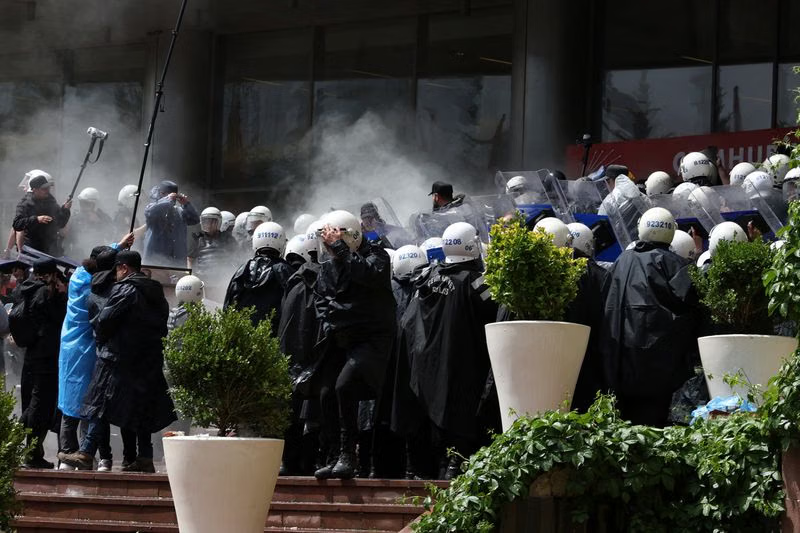
A group of Spanish activists expelled from Israel returned home to a reception they probably did not expect – not from Israeli forces this time, but from their own country's police. Tense scenes erupted at Bilbao airport on Saturday as members of the Global Sumud Flotilla clashed with the Ertzaintza, the autonomous police force for the Basque Country. The disturbances ended with four arrests on charges including serious disobedience, resisting authority, and assaulting a police officer.
According to police sources, the trouble began when six flotilla members, having just landed, posed for the media and blocked one of the arrivals' exits at the airport. Officers intervened, stating that a security cordon had been breached. Shoving followed, then moments of high tension involving activists, their supporters, and police. Videos circulating on social media show serious clashes, with some activists pinned to the ground before being handcuffed.
The return of these activists had already been delayed by a day. Two of them required hospital treatment after being injured when Israeli forces intercepted their vessel as they attempted to reach the Gaza Strip with humanitarian aid. Those arrested at Bilbao airport were handed over to judicial authorities following the incidents.
The diplomatic fallout was immediate and came from an unexpected direction. Israel accused the Spanish government of "hypocrisy" after videos emerged allegedly showing Spanish authorities using force against the very activists who had tried to breach Israel's naval blockade. In response, the Political Director at Israel's Ministry of Foreign Affairs, Ambassador Yossi Amrani, summoned the Chargé d'Affaires of the Spanish Embassy in Israel, Francisca Pedrós, on Sunday for a clarification meeting. The instruction came directly from Foreign Minister Gideon Sa'ar. A statement issued afterward said Amrani raised what he described as the inconsistency of Spain's position – sending activists toward Israel and then condemning Israel's enforcement of a naval blockade, while Spanish authorities themselves reportedly used severe violence against the same flotilla participants.
Not every arrival ended in chaos. Another twenty activists from the Global Sumud Flotilla landed at Barcelona-El Prat airport around midday with no incidents reported. Approximately 200 people greeted them in the terminal, waving Palestinian flags and welcome banners. Political representatives and public officials were among those present, showing support for the initiative.
The activists had been seized five days earlier in international waters as they headed to Gaza with humanitarian aid. That operation has drawn criticism and complaints about the treatment they received during detention. Lawyers representing the group say several activists were injured, with three taken to hospital and later discharged, and dozens more reportedly suffering suspected broken ribs and breathing difficulties.
One of the Spanish activists, Santiago González Vallejo, reported after his deportation that the violence against them had been "in crescendo" during his detention. He told RTVE on Friday that Israel's National Security Minister, Itamar Ben Gvir, said to them that "neither Palestine nor Gaza exist" and labeled them "terrorists." González said he suffered blows, painful restraint holds, and the withdrawal of his medication, and claimed that several of his companions remain in the hospital with serious injuries.
The organizing coalition is now considering legal action over what it describes as arbitrary detention and ill-treatment, while also announcing plans to press ahead with new initiatives to denounce the blockade of Gaza.
The controversy surrounding the flotilla has already triggered diplomatic consequences at the highest level. France has barred Minister Ben Gvir from entering its territory, deeming his actions "unacceptable" toward French and other European citizens detained during the interception of the flotilla. Paris responded to what it called a series of "humiliating and threatening" behaviors, including videos shared on social networks showing the minister standing among bound and kneeling activists. The French foreign minister stressed that although the French government does not agree with the flotilla initiative, it cannot tolerate public officials intimidating or mistreating European citizens. France and Italy have indicated they will call for sanctions at the European Union level against the Israeli official.
For now, the activists who made it back to Spain are licking their wounds – some literally, some politically. The ones who landed in Barcelona were embraced. The ones who landed in Bilbao were handcuffed. And in Jerusalem, a Spanish diplomat was asked to explain the difference.