May 15, 10:19 AM
Cuba Has Officially Run Out of Oil, Trump Offers Food, Medicine, and Free Internet
The government blames a "genocidal blockade." The US says the offer is humanitarian. Either way, Havana is facing blackouts, protests, and summer heat with no air conditioning.
Cuba has run out of oil. Not "we're running low" or "supplies are tight." Absolutely nothing. Those were the words of Cuba's energy minister, Vicente de la O Levy, as he addressed the press on Wednesday. "Crude oil, petrol – we have absolutely none of that, and diesel – we have absolutely none of that either. I repeat: absolutely nothing." The only thing the country has, he said, is gas from its own domestic sources, where production has actually increased.
So how did a country end up with no oil? The US had cut off oil supplies from Venezuela, Cuba's socialist ally, after the arrest of Venezuelan President Nicolás Maduro in early January. Mexico, which alongside Venezuela had been keeping Cuba's energy system afloat in recent years, also halted deliveries following threats from US President Donald Trump. Trump announced sanctions against any country that continued to supply Cuba with oil. The US does allow private companies to sell oil to Cuba, but since most of Cuba's economy is state-controlled, those deliveries amount to small quantities. For February and March of this year, private shipments were estimated at just 30,000 barrels. A Russian tanker carrying around 730,000 barrels did reach the island in early April – apparently with American approval.
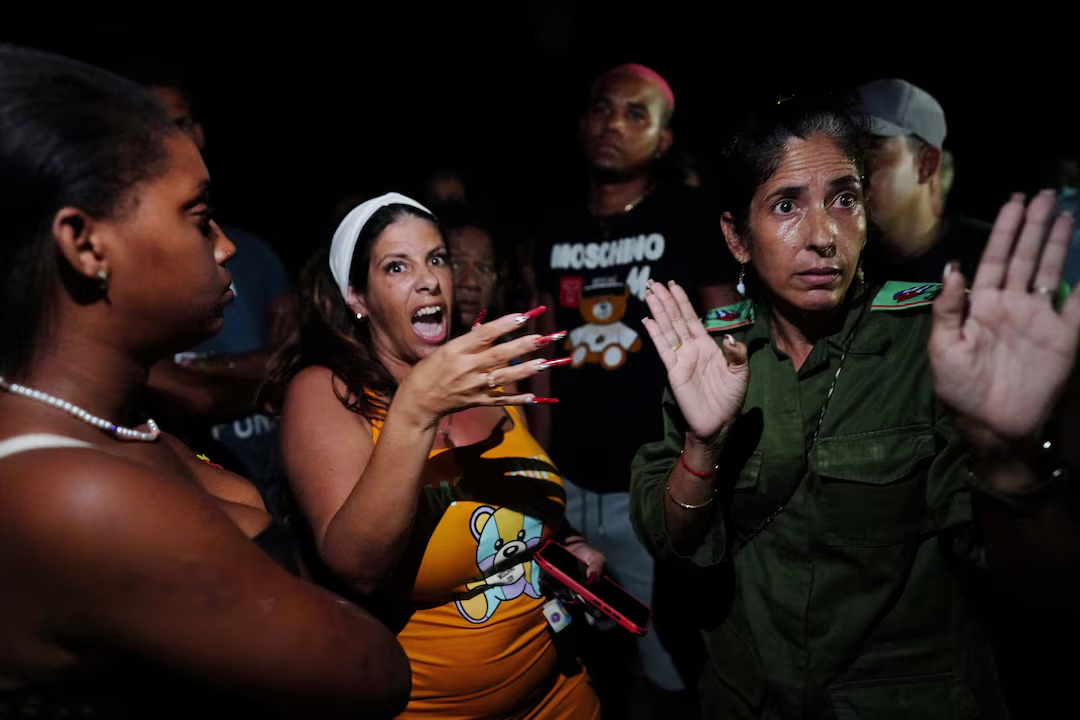
The oil shortage is now crippling both transportation and electricity production. Rolling blackouts have grown longer and more frequent. In the capital, Havana, residents protested on Wednesday by banging on pots and pans and blocking streets with burning barricades. The protests remained peaceful, but the message was clear: people are running out of patience as well as fuel.
Cuba is heading into summer. Temperatures are already often above 30 degrees Celsius. The loss of air conditioning, refrigerators, and water pumps is not an inconvenience. It is a health hazard.
President Miguel Díaz-Canel addressed the nation on Wednesday, explaining that during peak nighttime hours, the electricity deficit is around 2,000 megawatts. He blamed the crisis entirely on what he called the "genocidal energy blockade" imposed by the US and the "irrational tariffs" threatened against any nation that supplies Cuba with fuel. He also rejected any suggestion that his government's policies were responsible, noting that the brief easing of US sanctions during Barack Obama's diplomatic thaw from 2014 to 2016 had shown how much both countries could benefit from better relations. Millions of American tourists visited Cuba during that period, boosting the economy. "It is precisely such improvements that terrify a small group of ultra-rightists who have hijacked policy toward Cuba," Díaz-Canel wrote.
Human rights activists and Cuban exiles have long denounced repression on the island, claiming there are over 1,000 political prisoners. Trump justified his hardline stance in January by citing an "unusual and extraordinary threat" to US national security. He alleged, without providing evidence, that the communist regime cooperates not only with China, Russia, and Iran but also with the terrorist groups Hamas and Hezbollah.
On Thursday, CIA Director John Ratcliffe unexpectedly met with Cuban government representatives in Havana. The initiative reportedly came from the US side, which said it wanted to promote political dialogue. Cuban representatives made clear that the island poses no terrorist threat to the US and that neither its place on the US terror list nor the sanctions against Cuba are justified, according to a Cuban government statement.
Experts believe Trump is eyeing a place in the history books with his Cuba policy. He is also courting the votes of roughly two million Cuban-Americans and other Latinos ahead of the November midterm elections. But the dire situation in Cuba has drawn criticism even within the US. Large parts of the Cuban exile community in America are uncomfortable with the fact that, for example, Cuban hospitals are no longer fully functional.
To make clear that US pressure is aimed at the regime and not at the Cuban people, Trump has now offered a humanitarian aid package worth $100 million. The supplies are to be distributed by Caritas, the Catholic relief organisation, and other independent aid groups. Along with an offer of free satellite internet, the move appears designed to drive a wedge between the Cuban population and its government. "It is now up to the Cuban regime to accept our aid offer or refuse life-saving assistance and ultimately answer to the Cuban people for blocking that aid," the US government said on Wednesday.
Díaz-Canel hinted on Thursday that his government might accept the aid if it comes with no strings attached. But if Washington really wants to do something about the island's suffering, he said, lifting US sanctions would make a lot more sense.
For now, Cuba sits in the dark, the heat rising. Aid is on the table. Internet may be coming. But oil? Absolutely nothing. And summer has only just begun.
Written by Martina Kirchner
Latest news