May 27, 1:01 PM
Coco Gauff Says Australian Open Never Apologized for Broadcasting Private Racket Smash
French Open champion criticizes lack of response after hidden camera captured her frustration; players demand privacy as tournament cameras multiply.
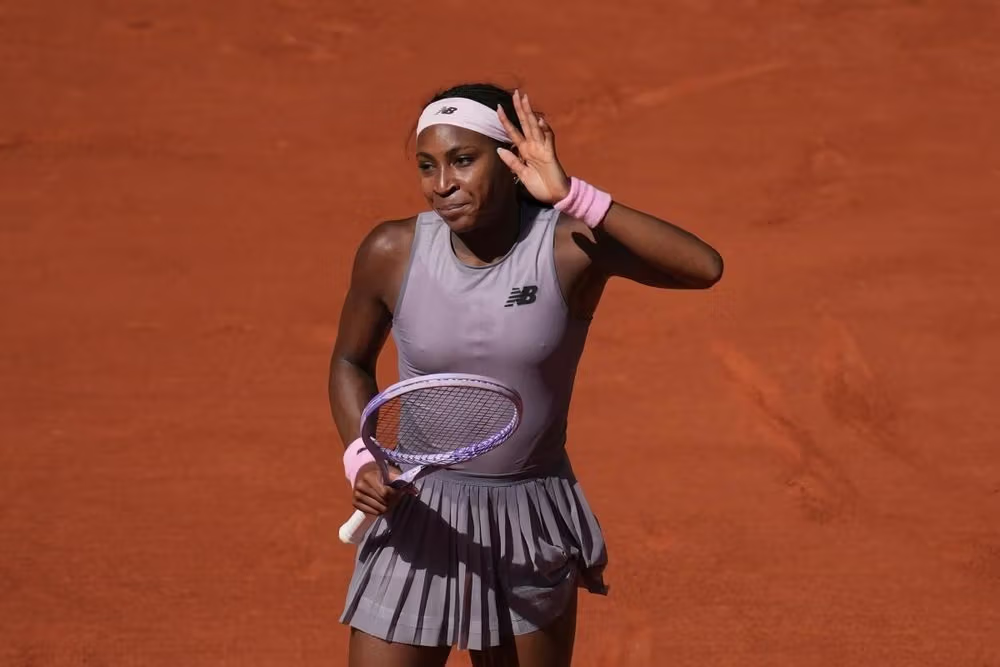
Coco Gauff has revealed that she received no apology or response from the Australian Open after tournament cameras broadcast footage of her breaking a racket in a private area following her quarter-final loss in January. Speaking after beginning her French Open title defense with a 6-4, 6-0 first-round win over American compatriot Taylor Townsend, Gauff said she did not get anything from her email that she knew of. She noted that the WTA sent something, but they are different from the Grand Slams, and the WTA wants to talk to the slams about different private areas.
The footage of Gauff smashing her racket in an underground corridor was broadcast worldwide, prompting numerous players to speak out about the lack of privacy they felt in Melbourne. The issue resurfaced in the buildup to the French Open, where tournament director Amélie Mauresmo said the event would not add any additional cameras to private player areas, even though broadcasters have pushed for greater video access. Camera-free areas will continue to exist for players to relax away from the public eye.
Gauff acknowledged that the French Open has handled cameras well in her personal experience. She said she has not had any experiences where they broadcast an emotional moment. She prays before her matches, usually in the gym, and they have never broadcast that. She is sure she has been crying in that gym before, and they have never broadcast that. She added that she has not broken a racket at Roland Garros, so maybe if she does that, they will show it. But overall, she believes the tournament has done a decent job.
There has been a general increase in cameras around tournament facilities in recent years. It is not unusual for cameras in tunnels leading to and from Court Philippe-Chatrier to capture players' tears while leaving the court. Madison Keys, a member of the WTA player council, unsuccessfully campaigned for the removal of intrusive cameras as soon as they began to appear. She explained that players and tournaments must agree on rule changes. If players want something but tournaments think it is great for broadcasting and makes them more money, then there is a stalemate. She noted that signs have been put up indicating that players are being broadcast, sarcastically calling it a "big win."
Another controversial incident at the Australian Open involved eventual men's champion Carlos Alcaraz, who was scrolling on his phone while standing alone in the player transportation area. Alcaraz did not realize that a camera was positioned directly behind him, pointing downward with a direct view of his screen. The footage was broadcast live on the Australian Open's YouTube channel and went viral. Viewers could see exactly what Alcaraz was viewing and which pictures he zoomed in on. Alcaraz, who is absent from Paris due to injury, confirmed he was aware of the incident. He said it is weird for players because they do not have private space to relax. Players are constantly thinking cameras are watching them. He argued that a camera positioned so low that it can see what is on a phone screen is too much.
Wimbledon, meanwhile, will maintain many private areas for players and their teams, with camera locations communicated to players before the tournament. The cameras will not livestream, and all video is reviewed by an in-house team before being published.
At Roland Garros, Naomi Osaka moved into the second round with a 6-3, 7-6 (3) win over Laura Siegemund, but her solid performance was overshadowed by her outfit. The 28-year-old entered the court wearing an all-black corset and floor-length skirt before revealing a shiny gold dress embroidered with sequins. Osaka said that people sometimes say athletes are in show business or entertainers. For her, Grand Slam walk-ons are the only time she feels like an entertainer.
For now, Gauff is focused on defending her French Open title. But the question of where a tennis player's private moment ends and a broadcaster's content begins remains very much unanswered. And in Melbourne, at least, no one is saying sorry.