
Jul 12, 4:01 AM
Billionaires, Bones, and the Free Market: Why a $30 Million T. Rex Belongs on the Auction Block
The scientific establishment is lamenting the upcoming sale of a remarkably complete Tyrannosaurus rex. Yet without the profit motive, these prehistoric treasures would simply crumble into dust.
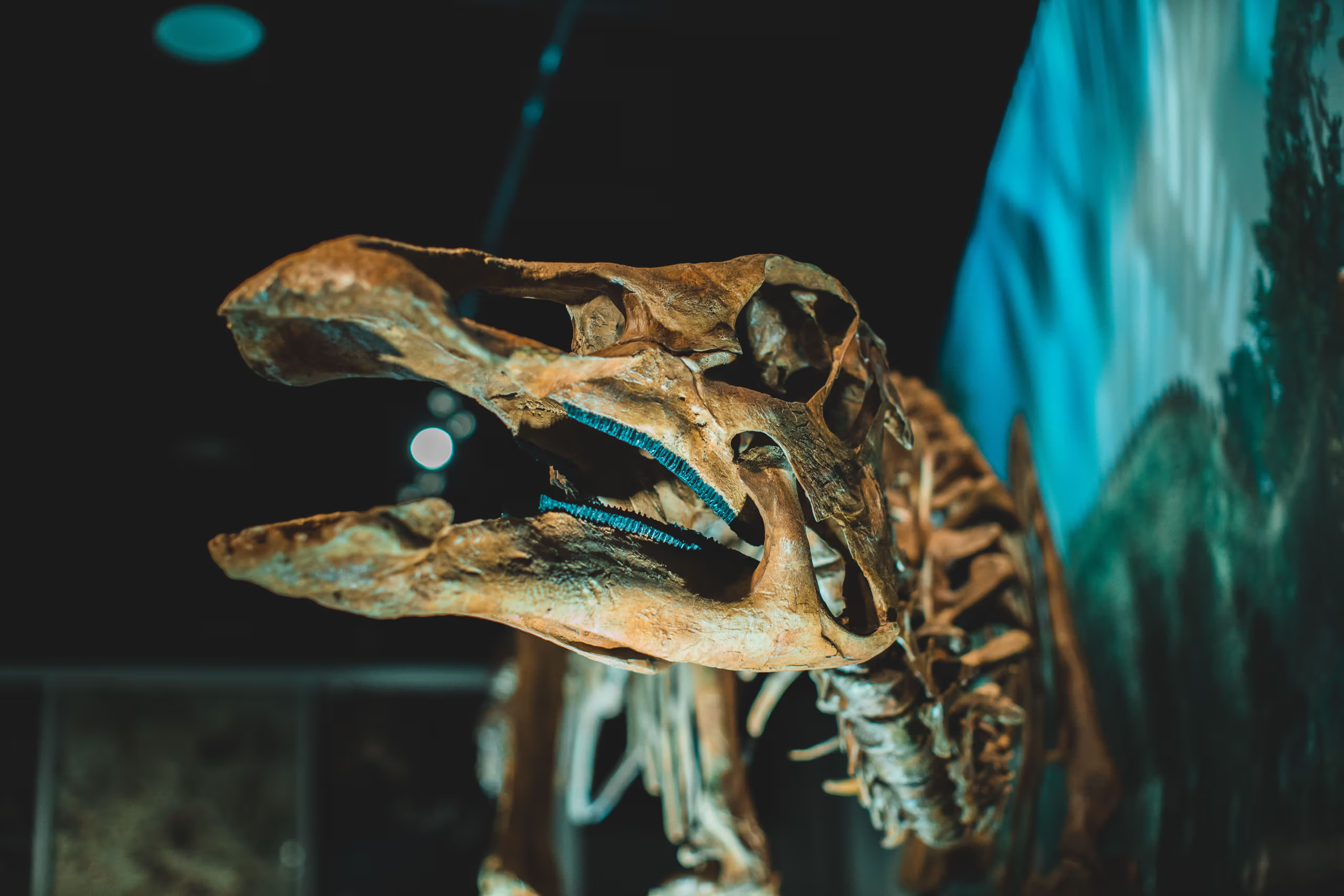
The fossilised remains of a 67-million-year-old Tyrannosaurus rex, dubbed Gus, are poised to cross the auction block at Sotheby's. Valued at $30 million, with a minimum bid of $19 million, the 61-percent complete skeleton is a monument to both prehistoric apex predation and modern market forces. The impending sale has predictably triggered institutional anxiety among palaeontologists, who argue that the commodification of natural history deprives the scientific community of vital empirical data.
Yet, this academic hand-wringing misses a fundamental reality of fossil recovery. Unearthing a multi-tonne predator from the unforgiving terrain of South Dakota is an enterprise fraught with physical peril and immense financial risk. The team that discovered Gus, named after the late rancher on whose land the bones rested, invested three gruelling years merely to extract the specimen during narrow seasonal windows. This was followed by another three years of meticulous laboratory reconstruction. These prospectors rely on the promise of a substantial return on investment to fund their operations.
Without the intervention of commercial excavators, fossils exposed to the elements rapidly degrade. Independent palaeontologists acknowledge that the moment a bone is freed from the earth, it begins to decay. The financial incentive provided by the auction market ensures that the necessary resources are deployed to salvage these scientific marvels before geological forces grind them to dust.
Naturally, the academic establishment views this commercialisation with deep suspicion. Researchers at institutions like London's Natural History Museum lament that they are entirely priced out of the market. They point to a recent trend of skyrocketing valuations, noting that the five most expensive dinosaur fossils have all been sold since 2020. This includes the T. rex known as Stan, which fetched $31.8 million, and Apex, a Stegosaurus that commanded a record $44.6 million in 2024.
The rigid orthodoxies of the scientific community compound their own misery. Leading academic journals categorically refuse to publish studies based on privately owned fossils, arguing that specimens must remain permanently accessible for future verification. This dogmatic approach effectively renders any privately held dinosaur non-existent in the eyes of academia.
Such institutional stubbornness ignores the long history of private philanthropy in the sciences. The Stegosaurus Apex, purchased by hedge fund executive Kenneth Griffin, was promptly loaned to a major natural history museum. The wealthy individuals driving up auction prices are frequently the same benefactors who ultimately populate museum halls.
Rather than vilifying the free market, the scientific community might do well to recognise it as the most efficient engine for preservation. The commercial trade does not hide history; it funds its unearthing. If a massive price tag is what it takes to pull a Tyrannosaurus rex out of the Badlands, it is a cost well worth paying.
Written by Freya Stensrud freya.stensrud@alpineweekly.com


